

The Core’s Competence
The case for recentralization in consumer products companies.
 |
|
Illustration by Michael Klein |
But the stock market responded by shaving Gillette’s stock price by more than 5 percent. Why? Although effective cost cutting has contributed to Gillette’s profits, the company’s annual rate of sales growth shrank from a 10-year average of 6 percent (from 1993 through 2003) to 1 percent over the three years from 2000 to 2003. Over the long term, it takes consistent revenue growth to deliver outstanding shareholder returns.
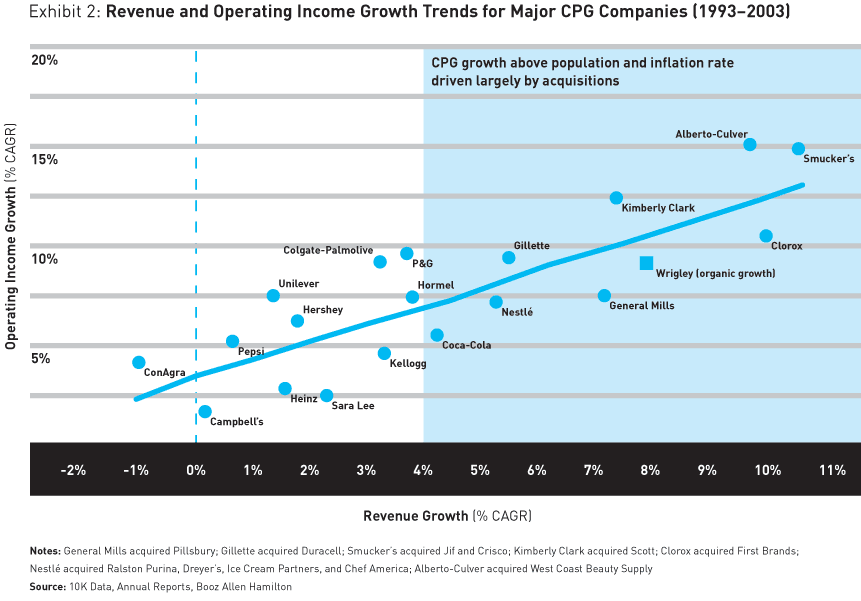
If Gillette is taking it on the chin despite a long-term initiative aimed at turning innovation into growth, so are many of its consumer packaged goods (CPG) peers. Unilever and Colgate are among the other giants punished by shareholders for revenue and earnings growth deemed disappointing. Top-line growth in the industry often is an optical illusion, barely keeping pace with the “natural” growth rate — population growth plus the rate of inflation. Most CPG companies say they anticipate top-line growth of only 3 to 5 percent annually, and profit growth of 8 to 12 percent, generally premised on new rounds of cost cutting. Most consumer products companies that have grown more have accomplished the feat by acquisition.
But the real surprise isn’t that most CPG companies barely have managed to run with a very slow pack. It’s that some have flourished. Indeed, the difference between growth leaders and laggards can be stunning. Wrigley, for example, has delivered annualized revenue growth of 8 percent for the past 10 years, and grown operating income by 9 percent a year — impressive in almost any industry and nearly double the CPG sector’s average growth rate of 4.7 percent.
What are the CPG winners doing right? In virtually every case, they have found ways to surmount the “customization conundrum.” Consumers, retail customers, and institutional customers increasingly demand specific products and services tailored to their particular needs. Successful CPG companies outflank competition and powerful channel partners by identifying a distinctive, brand-linked value proposition. They build strategically differentiated businesses around this competitive advantage. They customize service offerings to suit the shopping occasion, the channel, and the customer. They understand the profitability potential of different channels and consumer segments. They budget sales and marketing expenditures to support such “smart customization.”
But in order to finesse and sustain such complexity, smart customizers have also done something utterly countercultural in an industry that for decades has been characterized by broadening portfolios and higher degrees of decentralization: They have strengthened the corporate core.
At the best consumer products companies, the corporate centers are not passive holding companies. Under their new business model, the core actively drives profitable growth across the organization, by deploying an advantaged business model across numerous categories, geographies, and channels. Instead of letting a thousand flowers bloom, today’s CPG stars:
-
Define the differentiated business focus and align portfolio and investment decisions with it by assigning different roles to different parts of the business.
-
Develop innovation, marketing, and channel management capabilities that are systematically shared across the portfolio.
-
Structure the organization for growth and improve competitive agility while realizing scale advantages in shared services.
-
Manage growth by balancing the pursuit of short-term wins and longer-term “breakthrough bets.”
This kind of “recentralization” doesn’t come easily or painlessly. It presents real organizational challenges — and in many cases requires organizations to change ingrained behavior. Investing for growth requires harvesting cash from businesses with lower potential in order to fund opportunities in a disciplined way. That implies overcoming political resistance in companies where the low-growth businesses have been an important part of the organization’s history or culture — the way Pepsi divested restaurants, or Procter & Gamble abandoned food — in order to focus on growth.
Consolidated Losses
In many ways, the consumer products industry has been victimized by the mythology that developed during a century of very real success.
Starting in the late 1800s and continuing for decades, few businesses were more sustainable or more attractive than packaged goods. CPG companies and their investors saw an insatiable public appetite for branded staples. The firms’ wellsprings of innovation stocked supermarket shelves with “new and improved” cleaning supplies, laundry detergents, cereals, and snacks. And if mature markets tired, executives saw countless virgin markets all around the world. From the heyday of Listerine’s war against halitosis right up through “Coke Is It,” an oasis of infinite growth beckoned at every horizon.
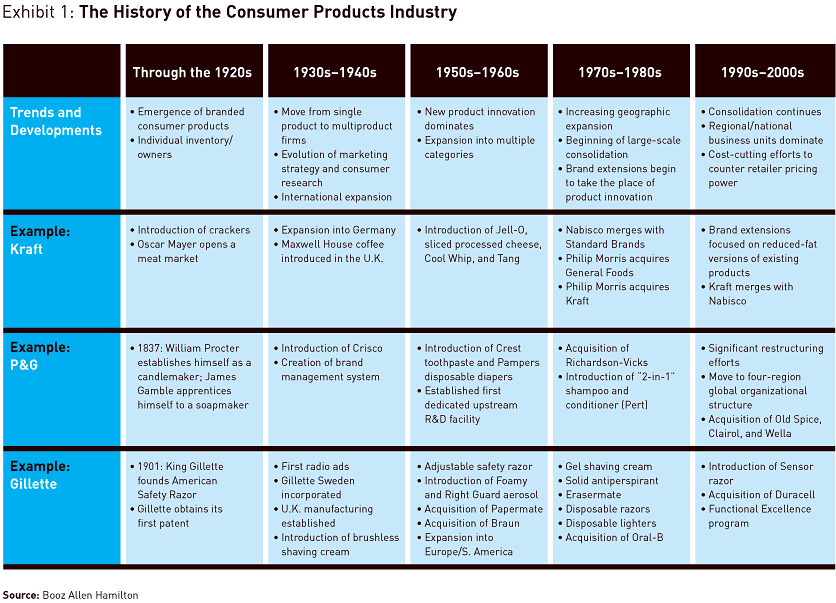
But that vision has long since faded. The last wave of growth in consumer products started when Eisenhower was president, and it broke with the Nixon administration. True CPG product innovation — the kind that brought individually wrapped cheese slices, detergents with bleach, and disposable diapers — all but ended in the 1960s. During the 1970s and 1980s, the consumer products industry was more show than go, producing brand extensions instead of new products. To be sure, sales kept pace with population growth. But otherwise, despite some high-profile technological innovations (the Swiffer mop, Sensor razor, and Kraft Lunchables portable convenience foods), sales for CPG companies have been like Lost Boys in Neverland — they just don’t grow. (See Exhibit 1.)
As both real innovation and real growth declined, the power of retailers rose. Close to their customers, and aided by new information technology and increased buying power, retailers were able to extract lower prices, stocking allowances, and other concessions from manufacturers. In response, many CPG companies indulged in one of two strategies that have proved costly and largely fruitless: consolidation and customer “connection.”
Consolidation was the most popular reaction to the industry’s changing fortunes. It was also the most hollow. It’s a truism in the M&A business that mergers rarely deliver promised synergies, and the wave of consolidation that swept over the CPG industry during the 1980s and 1990s shows us why. Although the era’s mergers — Nabisco with Standard Brands, Philip Morris with General Foods and Kraft, Kraft with Nabisco — brought together sales forces, the businesses generally retained autonomous marketing, supply chain, and R&D organizations.
As a consequence, the typical CPG company became a portfolio of unrelated businesses, each usually saddled with utterly different competitors, consumer bases, customer needs, infrastructures, and success factors. After a recent culling, for example, Unilever still has 400 “core” brands. When a product portfolio is broad and unwieldy, the gain in consolidation efficiencies usually is not sufficient to offset the loss in focus. Instead of innovating, consolidated CPG companies fall into the trap of “incrementalism” — each brand gets its extensions every year, and proliferating extensions clutter retailers’ shelves. That makes it harder for any one brand to capture the fancy of the consumer, and renders it difficult for that brand’s managers to learn about the characteristics their customers might have in common with those of another brand — or to find supply chain synergies, build effective joint sales forces, or innovate consistently and effectively.
For these reasons among others, consolidation has proved more of a drag than a draw on revenue growth, particularly for the largest consumer products companies. More focused players — such as Wrigley, which has specialized in chewing gum for 103 years — have consistently outperformed consolidated companies. In fact, Wrigley is the only major consumer products company to grow sustainably above the rate of inflation and population from 1993 to 2003 without taking on major acquisitions. Over the same period, Gillette acquired Duracell; Clorox acquired First Brands; Kimberly Clark acquired Scott; and Nestlé acquired Ralston Purina, Dreyer’s, Ice Cream Partners, and Chef America. (See Exhibit 2.)
Customer Mythology
Perhaps it’s more correct to say that proliferating extensions would clutter the shelves — if the CPG companies had the power to get their products on shelves. But that power isn’t theirs anymore.
Until the 1990s, retailers were a weak and fragmented lot. Indeed, in some senses CPG consolidation was an attempt to exploit that weakness; it promised manufacturers economies of scale in sales and advertising, and gave big manufacturers an advantage for negotiating stocking and trade promotions with relatively small retailers.
But while consumer products companies were busy consolidating, such visionary retailers as Sam Walton and Sol Price were building a new industry. They used radical new supply chain efficiencies, pricing programs, and even store organization to create, respectively, Wal-Mart — now the biggest company in the world by revenue — and Price Club, the first warehouse club, eventually acquired by Costco.
Today, Wal-Mart accounts for approximately 28 percent of Dial’s sales, about 25 percent of Hershey’s, and roughly 18 percent of Procter & Gamble’s — fairly typical proportions for consumer product manufacturers’ sales through the retailing behemoth. Not even the biggest CPG company constitutes more than 5 percent of Wal-Mart’s sales. Wal-Mart and the other value-focused discount and club channels are powerful enough to demand continual concessions — notably dramatic new supply chain efficiencies — in order to pass the savings on to consumers in the form of ever-lower prices.
Consumer goods companies responded with their second grand strategy of the 1990s: “Win with winning customers.” This scheme concentrated a company’s human, financial, and intellectual resources on the handful of retailers that appeared best able to gain it additional share.
Unfortunately, CPG companies have not won with their “winning customers” strategy.
The essential problem with the approach is that it brought little to the CPG companies beyond the immediate contribution to revenue growth. As the club, discount, and dollar store channel grew, such outlets indeed took more product, boosting consumer goods companies’ sales figures even as their pricing power declined. But the CPG marketers rapidly became passive responders to the retailers’ demands, and lost much more than their control over pricing: They squandered their linkages to, and ultimately the allegiance of, consumers.
Wal-Mart, for example, encourages its vendors to limit spending on advertising and promotion so that it can maintain lower prices — a tactic that threatens to consign brand loyalty (and brand premiums) to the dumpster of history. Innovation has also suffered; clubs are notorious for their narrow product selection and typically carry just one brand in a category, limiting a manufacturer’s incentive to develop breakthrough products and major new revenue sources.
As CPG companies lose their historic connection to their audiences, retailers have stepped in to fill the vacuum. Retailers have clear strategies for attracting consumer traffic; increasingly, they are tailoring value propositions for their shopper segment, and forcing makers of consumer goods to follow. “Suppliers can benefit from working with Wal-Mart through increased efficiency, reducing promotional and distribution costs,” a Morgan Stanley analysis concluded.
But the risk to CPG companies is implicit in those words: The retailers are coming to control not only the channel, but the loyalty of the end consumer. Recent research by Point of Purchase Advertising International, a marketing trade association, indicates that as much as 70 percent of all CPG purchase and brand decisions are made at the retail store. Companies that fail to manage their diminishing ability to connect with consumers at retail risk losing their ability to command a premium price for their products.
Pleasing the customer but not the consumer is fraught with risk. Consider the example of Vlasic, the now-bankrupt pickle company. It used to own a premium brand. Hungry for growth, Vlasic agreed to Wal-Mart’s demand for gallon jars of pickles priced at $2.97 to the consumer. The jars were a “statement item” for Wal-Mart. Stacked on pallets at the front of the store, they signaled to consumers that Wal-Mart was the place to go for value. Indeed, a consumer could buy a whole gallon of plump Vlasic pickles at Wal-Mart for less than the price of a quart of sliced Vlasic dills at a grocery store.
Perhaps Vlasic should have foreseen the cost to its reputation as a high-quality, high-priced brand. Perhaps it should have anticipated the cannibalization, as consumers with a year’s supply of pickles in a gallon jar from Wal-Mart opted not to buy a quart of sliced pickles at the supermarket. But the company did not. Vlasic filed for bankruptcy in 2001. The gallon jar fiasco wasn’t the only reason, but it certainly didn’t slow the company’s downward slide.
Vlasic’s case is exceptional only in degree. Few CPG players are able to identify an area of strategic differentiation or a business rationale beyond cost reduction through scale. Too often their research and development efforts focus on quick wins through brand extensions to meet this year’s sales targets, instead of breakthrough, business-building innovations. The result: a stream of flavor, color, size, and packaging extensions that help hold share (often only barely, as competitors quickly imitate), but do not lead to appreciable top-line expansion.
It doesn’t have to be this way. CPG winners prove that it’s possible to regain and defend strong consumer relations, create must-have brands, develop shopper insights that help the retailer make money, and organize for efficiency. The only mechanism with which to accomplish these goals, though, is an organization able to identify key capabilities and leverage them across the entire, tightly focused, portfolio.
Organizing for Growth
With globalizing retailers threatening the basic value proposition of consumer products companies, sustainable growth can be achieved only by a more engaged corporate core and a “federalist approach” to managing growth initiatives and investment decisions.
The federalist concept of core-unit relationships, as our colleagues Paul Kocourek and Paul Hyde have written, “is based on the philosophy that value is created in two places: at the operating companies closest to the customers and at the corporation, in the linkages between the operating companies.” Far from limiting the operating independence of the business units, the federalist approach actually increases their autonomy, but it does so within boundaries established and monitored by the core, whose role is to set corporate strategy and policy, to identify ways to create value above and beyond the operating companies’ value (e.g., sharing best practices or creating businesses), and to create and enforce a disciplined performance management model.
Such companies as General Electric and Lucent Technologies have benefited greatly from this federalist model, which Messrs. Kocourek and Hyde have labeled the “Model 2” organization. For consumer products manufacturers, applying it and spurring growth with it means inculcating, systematically advancing, and integrating four vital elements: business focus, capabilities development and planning, resource allocation, and a growth imperative.
Business focus is the basis for all investments and the criterion for all plans and budgets. The focus determines what capabilities a company will develop and where and how it will grow. The focus must be clear, because it tells everyone what the company will do — and what it will not do.
Business focus cannot be decreed; rather, it must be premised on the firm’s existing — and ideally its historical — strengths. This is because the company must be able to establish, for its own people as well as its present and future customers, a clear “right” to win. Research (by Jim Collins, among many others) has shown repeatedly that those who stick to a consistent strategy outperform their peers over the long term.
Focus need not have anything specific to do with the product portfolio. Clorox focuses on bringing big-company capabilities to niche categories. It can win in bleach and in specialized laundry products, such as stain removers — but not in laundry detergent, so it doesn’t go there. This explicit business focus tells Clorox managers which initiatives fit and which are inconsistent with the strategy. Acquisitions that would bring Clorox into big categories do not fit. But acquisitions that allow Clorox to transfer its large-firm capabilities to small categories do, hence its successful acquisitions of Kingsford Charcoal and Glad bags. In small ponds, Clorox can be the big fish.
Focus adds coherence to a product portfolio — and coherence is a clearly developing best practice among CPG leaders. Heinz sharpened its focus on condiments with its 2002 sale to Del Monte of seafood, pet food, private-label soup, and infant food brands. Procter & Gamble has a clear focus on technology and a portfolio aligned with categories in which technology makes a difference. When its experience with the Olestra fat substitute made it clear that technological innovation had a limited future in the food business, P&G disposed of its beverage and snack businesses. The company even sold off Crisco, a big-name shortening and food oil brand it had introduced in 1911 and advertised ever since.
Business focus naturally implies a consistent approach to capabilities development and planning. Although any executive would want his or her firm to be world-class in R&D, supply chain management, marketing, IT, customer management, and trade promotion, the brutal fact is that few companies can simultaneously develop all these capabilities, let alone the myriad other capabilities a large company needs in doses small and large. For any company, some subset of functional capabilities is more important than others to transform its strategy into sustained growth.
A capabilities plan identifies the tools and know-how that can bring the business focus to life. It can point to necessary new capabilities, or guide the further development of capabilities in which the company is already a leader. Procter & Gamble has built an unparalleled R&D capability, invested generously in innovation, and developed processes and methodologies for leveraging technology innovations across businesses. One result: Crest Whitestrips, a blockbuster innovation that combined bleaching, dental care, and adhesive technology.
Campbell Soup Company has a capability set that centers on convenience — unsurprisingly, considering its business focus is convenience food. That focus is realized through capabilities in research, customer relationship management, and sales force management, among other capabilities.
For example, to make it easy for supermarket shoppers to buy Campbell soups, the company has created an in-store display system that shelves each variety of soup in rows on a sloped rack. When a shopper takes one unit, another slides handily to the front. While seemingly simple, the system actually was the result of a series of insights into both consumer and retailer needs. Campbell consumer researchers discovered that a shopper who wants to buy low-salt cream of mushroom soup and doesn’t see it on the shelf will hunt behind the cream of broccoli and the chicken noodle, shuffle the adjacent rows, and leave frustrated if the desired product can’t be found. The disarray creates difficulty — and cost — for the retailer, who must restore order to the shelves. Campbell’s solution solved the problem for both the retailer and the consumer. People see what they’re looking for immediately or they immediately see that it’s out of stock. Because there’s no more rooting around at the back of deep shelves, the retailer keeps a tidy display and has a reliable indicator of stock level. Getting this concept to work also required additional training of the retail force and a dedicated effort to get retailers’ “buy-in” on the new shelves.
Capabilities do not have to be inborn or part of a long-standing firmwide tradition. One CPG firm with which we worked set its capability-development priorities by surveying retailers to identify their needs and gather their impressions of the company compared with its competitors. The survey revealed that the firm lagged its competition in three areas: category leadership, innovative marketing, and trade promotion practices. Of the three, innovative marketing mattered most to the retailers. The firm responded by changing its focus from brands to categories, and by developing capabilities to customize and share information, insights, and tools in order to meet the needs of retailers.
Capability plans should be unique, but there are category benchmarks. In the tissue-paper business, a capabilities development plan probably will emphasize manufacturing, because managing huge capital investments must be a core aptitude. In the ice cream business, where supermarket margins are very narrow, a capabilities development plan may concentrate on an integrated set of competencies — research, IT, marketing strategy, marketing tactics, and so forth — having to do with impulse buyers. It may even include a capability in supply chain adaptability; the company may need to be able to move freezers from summer lake resorts to winter ski lodges, to be where the buyers are. The plan might even involve developing competencies in outsourcing; the company might decide to outsource supermarket sales in order to focus on the impulse buyer in nontraditional channels.
Resource Allocation
If the business focus tells you where you want to make a difference in the market, and the capabilities development plan tells you how to do so, resource allocation is the element of a CPG growth strategy that explains how the company will pay for it. Fundamentally, it’s about the hard choices that companies, in the era of a thousand flowers blooming, tried desperately not to make.
Most CPG companies today (best-practice leaders largely exempted) suffer from the curse of the turnaround plan. The scenario is familiar. It starts with a brand whose margins are high but whose growth is low. Maybe it’s in a category where the company can never emerge as a leader, but can garner consistently good returns with minimal investment. Maybe tax implications make a sale unattractive. No problem. All this scenario demands is a marketing manager able to milk the brand efficiently.
But marketing managers don’t make it to the top by milking brands efficiently. They soar by grabbing attention with bold turnarounds. So, year after year, brand manager after brand manager, there’s a new turnaround plan promising that this tired old workhorse of a brand will become a new Smarty Jones. The brand organization pushes for its share of investment, and because the company doesn’t do zero-based budgeting, the brand gets about what it got the year before — with good politicking, maybe a little more. And so the company’s budget spreads resources among all the brands, starving those that can grow and overfeeding those that can’t.
Part of the problem is that, in most CPG companies, brand organizations are too strong and the center is too weak. Allocating resources successfully means putting more money on the best bets — which, logically, would mean taking it away from lower-odds bets. But shifting funding from one brand, market, or R&D project to another often results in backlash. It implies that people working on disadvantaged brands aren’t doing important work.
Solving this problem is a job for the corporate center. In the federalist construct, the core needs to make it clear that brand harvesters can be stars just as much as brand growers. Anyone can manage a brand through a profitable decline by cutting all advertising and promotion and letting it die. But it takes an astute manager to strike the balance that avoids overinvestment, yet invests just enough to keep the brand alive and the cash flowing in. It means doing things on the cheap. Spend a little money on packaging changes. Invest just enough in advertising. That’s good brand management, and it needs to be recognized and rewarded as vigorously as the successful turnaround.
Private equity firms, interestingly, have been leaders in the art and science of brand resource allocation. They have perfected the practice of building, making money from, and selling “tail brands.” A celebrated recent example is that of Pabst Blue Ribbon beer. Purchased by an investor who planned to cut costs and let the brand generate profits as it died, Pabst Blue Ribbon has become a favorite of alternative-lifestyle types, thanks to an innovative and low-budget marketing campaign. Pabst outsourced its brewing and invested modestly in marketing by sponsoring bicycle polo tournaments, screenings of skateboarding movies, indie rock concerts, and the like.
If venture capitalists can win fame managing not-for-turnaround, why not CPG marketing managers? Paradoxically, the continued decline of mass media channels opens new opportunities to squeeze growth and profits from previously neglected tail brands. With the cost of major network advertising going up even as audiences decline, companies are less likely to reflexively order a mass media campaign to support a flagging brand. Innovation in packaging, below-the-line marketing, and sales force management is increasingly likely to be the driver of a brand’s revival.
To make resource allocation work in a diverse organization, the center must develop with the units a common understanding about the varied ways the different parts of the business have to contribute to growing the enterprise. Creating this growth imperative is, perhaps, the most important and most difficult task of the corporate core.
Consider the example of Procter & Gamble. During the late 1990s, margins were suffering on volume that was growing weakly. Franchise brands, even Tide detergent, were struggling as new product initiatives got a disproportionate share of marketing dollars. By mid-2000, the company was losing share in seven of its top nine categories, and had lowered earnings expectations four times in two quarters.
P&G recently completed a four-year restructuring program aimed at refocusing on the core — big brands, big customers, and big countries. Those changes, which included the divestiture of noncore businesses and the shift of resources to higher-growth businesses, happened only because the company’s leadership determined to drive them. Organizationally, P&G has reasserted central control, establishing five global business units and downgrading the once-almighty country organizations to sales offices. Each of the global business units has a tightly focused portfolio, and both strategy and P&L responsibilities for its brands.
The new organizational strategy is not without risk. For example, Procter & Gamble took longer than it might have to react to the Argentine financial crisis because the country organization was weak. The company has also discovered that in emerging markets, a too-centralized approach limits success. P&G has modified its product range, channel, and pricing strategy in such situations. But the center still has much more power than it once did, while the global business units remain empowered, but bounded.
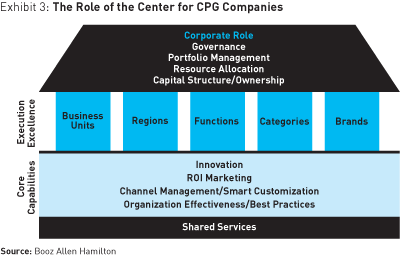
The P&G example shows that “recentralization” is less about command-and-control than about coordinate-and-communicate. The federalist model keeps at the core responsibilities for strategy and oversight — identifying the common themes that connect the business units and ensuring that this strategic agenda is driven across the business. Business units remain closest to the markets and create value through these relationships. This Model 2 organization bridges the chasm between the center that acts merely as a financial holding company, and the center that becomes operationally involved in the managing of the business units. (See Exhibit 3.)
“Win with winning customers” has been the slogan of consumer products companies, but the reality for most players in the industry has been far different. Consolidation and diffusion of power through scores, even hundreds, of brand organizations have made it impossible for them to win. In order to innovate effectively and develop the must-have products that give them growth, they need to abandon their “states’ rights” organizational model and adopt a recentralized federalist approach that shifts oversight to the center, even as it values insights at the units more than ever.
Reprint No. 05105
Steffen M. Lauster (lauster_steffen@bah.com) is a vice president with Booz Allen Hamilton in Cleveland. He concentrates on strategy development and revenue management for manufacturers of consumer products.
J. Neely (neely_j@bah.com) is a principal with Booz Allen Hamilton in Cleveland who specializes in growth strategy and transformation for consumer and industrial companies.
