
Leaning Toward Utopia
The Toyota Production System has revolutionized industry. James Womack and Daniel Jones believe it can transform the world.
  |
|
Photography by Julian Anderson (Top) and Jon Madere (Bottom) |
Of the hundreds of walks that Dr. Womack and Mr. Jones have taken since the mid-1980s, perhaps the most significant was conducted by Mr. Jones in 1995, at the Tesco supermarket chain. At that time, Tesco was an unusually innovative grocer operating largely within the U.K. Mr. Jones had consulted with Tesco supply chain director Graham Booth for six years. By streamlining the chain’s warehouses, they had exposed the chronic lateness of many Tesco suppliers: More than 20 percent of the grocer’s goods arrived behind schedule. In fact, only the providers of fresh fruit and fish, propelled by high spoilage rates, consistently delivered on time. Why couldn’t the suppliers of cans and boxes do the same?
Mr. Jones and Mr. Booth started at the grocery aisle for soft drinks, walked back to the shipping dock, and then drove back to the bottling plant. “This single can,” Mr. Jones recalls, “took five minutes to drink; but it sat for five weeks on pallets at the bottler’s, and for 21 days in Tesco’s back rooms.”
Suddenly, it was obvious how much of Tesco’s profits depended on the processes it shared with other companies. Over the next few years, Tesco entered into strategic partnerships with many of its suppliers, including Procter & Gamble, Unilever, and Coca-Cola, sharpening distribution schedules wherever possible. Weekly shipments were replaced with daily deliveries. To accommodate the stepped-up timetable, cans and bottles were carted on wheeled pallets that snapped directly into the shelf fixtures. The sitting time for a can of cola shrank to five days.
Tesco parlayed its lean strategy into an impressive overall financial performance — nearly doubling annual sales and net income between 2001 and 2004 — a burgeoning global strategy, and a pioneering role as the first major supermarket chain to run a Web-based delivery business profitably. It now owns 35 percent of the Safeway grocery chain in the U.S. and hundreds of stores in South Korea, Japan, China, Southeast Asia, and Eastern Europe. Tesco is becoming Wal-Mart’s most challenging competitor in today’s emerging consumer economies. (See “Welcome to Tesco, Your Glocal Superstore,” by Victoria Griffith, s+b, First Quarter 2002.)
“We experimented first with retail systems linked to distribution processes, and then moved on to inventory management, key performance measures, store design, product mix, supplier relationships, and ultimately our supply chain strategy,” says Mr. Booth, who retired in 2002. “The hardest part was breaking through our corporate mind-set.”
The Tesco walk was a turning point for Dr. Womack and Mr. Jones as well. Previously, they had essentially based their practice on codifying and adapting Toyota’s famous manufacturing production system so other companies could replicate it. They had first encountered that system as part of the research for a seminal book they coauthored, The Machine That Changed the World (HarperCollins, 1991). During the late 1980s and early 1990s, they had expanded on Toyota’s ideas, incorporating concepts from supply chain management, the quality movement, total productive maintenance principles, and MIT systems theorist Jay Forrester. But they always remained focused on one key Toyota precept: muda. Translated from Japanese, muda means “waste,” but in the Toyota-Womack-Jones lexicon, it represents any excess interruption, misalignment, unnecessary work, or ingrained redundancies that add no value for customers. By dispassionately removing muda from all parts of a corporate system, Dr. Womack and Mr. Jones taught managers not just to slim down bureaucracies and speed up processes, but also to breathe new life into corporate strategies. Hence the name for their approach: “lean thinking.”
After the Tesco session and with the 1996 publication of their book Lean Thinking: Banish Waste and Create Wealth in Your Corporation (Simon & Schuster), Dr. Womack and Mr. Jones began to study the ways in which muda travels from one company to another — in which companies themselves are caught up in waste-filled interrelationships that no single enterprise can tackle alone. This year, that work is coming to fruition in their third commercially published book, called Lean Solutions: How Producers and Customers Achieve Mutual Value and Create Wealth (forthcoming in September from Simon & Schuster). The new book argues that even the most brilliantly conceived and efficiently executed products and services on the market can be rife with muda. For example, as an offshoot of their products’ increasing integration — music stored on personal computers is played through audio equipment; toys and accessories are sold as ensembles; cars become a series of interconnected electronic systems — the makers of automobiles, computers, electronic goods, tools, toys, and housewares have, in effect, downloaded their process problems onto their customers. Instead of increasing value, they have added complexity. As a result, more often than not, say Dr. Womack and Mr. Jones, attempts at integration fail to achieve their goal of providing customers a better product.
Services are frequently just as flawed, the authors claim: When you phone a help desk, bring an auto in repeatedly for a seemingly unfixable repair, or spend an hour waiting in a hospital room for a routine medical test, you are dealing with a costly artifact of an outmoded industrial model. Whether in services or products, this model adds costs, decreases quality, promotes remote and therefore dangerously unresponsive off-shore outsourcing, and imperils brand loyalty.
To Dr. Womack and Mr. Jones, the essence of lean thinking is not so much the ruthless efficiency of reengineering (with which it is often compared), but the ruthless redesign of all processes, within and among companies, to achieve an ingrained respect for the people affected by these processes. If the whole world could emulate the best of Toyota, Tesco, and a few dozen other relatively lean companies, we could enter a new kind of post-industrial utopia, they argue.
“We started out thinking about how to optimize production processes,” says Dr. Womack. “To accomplish that, you have to reshape the company and the value chain to meet human needs, and it eventually turns out to be a pretty interesting human sort of endeavor where, by God, you want to optimize everything.”
Lean Leaders
To implement lean thinking is not easy, nor is it a guarantee of instant financial success. Consequently, as with many management fads, says Dr. Womack, companies tend to drift away when they notice how hard it is to put in place.
“Every company will tell you they’ve got a lean initiative,” he says. “But a true lean initiative integrates four different systems: production, product development, supply chain management, and customer management. Most companies have only begun to work on one of the four.”
Nonetheless, a growing number of businesses have made a sustained commitment to lean thinking that often does pay off over time. General Motors, for instance, adopted lean thinking as the guiding principle behind its “Global Manufacturing System,” which is the blueprint for all new plant designs and old plant retrofits — an ambitious undertaking to dig out from the company’s quality and cost problems. The company also hired John Shook, a senior advisor at Dr. Womack’s Lean Enterprise Institute, to map and redesign the company’s back-office processes. Enough muda was unearthed in this effort to save the automaker hundreds of millions of dollars a year.
“You walk into an office and everybody looks busy, so you think it’s all unique, creative, and highly valuable,” says Kent Sears, the GM North America vice president of manufacturing processes and global manufacturing system implementation. “But we’re finding that 30 to 60 percent of it is repetitive, transactional, full of unnecessary reviews and redundancies, and not very creative at all.”
Hyundai Motor Company, the Danaher Corporation (manufacturers of tools and instruments), and General Electric Company have all invested heavily in lean thinking. Though they don’t always comment openly about it (Danaher is particularly publicity-shy), people close to the companies note its significant impact on current-day operations and its role in planning future performance.
Pratt & Whitney, a division of United Technologies Corporation, began its lean initiative in the early 1990s, eliminating one-fourth of its manufacturing space and putting every product into a “continuous flow” configuration, which attempted to eliminate pauses during the assembly process that slow production down. This effort shrank manufacturing time by 25 percent. After posting $250 million in losses in both 1992 and 1993, Pratt & Whitney has maintained consistent profitability since 1995. Recently, a U.S. Marine Corps report on Pratt & Whitney credited the company’s lean efforts for its success in winning Air Force contracts for the new Joint Strike Fighter and delivering its prototype engines on time and under budget.
“The purpose of lean thinking is not to cut your cost or inventory, but to change your strategy,” says Art Byrne, a veteran production executive who has led a series of lean thinking projects at GE, Wiremold, and Danaher. “When you make things flow in a smoother, more effective way, you can gain market share dramatically against your competitors. And if you get a three- to five-year head start, then eventually they can’t catch up, even if one of them starts to do it themselves.” Mr. Byrne is currently a partner at J.W. Childs, a Boston-based private equity firm that requires firms in which it takes a stake to adopt lean thinking. This policy assumes that the resulting productivity and management improvements will eliminate much of the investment risk. Indeed, ever since Toyota began the first lean initiative with its production system in the 1950s, the idea of eliminating risk — not the risk of external threats, but the danger of staleness, complacency, and expediency from within — has been central to lean thinking.
Making Sensei
“I studied the car industry for years,” says James Womack, “but I was never a car guy. Really, cars have all pretty much been the same since the Model T.”
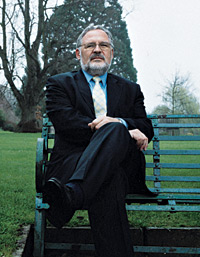
The 56-year-old Dr. Womack is lanky, bearded, bespectacled, soft-spoken, and erudite. Born and raised in Arkansas, he has lived in the Boston area since 1973. He is prone to blurting out crusty, ironic asides, most of which touch on the fallibility of human nature. “America is a supersized nation,” he observed recently, “but it’s obsessed with leanness. That’s why Americans like our work so much.”
Daniel Jones, the same age as Dr. Womack, is also bearded with glasses. He lives in an English village called Ross-on-Wye near the Welsh border, and comes across as an update of an English country squire, enjoying the quiet pleasures of an epicurean life, and apt to chuckle when the production systems around him don’t yield it.
In 1979, both men were aspiring intellectuals with a common interest in public policy; they were advocates of free trade. Jim Womack, then completing a Ph.D. in public policy from MIT’s Sloan School of Business, had little interest in business per se, but he had an intimate familiarity with cars. As a teenager, he rode thousands of miles around the rural south with his father, a Veterans Administration caseworker and amateur mechanic who loved automobiles so much that he reminisced on his deathbed about fixing his Model T’s brakes. Dan Jones, a young economist of Dutch and English parentage, had studied with an associate of European Union founder Jean Monnet and had written a well-regarded monograph on the competitiveness of the British auto industry. That study in turn caught the eye of Dan Roos, an MIT professor known for organizing ambitious research projects. Dr. Roos recruited the two young postgraduates as part of a larger global team to write an MIT report called “The Future of the Automobile,” funded by a group of automobile industry–related corporations. Both researchers worked intensively on the project for several years, with Mr. Jones commuting to the U.S. several times a year to participate.
They had a lot of ground to cover. General Motors and Ford had posted their first losses ever in 1979; Chrysler was nearing bankruptcy. Oil prices were at an all-time high, and environmentalists were questioning the viability of automobiles in general. The most visibly thriving car industry was in Japan — and Detroit’s leaders, lobbying for tariffs and trade restrictions, argued that they couldn’t compete with that workaholic country where labor unions were cooperative and robots commonplace. The researchers were intuitively suspicious of these arguments, and a year of intensive research into Japanese automobile practices confirmed their skepticism. Rather than automation or company songfests, the secret Japanese weapon that the U.S. carmakers were facing was a distinctive set of methods for moving product seamlessly along the assembly line and into dealers’ hands, responding as quickly as possible to customer orders. And although it appeared that all Japanese companies had the edge on their American and European counterparts, in fact, one Japanese car company stood out: Toyota outperformed not only its Detroit and European rivals, but most other Japanese car companies as well.
The “Future” study, published by MIT Press in 1984, was not designed to differentiate individual companies; it hid Toyota’s production statistics within those for Japan. Even so, the data revealed a 3-to-1 productivity difference between Japan and the U.S. That was enough to attract a few industrial representatives to offer to sponsor a follow-up report. “None of my colleagues will believe you without a lot more analysis,” one Detroit auto executive said. “Why not also include governments worried about revitalizing their motor-vehicle industries, and raise enough funds to really do the job properly?” Dr. Roos, Dr. Womack, and Mr. Jones rapidly organized a new MIT research group, called the International Motor Vehicle Program, and began a five-year, $5 million study focused entirely on the operations differences between Toyota plants — including NUMMI, the New United Motor Manufacturing Inc. plant that GM and Toyota ran together in Fremont, California — and the rest of the industry.
The study was unprecedented in its scale, its mix of industrial and government sponsorship (no single company or government contributed more than 5 percent of the total cost), and its level of access. Auto companies on three continents opened their plants to the researchers. The study concluded that the Toyota production system was even more capable than it had seemed; it could launch new cars three years faster, and for $2,000 less, than the American equivalents. With the publisher-chosen name The Machine That Changed the World, the resulting book (coauthored by Dr. Womack, Mr. Jones, and Dr. Roos) became a management bestseller, with about 700,000 copies in print. Although, as Dr. Womack later noted ruefully, it wasn’t really about the automobile or any other machine — it was about a group of processes that hadn’t yet changed the world — the book made a persuasive case that the Toyota production system would have to be adopted by even the most recalcitrant auto companies or they would fall too far behind to catch up. At the very end of the book, in a two-page epilogue, they hinted that the same would be true for other industries as well.
“Womack and Jones did a lot of work to codify and articulate the basic principles of the Toyota production system,” says George Roth, head of research on organizational change at MIT’s Lean Aerospace Initiative, and a seasoned MIT researcher on organizational learning. “The result was probably the most powerful set of tools and ideas we’ve seen for managing any set of operations.” But as Dr. Roth notes, very few other companies, automotive or otherwise, successfully changed their ways after Machine came out. “Some of them took the ideas but didn’t grasp the ideology that made them work at Toyota, and therefore didn’t get the sustained results.”
In fact, quite a few naysayers within Toyota, including its famously innovative and autocratic chief production engineer Taiichi Ohno, scoffed at the idea that the company’s methods could ever be implemented outside Japan. The automaker’s first transplanted factories in the U.S. had failed to fully implement Toyota’s own production system, and not just because the American managers they hired didn’t seem to understand. “When we first visited them,” Mr. Jones recalls, “Toyota was completely incapable of articulating its first principles. They could tell you all the techniques they used, but not the rationale behind them. They’d lived their way for two generations. And they were surprised the rest of the world didn’t work the same way, too.”
The company trained (and still often trains) its managers through the psychologically demanding methods of a Japanese sensei (master teacher). Mr. Ohno, for example, was known throughout Toyota for his practice of greeting enthusiastic young management recruits from the University of Tokyo by drawing a chalk circle on the factory floor and telling them, “Stand there and look for waste until I come back.”
Hours later Mr. Ohno would return and ask what the young engineer had seen — and invariably reply, “You’re a complete blockhead. How did we ever hire you?” The same thing would happen repeatedly, until the dispirited recruit gasped out the right answer (or, more likely, had it whispered to him by a nearby veteran). This kind of ultra-Socratic teaching has some benefits: It breaks down the self-righteous egotism of young trainees, and it instills a problem-solving management culture in which everyone in the organization feels driven to observe problems, suggest solutions, and listen to others’ ideas. But it is painfully slow; it can take 20 years to train a Toyota production expert. And it is particularly difficult to adapt the sensei approach for the kinds of independent-minded gaijin (non-Japanese) managers whom Toyota hired to manage production as the company expanded in the U.S.
Dr. Womack himself said as much in a newspaper interview in the early 1990s, which prompted Fujio Cho, then the president of Toyota’s North American subsidiary and now the president of Toyota Motor Corporation, to seek him out and respond in a private meeting. Other companies, said Mr. Cho, tended to hire brilliant people to run broken, disconnected processes. Toyota designed processes that average people could use to get brilliant results. In the end, Mr. Cho said, Toyota would win.
In effect, this conversation made clear exactly how much of a challenge Dr. Womack and Mr. Jones had stumbled into. Having argued that there wasn’t anything culturally unique about Toyota, and that its production method could be taught anywhere, they could only prove their argument by teaching it so that even “cowboys and geniuses out of management school,” as Dr. Womack says, could understand it. Thus the pair found themselves in the enviable position of being the most popular and prominent translators of Toyota’s management approach for the West.
Learning from History
The phrase “lean production,” as a universal way of describing the Toyota system, first appeared in The Machine That Changed the World. The authors had reluctantly acquiesced when their MIT colleagues suggested the term “fragile production,” but abandoned it with relief when researcher John Krafcik, a former NUMMI manager recruited to MIT, came up with “lean” instead. (Mr. Krafcik would later go on to a career at Ford and eventually to Hyundai Motor America, where he is now vice president of strategic planning and product planning.)
Dr. Womack and Mr. Jones already knew that the Toyota system had roots in Detroit. “I learned everything I know from Henry Ford,” Mr. Ohno had written, “but I took it to the logical conclusion.” Machine traced the history of Toyota’s production system from 18th-century Venetian boatbuilders to 19th-century meatpacking plants to Henry Ford’s first major factory: the producer of Model Ts in Highland Park, Mich. Mr. Ohno and other Toyota executives had studied that plant in the 1930s, when they first converted their business from loom making to car making. (For several years, Dr. Womack has been on a mission to convince Ford’s executives to turn their old, abandoned Highland Park site into a museum of manufacturing history.)
But Toyota’s precursors, including Ford and General Motors, all used “batch and queue” systems, as Dr. Womack and Mr. Jones called them. They were all geared for mass production. They made large quantities of every automobile they produced, depending on economies of scale to lower their costs, and therefore kept large inventories on hand of every part they needed. Toyota plants, by contrast, produced a varied stream of goods flowing rapidly down the line, at a cost below those of their competitors. This seemingly impossible feat was achieved through a series of interrelated innovations, which evolved gradually from the 1930s on. Toyota’s process designers judged every step according to the value it provided customers; if they saw no customer value in it, they discarded it, no matter how beloved it might be to finance, engineering, or any other organizational function. With this principle of eliminating muda implemented and supported from the top, workers at each station could be entrusted to control their local operations — not in a random way, but in harmony with the operation as a whole.
For example, each station in a Toyota plant produced only as many parts, whether fenders, windshield wipers, or assembled engines, as its “customer” at the next station called for. Each plant as a whole produced only the vehicles that a dealer had specifically ordered, either in response to a purchaser’s request (which was typically fulfilled within 10 days) or from the dealers’ on-the-ground awareness of customer preferences. This was known at Toyota as the “pull” principle, a term adopted by Dr. Womack and Mr. Jones. “Whenever we drive by a car dealer,” they wrote in Lean Thinking, “our first thought is always the same: ‘Look at all that muda, the vast lot of cars already made which no one wants…. Why did the factory build [them] in advance of customer pull?’”
Toyota also had developed its principle of “flow”: the smooth movement of work from each step to the next, with as few breaks in the sequence as possible. Instead of being controlled from above, the plant moved according to signals sent forward and back from each part of the factory to its internal customers and suppliers. The whole system regulated itself through “takt time,” an expression that Toyota borrowed from German musicians: a metronome-like beat that was paced to match the daily demand for particular components. There were no quality inspectors; workers verified each part’s reliability before it left the station. There were few, if any, storehouses; Toyota had invented the “just-in-time” delivery system to ensure that its suppliers delivered parts as soon as they were required, directly to the places that needed them. And there were no labor problems. Toyota had worked out a groundbreaking agreement in 1946, exchanging lifetime employment for flexibility: Workers could be redeployed or retrained at any time.
Toyota’s customer-based concept of value (“only assets that attract customers are considered valuable”) turned many conventional practices upside down. For example, the automaker saw typical adversarial supply chain relationships as intrinsically wasteful and expensive, because companies were preoccupied with outwitting each other instead of serving customers. Donald L. Runkle, the vice chairman of Delphi Corporation (responsible for purchasing, and a long-standing lean production champion at Delphi and GM) compares these relationships to poker games. “Each side holds their cards close to the vest, and they often negotiate by bluffing,” he says. “You don’t talk about costs very much, because that might show your cards, and you might lose some advantage.”
Moreover, as Mr. Jones noted in a recent e-mail newsletter, the practice of squeezing suppliers tends to push them into self-defeating efforts that produce savings only in the short run: “Without any fundamental changes, there is a limit to how much margin there is left to squeeze.”
By contrast, Toyota picks two or three suppliers for every component, and — rather than asking them to bid against each other — guarantees each a percentage of the business. Together, they develop a cost model that reflects the muda they can cut out of the process, protecting enough supplier profits to guarantee further joint creativity and innovation. This is possible, of course, only because the participants trust each other. The suppliers reveal more to lean-thinking customers about their operations and margins than a “poker-playing” company would ever find out.
True lean operations require a paradoxical kind of hierarchy: fierce top-down controls, but intensive bottom-up participation. The most durable lean companies tend to handle the paradox as Toyota does, putting authority over process mapping in the hands of a chief engineer whose decisions trump those of other executives — but who is charged with making sure that the process designs reflect the insights and observations of frontline employees. Thus, Tesco took stock-ordering responsibility away from store supervisors and installed a centralized computer-based system managed by the supply chain group to coordinate its intricate web of shipments throughout the chain.
“But the store managers gradually developed influence over the centralized decisions,” notes Mr. Booth, the former supply chain director. “It happened through trial and error. We visited stores day and night; we worked so that the store managers didn’t see us as an ivory tower or head office team. Instead, we were trying to make life simpler for them so they could move, in turn, to more customer-facing activity.”
Besides “value,” “pull,” and “flow,” Dr. Womack and Mr. Jones base their work on two other key precepts: “perfection” (an update of the idea of continuous improvement) and “mapping.” These precepts form the researchers’ answer to Toyota’s sensei. The lean mapping approach, in particular, represents the duo’s teaching method for translating the automaker’s production system to American and European companies: an elaborate set of do-it-yourself techniques that production teams can employ to diagram and diagnose their value stream. The authors first devised it when researching The Machine That Changed the World. Needing to compare many companies’ incompatible factories, they borrowed blueprints from a friend who ran a Renault plant and reconfigured these drawings into symbols that can be used to analyze flow and pull.
By now, their mapping icons have evolved to indicate every aspect of production operations, including the time that inventory remains in storage, transportation frequency (little truck and airplane images might be labeled “1x/day,” “2x/month,” or “3x/year”), and even computer connections. A map for a single product line could extend across a wall’s worth of butcher paper and contain hundreds of icons, notes, and subdiagrams showing quality levels at any given stage. The longer the stream, the more muda; as lean thinking takes hold, the map gradually contracts, getting smaller and simpler.
Industrial Utopia
When Lean Thinking was first published in 1996, Dr. Womack and Mr. Jones were full-time researchers at, respectively, the Massachusetts Institute of Technology and the University of Sussex. Soon afterward, they started a pair of independent but connected nonprofit organizations. Dr. Womack heads the Lean Enterprise Institute in the U.S., which is based in his Brookline, Mass., home. Mr. Jones until recently ran the Lean Enterprise Academy in the U.K., which is based at Cardiff University. Today, both men have left academia. They make some of their living from consultation (though they say they do not charge consulting fees to any company they write about, for fear of compromising their research). They put on conferences, called Lean Summits, that routinely draw hundreds of executives who are keen to implement the methods they teach. And they sell thousands of copies of self-published manuals each year, written by Dr. Womack, Mr. Jones, and a group of colleagues, to help people apply their mapping methods and lean thinking techniques in real-world settings.
Increasingly, those real-world settings include service industries: retailers like Tesco, repair outlets, and health-care facilities. “Whenever I find myself in a hospital, I start making notes,” Dr. Womack told a group of medical professionals in February in a telephone/Web seminar organized by the Boston-based Institute for Healthcare Improvement. “What time did I arrive? When did someone see me? How much time did each step take? Generally, I find that a few minutes of treatment require me to sit there for several hours.” He quickly added that he didn’t blame hospital staffers for treating their patients as inventory; “not the way the system is currently configured. But why can’t we reconfigure the system?”
That last question is the essence of the forthcoming Lean Solutions. Why can’t institutions, whether hospitals, government agencies, or shopping centers, be designed with more respect for human time, dignity, and community? “My fear about the health-care future,” Dr. Womack told the medical professionals, “is that financial pressures will lead hospitals, in the name of efficiency, to decrease the time for [emotional support] and bonding, which may in fact be the key to healing.”
In the authors’ view of utopia, when all the moving parts connecting the corporate world to the consumer are perfectly meshed, customs officials can process passports while airplanes are still aloft; a single computer help desk can diagnose problems for a wide range of equipment by diverse manufacturers; and car-repair shops can design schedules to eliminate long waits. They foresee diminished popularity for outsourcing production to remote offshore locations, as manufacturers discover that the hidden costs of transporting goods across oceans outweigh the savings from cheap labor. For example, they cite Nike’s decision to manufacture its customized backpacks in San Francisco, not China, because of the logistical nightmares of storing products at container ports, navigating them through customs, and suffering the lost sales and overstocks that delays tend to produce. “Lean thinkers don’t like large, slow ships,” says Mr. Jones. “They like small, fast trucks.”
This kind of intellectual and clerical renaissance would require companies to reimagine themselves as their customers would like to see them, not as they would like to see themselves. An airline, for example, might routinely book its regular customers on competitors’ flights, knowing that customers don’t care whose name is on the plane. This could result in less revenue per ticket, but it would eliminate the costs of half-empty duplicate flights. It’s likely that passengers would continue to patronize the booking airline as long as it provided the most comfortable, amenity-filled, and responsive service on the ground. Similarly, an automobile or refrigerator company might offer a cash incentive to people who make their purchases three weeks ahead of delivery, thereby complementing the natural flow of manufacturing and allowing the product to appear entirely made to order. A computer company could sell all its wares on a subscription basis, customized to the most detailed specifications, and deliver a package of printers, network devices, and home entertainment electronics preconfigured to work effortlessly together. Every six months or so, a smoothly integrated upgrade of hardware and software would arrive.
Some of this is already happening. Dr. Womack and Mr. Jones recount the story of Fujitsu Services, a computer help line outsourcer handling calls from British Midland International airline staffers. Facing an inordinate number of complaints about chronically malfunctioning printers, the previous outsourcer had pushed for faster printer repairs. Fujitsu, by contrast, decided that any repairs were wasteful, and lobbied British Midland International to replace its printers with more durable models.
The logical conclusion of lean thinking is a world in which every product is brought to life because a customer has specified that he or she wants it. Dr. Womack and Mr. Jones call this a “make-to-order” world, and they argue that it could be born out of the current system of mass production. In the long run, they imagine manufacturers shrinking the fabrication time for many products down to one or two days between the time the customer places an order and the time it is delivered to a store nearby.
To be sure, in such a world, today’s conventional notions of corporate structure and finance would go by the wayside. Dr. Womack discovered this firsthand in the late 1990s when he and a young colleague named Guy Parsons bought a near-moribund bicycle manufacturer named Merlin Metalworks as a test bed for lean manufacturing principles. Mapping the flow of work, Dr. Womack and Mr. Parsons did all the right things, according to lean thinking: They dropped throughput time to one day, reduced inventory, streamlined order fulfillment, sold off their unnecessary machinery, and sent all their back-ordered stock to customers. Then they sought a bank loan. The loan officer looked at the empty shop floor, warehouse, and receivables books and said, in effect, “We can’t lend you anything. You’ve got no assets.” In other words, the very qualities that spelled success in a lean world made it look like a failure in the traditional world of finance. Dr. Womack and Mr. Parsons sold the bicycle business shortly thereafter.
To Dr. Womack and Mr. Jones, stories like that are proof of the power of their approach. If it weren’t so significant, the impact that it has would not be so obvious. “It’s as if we’ve finally learned how to change society,” says Dr. Womack. “It happens not from the top, but, strand by strand, from the bottom.” And then he describes a conversation he had with a man he met during a visit to his daughter’s college, an African-American evangelist who is building a mission hospital in Tanzania. “You realize,” his acquaintance remarked, “that even if you succeed, you’d only make it easy for people to have more material affluence. That won’t make them any better off or any happier. It’s just a losing game.”
First, Dr. Womack ruefully agreed. But then he said, “Look, the most satisfying thing in life isn’t to have wealth. It’s to be part of a creative, productive process. Even climbing toward heaven’s gate is a process. Material wealth is just the excuse for raising our awareness of the processes we’re in.”
In the end, he realized, that’s utopia — not to live in a lean world but to be preoccupied, like Dr. Womack and Mr. Jones, in helping the world we’re in get a little bit leaner each day.
Reprint No. 05208
Author profiles:
Art Kleiner (art@well.com) is the “Culture & Change” columnist for strategy+business. He teaches at New York University’s Interactive Telecommunications Program. His Web site is www.artkleiner.com. Mr. Kleiner is the author of The Age of Heretics (Doubleday, 1996) and Who Really Matters: The Core Group Theory of Power, Privilege, and Success (Currency Doubleday, 2003).