

Reinhard Selten: The Thought Leader Interview
The Nobel Prize–winning German economist says understanding hindsight will improve foresight.
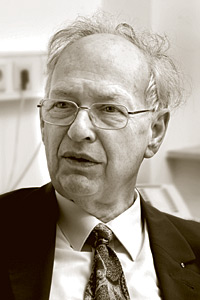 |
|
Photograph by Stefan Schickler |
Through analysis of such experiments, Reinhard Selten, professor emeritus of economics at the University of Bonn in Germany, explores behavioral economics and game theory — fields in which he has made several decisive breakthroughs. In 1994, his groundbreaking work in game theory was honored with the Nobel Prize in Economics, which he received jointly with John C. Harsanyi and John F. Nash (the enigmatic subject of the book and film A Beautiful Mind). Professor Selten expanded upon Nash’s original concept of an equilibrium point in noncooperative games. In a “Nash equilibrium,” when players interact repeatedly over time, they start to anticipate their competitors’ future responses, perceiving each other’s possible moves as potential threats or promises. These perceptions influence players’ present behavior, and thus affect the outcome of the game — often leading players to keep their current strategies intact even if there is reason to change. In the Selten “subgame perfect equilibrium,” competitors react only to threats and promises that they perceive as credible. The winning players are those who learn to distinguish credible threats and promises from bluffing, and this process of bluffing, counter-bluffing, and discernment becomes a feature of the ongoing game. Professor Selten’s refinement of this concept has opened new avenues for analysis of predatory pricing, entry deterrence, oligopolies, and similar competitive situations.
In addition to working on the foundations of game theory, Professor Selten has applied his research to numerous high-stakes problems in business and politics. During the early years of the Cold War, he belonged to a pioneering group that developed models of nuclear deterrence under a contract with the U.S. Arms Control and Disarmament Agency (which later became the U.S. State Department’s Bureau of Arms Control). More recently, he worked with a group of military experts to apply game theory to the strategic analysis of the Kosovo conflict. The results were published in Zur Lösung des Kosovo-Konfliktes (Toward a Resolution of the Kosovo Conflict), a volume he edited with Erich Reiter, director-general of the Austrian Ministry of Defense (Nomos Verlag, 2003).
Professor Selten has been one of the most influential developers of the theory of “bounded rationality” as an explanation of economic activity. This theoretical paradigm was first posited by Herbert A. Simon, another Nobel Prize winner. It builds on the observation that human perception, judgment, and memory are imperfect in ways that profoundly influence our economic and organizational choices over time. Proponents of bounded rationality aim to create, as Professor Selten puts it, a “more realistic” economic theory. After all, real people do not behave like the “hyperrational” creatures posited by conventional game theory and traditional economics. They behave, instead, like the students in Professor Selten’s experiments — or like the decision makers in real organizations.
The classroom experiment demonstrating the winner’s curse illustrates the complex relationship between game theory, human intuition, and optimal decision making. The mathematical explanation for the winner’s curse, first observed in bidding for oil fields, reveals the subtle intricacies of this apparently simple game. When bids for an item are based on estimates of the item’s value, the winner is the bidder who overestimates this value the most. As more bidders enter the auction, the range of estimates increases…which in turn increases the likelihood that the highest bid will exceed the true value. Intuitively, most people bid more aggressively when faced with more bidders, but more aggressive bidding increases the chances that a bidder will fall victim to the winner’s curse.
Exploring this counterintuitive lesson, Professor Selten repeats a computerized version of the coin game multiple times with his students, offering them a chance to learn from their mistakes. Looking closely at their behavior, Professor Selten has discovered that many people, after winning and overpaying once or twice, prudently adjust their bid downward in the next round of bidding. With these lower, less competitive bids in play, the jar may go to a lucky bidder who actually manages to turn a profit. In the following round, the disappointed bidders respond with more aggressive, upwardly adjusted bids, which makes the system once again more likely to produce a winner’s curse. Such behavior demonstrates why changes in organizations and markets alike can take a long time to take root. People alter their behavior through continual feedback mechanisms — responding in each round to their experience in the previous round, but failing to discover the “optimal” yet counterintuitive strategies needed to win in the long run.
Throughout his academic career, Professor Selten has been an active international consultant to both industry and government, and a prolific author of academic publications. In 2001, he edited Bounded Rationality: The Adaptive Toolbox (MIT Press) with Gerd Gigerenzer, and most recently, in 2004, he edited Human Behaviour and Traffic Networks (Springer Verlag) with Michael Schreckenberg. He spoke with strategy+business about the implications of his work during a colloquium on managerial decision making at the Batten Institute, which is based at the Darden Graduate School of Business Administration at the University of Virginia in Charlottesville.
The Defaulting Mind
S+B: Why is it so hard for your students to learn from their mistakes in the coin jar experiment?
SELTEN: In order to learn from your mistakes, you first have to recognize that you have made a mistake: You cannot learn from a mistake unless you see that it was a mistake. Of course, if it is clear to you that you made a mistake, you may learn from it, but it is not so clear in most cases, especially when the outcome of your action is uncertain.
S+B: Are you saying that experience is not a good teacher?
SELTEN: Experience is very important. Of course it is! However, the ways in which decision makers take experience into account — and therefore the outcome of any decision-making process — are different from the kinds of rational optimization assumed in economic theory. Traditional economics assumes that before you make a decision, you go through some rational calculations, which then yield a recommendation. The idea of optimization is a very attractive fiction. But it is a fiction. In actual fact, people are often not at all influenced by such calculations before the fact, but only after the fact. We call this “ex-post rationality.”
S+B: What do you mean by “ex-post rationality,” and why is it important?
SELTEN: In many situations, decision makers adjust their behavior by thinking about how different actions in the past could have yielded a better outcome. These alternatives, reinforced in the decision makers’ minds, become default actions to apply in future situations. When making decisions in those future situations, no optimization or rational calculations are involved, and instead, the decision maker simply follows the rules he has developed in the past — just like many of the subjects in my experiments about the winner’s curse.
S+B: This sounds very mechanistic.
SELTEN: In a sense it is; most decisions are made through some routine behavior because you cannot in a split second run through complex computations. When time is of the essence, you can only react to a routine program that is internalized in your mind, often by ex-post rationality.
Optimization is forward-looking: It is trying to anticipate the range of possibilities that might occur in the future. But ex-post rationality is backward-looking: guided by hindsight and what you could have done differently in the past if only you had known. Ex-post rationality often shows little regard for how much your current problems actually resemble your past experience. I saw this phenomenon myself, a long time ago, in one of the business games that I played with some experienced managers. I set up a laboratory market with only one product, and the participants’ earnings depended on the price they and the other players charged for this product. I used teams of three or four managers each to make the pricing decisions for the “firms” in the game. In the first round, one such team was discussing what price to charge. One person said, “In the paper industry, we apply a markup of 2 percent. So let’s take 2 percent.” Someone else said, “No, no! In the pharmaceutical industry, we apply a 100 percent markup.”
The game, of course, was neither about the paper industry nor about pharmaceuticals. Sharing these different perspectives therefore helped the entire team to make a better decision. If these participants had acted alone rather than as a team, they would have uncritically applied their respective industry experience, even though it was not necessarily relevant to the game environment.
S+B: This may happen in your experiments, but how about the real world?
SELTEN: Managers are human beings, too, you know! They also respond in the same way. For instance, the decision making in many organizations suffers because people are guided too much by experience without really understanding why something worked in the past. This gives you the wrong generalizations. You need to know not only what was good in the past, but also why it was good.
S+B: Your psychological explanation of behavior doesn’t fit well with how many of us like to think of ourselves.
SELTEN: Of course many people may be surprised. But it can be proved through experiments that people are not conscious of the reasons why they make a decision. In one experiment by Timothy Wilson and Richard Nisbett, subjects had to select one out of three nightgowns that were presented to them. It turned out that the last nightgown was selected much more often than the first, although the order in which the nightgowns were presented was determined randomly, with all six orders appearing with the same frequency. If you asked people afterward, “Did it matter to you that this was the last nightgown?” they would say, “No, no, no, not at all. It was the texture. It was the color. It was this or that.” They would violently reject the idea that the sequencing of their options had any influence on their decision…but it did.
People do not know what has influenced their decision and often invent reasons for their choice afterward. Only a small part of decision making reaches the conscious mind, while most decision making, just as most thinking, is below this threshold of consciousness. You know what you are thinking, but you do not know why you are thinking it.
Real-World Behavior
S+B: What is the goal of your experimental work in economics?
SELTEN: The first question of experimental economics is to find regularities in people’s behavior — consistent ways in which people respond to situations. The next challenge is to invent clear and precise theoretical models that describe this behavior.
S+B: I gather you are favoring models of “bounded rationality.” Can you describe this idea in more detail?
SELTEN: Bounded rationality is a subfield of what is now called “behavioral economics.” It is not really one homogenous field, but a broad collection of several approaches from behavioral science. You could say that this movement aims to base economic theory not on abstract notions of perfect rationality, but on the experimentally observed regularities in human economic behavior.
The concept has a long history; the economist and social scientist Herbert Simon introduced it in the 1950s based on his observations of administrative business practice. Simon argued that the traditional picture of rationality in economic theory was both wrong and insufficient. He said people make decisions by “satisficing,” trying to satisfy their aspiration levels just enough to feel comfortable, without necessarily reaching any optimal result. Experiments have shown more and more that such bounded rationality is not the exception; it is pervasive in behavior, and one has to look at it seriously.
S+B: How does the concept of “bounded rationality” fit into economic research?
SELTEN: It affects economics in many different ways. For example, in the standard economic theory of the stock market, your evaluation of a stock that you hold should depend only on your information about the future: on what you expect the future to be, and on what the future development of this company and its stock price will be.
In reality, however, people rely on facts about the past, such as the price they paid for the stock. From the point of view of traditional theory, the original stock price is irrelevant; but for real people it is of extreme importance in a buy–sell decision. Investors are very reluctant to sell at a price lower than the price at which the stock was bought.
S+B: You became famous for your work on game theory. How does that relate to your current emphasis on bounded rationality and the “fiction” of optimal decision making?
SELTEN: On the one hand, I have made the rationality assumptions of game theory even sharper by inventing some new “hyperrational” notions about the nature of equilibrium. On the other hand, there is my work on descriptive game theory and bounded rationality. There seem to be two quite different personalities involved in those types of work, right? Sounds as if I am a split personality!
But don’t worry. I reconcile them through a scientific position, which I call methodological dualism. In my descriptive work, I am concerned with how humans actually make decisions. In the end, only empirical evidence counts in this domain. Whether a theory sounds reasonable may be of some interest, but it’s certainly not decisive. On the other hand, my hyperrational approach to game theory addresses a philosophical question: What should complete rationality be, if it did exist? Imagine someone, a mythical hero, with no cognitive limitations. What would such a rational decision maker do and how could we describe his behavior?
Learning from Inexperience
S+B: How does this line of research apply to radio frequency auctions, the most prominent application of game theory in recent years?
SELTEN: Breaking with their past practice, several governments decided that it would be both fairer and more profitable for the state to auction off frequency bands to the highest bidder. At once, the problem arose of how exactly to design the auction process for these frequencies. For instance, a frequency may not be very useful to a bidder who doesn’t receive it along with a bundle of close-by frequencies. It would therefore be bad to organize the auction sequentially and to auction off one frequency after another. Buyers who bid on one frequency at a time would not have wanted to bid a whole lot because they would be worried about not receiving the right bundle to give this particular frequency a high value.
Firms participating in these auctions sought the help of game theorists. In the United States, for instance, the Federal Communications Commission decided to use a format that is now called “simultaneous ascending auction” — in which all licenses are auctioned off simultaneously. At the close of each round, participants can see all bids for a set of frequencies, and then adjust their bids in the next round. Today, researchers have also developed and tested several other auction designs for applications of this sort.
To some extent, it is true that this kind of auction design was a triumph for game theory and its hyperrational approach. But on the other hand, the new auction designs were also based on experimental work. If you cannot completely trust the idea that human behavior is guided by optimization, then you also cannot truly trust an auction design without testing it experimentally to observe real human decision-making patterns.
My team and I therefore decided that our advice would be soundly based on experiments. We worked out experiments that reflected the situation of the actual auction as accurately as possible. We had long and intense discussions with the firm we advised to create the right experimental environment. Then we conducted many such auctions with student subjects, and the outcomes of these auctions guided our advice.
S+B: Can you really transfer the insight from the behavior of students and other laypeople to the multimillion-dollar decision of a telecommunications company?
SELTEN: I run experiments both with experienced managers and with university students. Overall, the students do much better. It’s always the same story: People are guided too much by little-understood experience and make the wrong generalizations. Less experience can be advantageous when it forces you to think harder.
There is an interesting experiment involving wool auctions in Australia. Penny Burns, an Australian researcher, re-created these auctions in the laboratory and told the participants how much different quantities of wool would be worth. She then asked the participants to maximize their profits, which she actually paid them. On average, the inexperienced students realized much higher profits than the professional wool buyers. What was the reason for this?
It turned out that in their professional lives, the goal of wool buyers is not to make the highest profits. Instead, they need to see to it that they get enough wool for the factory to continue operating. The professionals bid aggressively in order to be sure to get at least a minimum amount of wool. They learn this behavior by experience without quite understanding what they do. When they buy too little wool, they are heavily blamed. When they buy too much, they are blamed much less. If they pay too much, they may be blamed, but less than if they bought too little.
In the laboratory situation, their goal was to maximize profits, yet they routinely applied their past behavior to this new situation, whereas the students who had no experience whatsoever had to think freshly about what to do. You also see the same contrast between students and professionals in option trading experiments and others.
S+B: How, then, can managers improve their decision making and limit these experiential biases?
SELTEN: The most effective way to improve your decision making is to improve your intuition. It is very rare that you can derive a decision from data and calculations alone. In most situations, you have to have some intuition that is based on the knowledge of analogies. These analogies concern very simple situations in which you can clearly see the best course of action. Such simple situations, sometimes presented in game theory, can then be transferred to more complex situations with similar features. When people have in mind great stores of such simple business or game situations and their analyses, they have better intuition. They will not easily forget the important aspects of a decision problem.
S+B: Most of the examples from game theory and even the cases at business schools seem oversimplified and unrealistic.
SELTEN: They are indeed very unrealistic. Nonetheless, they provide a basis for developing good intuition precisely because they are unrealistic and simplified. If the games were as complex as reality, you couldn’t learn anything from them.
Reprint No. 05209
Matthias Hild (hildm@darden.virginia.edu) is an assistant professor of business at the University of Virginia’s Darden Graduate School of Business Administration. His Behavioral Economics Seminar (www.darden.virginia.edu/bes) showcases pathbreaking insights into managerial decision making by internationally renowned researchers from economics, psychology, and management science.
Tim Laseter (lasetert@darden.virginia.edu) is the author of Balanced Sourcing: Cooperation and Competition in Supplier Relationships (Jossey-Bass, 1998). Formerly a vice president with Booz Allen Hamilton, he serves on the operations faculty at the Darden Graduate School.
