
The Future of Advertising Is Now
Marketers take heed: After years of overhype, the digital revolution is finally mainstream.
(originally published by Booz & Company)
 |
|
Illustration by Seymour Chwast |
“Ask him,” said one member of our group, pointing to the chief executive of a major television company, who had just sidled up and was listening, with some amusement, to our conversation.
“It’s the simple law of supply and demand,” the CEO said with a confident shrug. “Major marketers need to reach mass audiences, and we are the only game in town. They have the demand. We have the supply. And as with any product, as that supply gets harder to find, you can charge more for it.”
His complacency was understandable. Every year, pundits predicted dramatic change: the convergence of digital and broadcast media, the erosion of mass audiences, and the restructuring of the media and advertising industries. Every year, leading industry practices remained static, even stagnant, and the overall pattern of marketing spend barely changed.
But the long-predicted future has finally arrived. After a decade of denial, both mainstream media companies and major marketers are now accepting the facts: The methods by which consumers absorb information and entertainment — and the ways they perceive, retain, and engage with brands and brand messages — have changed irrevocably. As marketers take notice, their decisions are reshaping the media environment. Magazines are losing advertising to the Web (with total ad revenues declining about 2 percent per year since 1998); radio broadcasters are losing listeners, talent, and revenues to satellite upstarts and iPod playlists. Television networks also see the writing on the wall, as the penetration of digital television heralds the rise of video-on-demand, video downloads, interactive game networks, Internet TV, and other broadcast- and cable-busting enterprises. Broadcast advertising revenues declined in the upfront markets of both 2004 and 2005, according to the Jack Myers Media Business Report — the first-ever decrease in two consecutive years. In spring 2006, pundits predicted a third straight year of upfront price reductions. And the broadcasting CEO who seemed so confident about being the “only game in town”? He no longer has that job.
Does that mean gloom and doom for the rest of us? Hardly. These can be glorious times for media companies and marketers that are capable of change. And they know it. Interviews with more than 50 senior marketers and media executives, ongoing research conducted by Booz Allen Hamilton and the Association of National Advertisers (ANA); and analysis of data from a score of research services — all gathered from 2005 through early 2006 — support the observation that the prevailing attitudes among marketers have shifted. Most have come to accept the signal lesson of what is coming to be called the “nonlinear and engagement-focused” media environment: Marketing communications must be reborn as a consumer-centered craft.
The renaissance is already taking place at leading companies. Some of them, in industries that had previously premised their growth on relationships, regulatory protection, or engineering excellence, are now adopting a marketing mind-set and rethinking the assets they need to establish brand differentiation. The central catalyst in this transformation is an emerging class of highly capable chief marketing officers — “super-CMOs” — who are building new integrated marketing models that are more focused on return on investment (ROI), more multiplatform, and more targeted than ever before. Super-CMOs like Mary Minnick at Coca-Cola and Jim Stengel of Procter & Gamble have become architects of their companies’ growth agendas, taking into their portfolios such functions as innovation.
Major media companies, in turn, recognize the need to pump up the volume on advertising innovation or be left behind by the consumer. They are scaling up once-tentative experiments in consumer-created content, social networking, and interactive media for their clients. They are developing new types of advertising formats, sometimes in partnerships, as NBC and Yahoo did for Unilever’s Dove soap brand early in 2005 with a tie-in to the reality TV show The Apprentice. The promotion was unexpectedly successful: It drove a 1,500 percent increase in traffic to the Dove brand Web site. Other new formats being developed enable advertisers to segment markets in ways once unthinkable. For example, both the Fox Network and Comcast are using New York startup Visible World to customize television commercials locally, so that neighborhoods as small as a few blocks in size can receive custom-tailored commercials on cable-TV channels.
With the fragmentation of choices available to consumers and the consolidation of retail channels, the long-delayed emergence of marketers from the television-centered advertising ethos of the mid-20th century is now reshaping every link in the marketing–media value chain. “The opportunity to use different media to create more meaning, more connection, with the consumer is something we’ll be looking to do more and more,” says Katie Lacey, until recently the vice president of marketing for carbonated soft drinks at PepsiCo. Long a standard setter in television advertising, Pepsi last year relaunched its PepsiOne product without television. It is one of the leading major marketers (carmaker BMW is another) learning to thrive in the post-TV environment.
But, as ever when value chains are reconfigured, there is evidence of a widening gap between well-positioned firms and those for which disruption means dislocation. The winners, among brand marketers and media companies alike, are those learning to reconfigure their efforts in several key ways. They:
-
Shift spending and management attention to digital media, and use those media to more effectively influence consumer purchase behavior.
-
Develop formats to promote interaction with audiences, especially their most likely consumers.
-
Create new research approaches and metrics that measure outcomes, not inputs.
-
Combine “above-the-line” advertising (TV, radio, and print) and “below-the-line” marketing (promotions, sponsorships, events, public relations) in new two-way, integrated campaigns.
-
Create their own branded entertainment assets and appeal to customers directly through them.
-
“In-source” new skills and capabilities to achieve greater sales impact and other measurable results.
Embracing Digital Media
The years 2005 and 2006 will probably be known in advertising history as the period when marketing practices caught up with reality. After a decade of continual increases in advertising budgets but relative stability in their media mix, many leading marketers — Anheuser-Busch, Procter & Gamble, and DaimlerChrysler, to name a few — are rebalancing the assortment of communications channels they use. Specifically, they are directing more money and more attention to digital media.
“Two years ago, 10 percent of my advertising budget had an online component,” says the CMO of a U.S. auto company. “Today it’s 30 percent. Two years from now, it will be 50 percent. And overall budgets are not growing. It’s coming at the expense of television and print.”
In part, this shift represents a natural culmination of advertisers’ growing displeasure with those traditional media, especially broadcast television, that raised prices while efficacy declined. But it also reflects the increasingly strong financial returns, often in unanticipated areas, that marketers see from their digital endeavors. Enough consumers spend enough time accessing information and entertainment via digital media platforms — cable TV, mobile phones, video games, and, of course, the Internet — that they have shifted the overall pattern of media use. This shift will increase substantially in 2006 as greater broadband penetration — roughly two-thirds of all U.S. households with Internet access currently use broadband — makes the Internet more viable as an entertainment platform.
Changes in media technology and format have also gradually but fundamentally changed individuals’ expectations of advertising, along with their behavior as consumers. In studies by Yankelovich Marketing and Forrester Research, 70 percent of consumers say they like products that block advertising, especially TiVo and other digital video recorders (DVRs). Owners of these devices say they fast-forward through 92 percent of the commercials they receive. But relevance renders advertising worthy: Fifty-five percent of the respondents in one Yankelovich study said they would pay extra to receive more personalized marketing. In a Washington Post survey of working women conducted by Nielsen Media Research, 44 percent of the respondents (all of whom conduct at least part of their work online) rated the Internet a “very important” medium for prepurchase research on health-care products. That was more than twice the percentage saying they considered magazines, the next most significant research medium, “very important.” These results paint a bleak picture for companies whose marketing models depend on one-way “push” delivery of advertising impressions.
Meanwhile, the most successful media companies are building a presence in digital media (including Web sites, mobile platforms, social networking sites, and interactive gaming sites) and explicitly using that presence to develop deeper, more direct relationships with consumers. Broadcast and cable networks, for example, are making more of their high-quality content available to consumers online. Within just a few months of Apple Computer’s October 2005 introduction of its video iPod, ABC, NBC, ESPN, MTV, the SciFi Channel, and USA Network were among the television networks that were making shows available for download. In April 2006, ABC announced it would make four of its most popular prime-time shows available free on the Web. Dedicated online channels, such as ESPN Motion and MTV Overdrive, are selling out their ad inventory, at costs per thousand impressions (CPMs) that equal or exceed what they get on TV. Some mainstream programmers, including ABC News and CBS Sports, are putting content online or converting their programming into Web-only video formats, as Trio, the arts network, did at the end of 2005.
These experiments are only a harbinger. Because broadband delivery accommodates previously unwieldy video files, it will increasingly acclimate consumers to use of the Internet as an integrated information and entertainment medium. There will be vast new media inventories and new opportunities for advertisers to reach consumers who are no longer tethered to their living rooms or the network programmer’s schedule. As Apprentice and Survivor producer Mark Burnett remarked in February 2006: “To me, the new prime time is 9 a.m. to 5 p.m., because more people have access to a computer then.” Mobile devices will create additional opportunities to reach consumers outside their homes. With these developments accelerating each day, big-brand advertisers are poised to significantly increase their online advertising budgets, clustering around outstanding online communities and high-quality digital venues. In March 2006, for example, Heineken announced that it would launch its $50 million “Premium Light” beer campaign with ads on Yahoo, MSN, and ESPN.com, among other Web sites.
Conventional wisdom in the television industry has not yet fully grasped this change. Even with the tremendous publicity accorded Apple’s video iPod, the prevailing view is that digital video will create a new direct-to-consumer retail model — a pay-per-download revenue stream that will replace fragmenting advertising revenues. But it’s much more likely that digital video will embrace a variety of business models, including a great deal of free, ad-supported entertainment, offered to specified audiences who watch it when it is convenient for them and whose responses are tracked in detail. Although user attention is fragmenting, successful video deployment over multiple platforms will allow advertisers to deliver a much more targeted, productive, and measurable advertisement, and enable media networks and programmers to halt the advertising-revenue outflow and even capture new revenue.
And what of the laggards? To be sure, there are still plenty of them. Today, most major marketers allocate only between 4 and 10 percent of their measured media spending to online advertising. But the reasons for this are generally institutional, not strategic. Many companies’ media budgets remain bogged down in a TV-centric model. These companies’ marketing departments are hampered by organizational inertia, uneven levels of consumer insight, spotty effectiveness metrics, and the continued dominance of television in their strategies, incentives, processes, and promotional calendars.
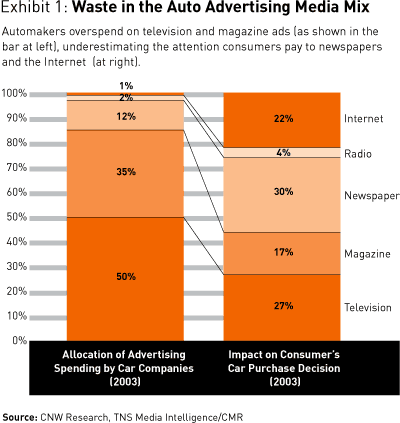
Consumer behavior has leaped ahead of the technological tortoises. Consider the automotive category. Some automakers can now correlate consumer usage of configuration sites — Web pages that allow buyers to experiment with color and trim packages — with subsequent orders. This allows automakers to guide shipments more accurately and reduce their own and their dealers’ inventory costs. (See “Building a Better Matchmaker,” by Maarten Jager and Steven Wheeler, s+b, Winter 2005.) Yet online spending barely registers as part of many automotive advertisers’ total budgets. (See Exhibit 1.) This is not because automakers prefer the status quo; it’s simply that the change requires alliances between dealers and manufacturers, and among their respective marketing, sales, and IT organizations — departments that are not used to moving quickly or working closely together.
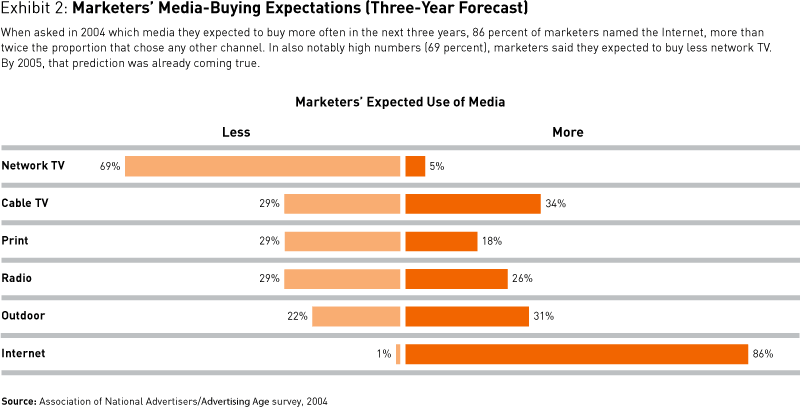
Also holding back the laggards: They have difficulty seeing beyond the compelling environment that television had made available for marketers. Marketing metrics and agency economics are built around TV; TV gets marketers’ retail and trade partners excited; and creative people have gotten used to the format of the 30-second spot as a vehicle for communicating brand value and emotional appeal. But as broadband penetration increases, so do the opportunities to exploit video entertainment and advertising, in new interactive contexts. Online advertising already appeals to marketers simply because the gap between an advertising message and a consumer action (e.g., a registration, a request for information, or even a sale) is so much narrower online than in other media. Combine that benefit with “higher quality” advertising inventory (that is, it allows users to click through for more information or direct sales) and it’s easy to see why blue-chip, brand-oriented advertisers are flocking online. (See Exhibit 2.)
Storefronts in Toontown
It is striking to see how consistently conventional marketing wisdom has denigrated the idea that consumers want more control over, and interaction with, their information and entertainment environment, and that they will pay more for that. In particular, after several high-profile interactive television experiments failed during the 1990s, chastened revolutionaries returned to the view of television vaguely derived from Marshall McLuhan’s assessment of it: a “cold” medium for “passive viewers” who preferred “least objectionable programming” (a phrase coined by NBC programmer Paul Klein more than three decades ago). Television, many believed, would remain forever distinct, in design, use, and location, from the computer.
But passivity has proven to be a myth, and convergence, despite the taint the word gained after the dot-com collapse, has proven a reality. Devices that combine digital distribution, content management, and playback have already transformed music consumption. At 1.25 million downloads a day from Apple’s iTunes service alone, the digital download music market is steadily growing, while annual sales of compact discs fell more than 7 percent in 2005 (according to Neilsen SoundScan). With Apple, Google, and a burgeoning number of Web sites offering video downloads — both repurposed inventory and original material — the TV industry is close to the day when each portable video player is the front end of a network tailored for one individual.
Although many longtime television executives are watching the erosion of traditional channel-centricity with trepidation, others relish the opportunities. Comcast, the largest cable television company in the U.S., says 65 percent of its customers with access to video-on-demand use it, with new users accessing it on average 23 times a month. Opportunities are also arising outside the television sector. Apple has sold more than 8 million video downloads since it began offering them in October 2005. Time Warner’s Time Inc. publishing division recently introduced a multimedia Web site aimed at young men, replete with original on-demand video.
Further eroding the boundaries between the networks of old and networks of now are online multiplayer games. In the fantasy game World of Warcraft, founded in 1994, players join one of two battling hordes in a world of humans and semihumans, with highly realistic visuals and (as in most role-playing games) rigorously defined rules that govern each character’s ability to communicate, gain skills, fight, purchase supplies, and learn. The game had 5.5 million paying subscribers as of January 2006, and annual revenues of about $700 million. Globally, about 10 million people held a subscription to multiplayer online games last year, according to the New York Times.
Another counter to the myth of passivity has been the growth of media environments created by consumers. As the cost of crafting and distributing creative content trends toward zero, adults and children alike are fashioning podcasts, playlists, online periodicals, and even original music recordings and films. Eight million Americans maintain their own blogs. The social networking Web site MySpace, on which men, women, and children post about themselves and their interests, has more than 50 million registered users and was adding 4 million new members a month at the end of last year. The shopping site eBay — a venue of consumer-created content with an almost unimaginable variety of sales information — has 79 million registered users; eBay’s automotive section alone attracts 10 million unique visitors per month, with each visitor spending an average of 45 minutes on the site. And YouTube, a site launched in February 2005 for member-uploaded video clips, already streams more video than either Google or Yahoo; it is becoming the premier video site for those in younger demographics.
Consumer time spent with such “engagement media” will increase along with the growing popularity of new delivery methods and devices. (See Exhibit 3.) The online gaming market will almost certainly expand as sales of large-screen high-definition television monitors, interactive game consoles such as Xbox and PlayStation, and digital home media centers increase. The ubiquity of mobile telephones is already prompting the evolution of a mobile social networking marketplace, with applications that include “shadow environments” (in which online participants can attach publicly accessible “sticky note” addenda to Web sites and other virtual spaces) and multiplayer mobile gaming.
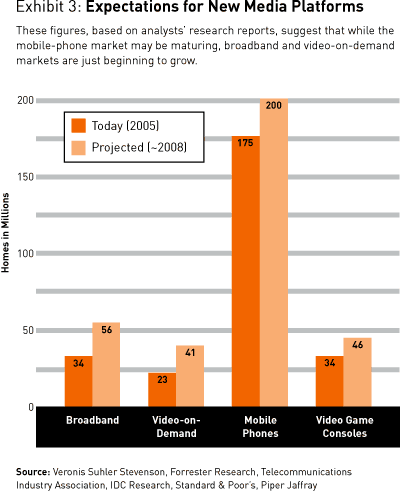
Advertising has already begun to follow interaction. Our own interviews, in addition to confirming research from Veronis Suhler Stevenson, Piper Jaffray, and the Yankee Group, lead us to estimate that the video game advertising market will grow from $30 million in 2004 to $750 million in 2008, and perhaps much more. So far, companies like RuneScape and Electronic Arts have barely begun to develop their competence as advertising platforms; a few startups like the Massive video game network are experimenting with interactive placements within the games themselves. Consumers report that they like the authenticity that real-world advertising lends to a fictional game environment. On a 50-inch plasma screen with high-definition sound, spending time online will be akin to wandering in “Toontown,” the madcap cartoon environment from the film Who Framed Roger Rabbit? Walk down the street, and a streetlamp may spring to life, address you by name, and invite you to a sale at the animated storefront next door.
Consumers and the advertiser marketplace also confer increasing value on online communications vehicles because they make it easy for people to make connections and take action. Interactive appeals that invite audiences to vote via mobile phone, register an e-mail address at a company Web site, or test-drive automobiles at a promotional event can create opportunities to forge one-to-one relationships, thus creating value that can be monetized well beyond the initial impression. That’s meaningful currency to marketers. The insights gained from these “two-way” solutions inform innovation priorities, offer real-time feedback on marketing programs, and, in some cases, even provide predictive input on product and service demand. Marketing can increasingly send data upstream to inform design and supply chain decisions for new products. This saves consumer goods companies significant expense; it also changes the nature of marketing at these companies and raises the profile of the marketing professionals who understand the change.
Accountable Revolutionaries
The growth of marketing communications during the 20th century was fertilized by a paradox. Beyond local experiments in retail price communications, for most of the period it was difficult to know how, if at all, advertising moved markets. “Does advertising increase demand for a given firm’s products?” asked Harvard Business School Professor Neil Borden in his classic 1942 text, The Economic Effects of Advertising. “Indeterminate,” he concluded. Does it preclude price competition? “In no case,” he wrote.
Advertising thus grew as a faith-based initiative, with ad agencies and clients alike believing it worked best when it raised awareness of brands and goods across a large swath of a target population, with success calculated using various survey-based input measures, such as page impressions; cost-per-thousand viewers or readers; and gross ratings points (GRPs), an indicator of audience size. Volume was the highest value. Rosser Reeves, head of the Ted Bates ad agency, voice the prevailing view this way in 1960: “If 90 percent [of the audience] do not remember it, the story is not worn out.”
With slowing economic growth during the 1970s, marketers started to reassess their laissez-faire attitude about measuring marketing performance. But it wasn’t until the 1990s and the rise of the Internet that the accountability revolution commenced. It was still in its infancy eight years ago, when Randall Rothenberg, one of the authors of this article, wrote in Wired magazine:
The new media technologies, by drastically reducing production and distribution costs and making possible almost continual and instantaneous refinements in message, promise to increase the efficiency of accountable advertising.… The spurious distinction between image advertising and retail advertising will erode, then disappear, as each advertisement, every product placement, all editorial can be tied to transactions.
Today, the accountability revolution is approaching its second stage. Marketers are more explicitly moving their strategy and spending decisions down the “purchase funnel” of consumer behavior. (See Exhibit 4.) They are no longer satisfied with media placements that merely build “top-of-the-funnel” responses from consumers (awareness and consideration). They favor media that can substantiate an ad’s influence on customer preference, purchase, and retention. This means a growing penchant for online media, especially those that can deliver a reliable indication of customer response.
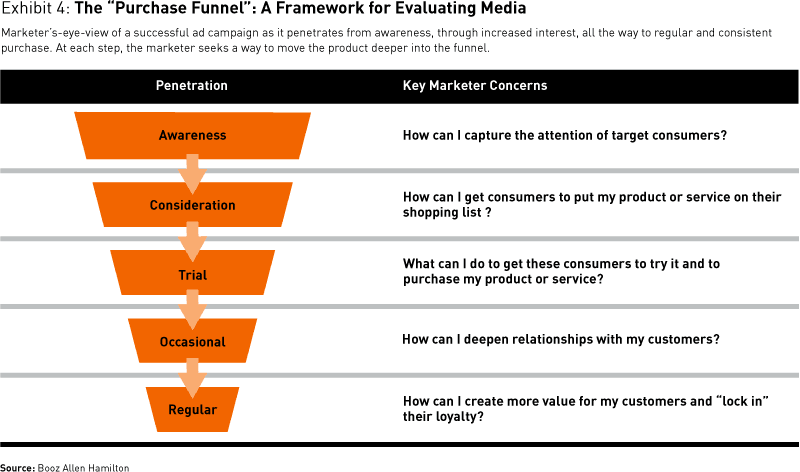
Media companies are increasingly asked to go beyond reach and frequency metrics like GRPs to more tangible and quantifiable evidence of return on marketing investment. No longer do marketers ask, “What is the cost of the GRPs I am buying?” Instead, they ask, “How many toll-free calls or online registrations did that ad generate, and how many were converted into sales?” Then, as they become more sophisticated at tracking the relationship between advertising and sales, they allocate their media buys on the basis of how well their offerings drive consumers through the purchase funnel.
To gain the requisite statistics, marketers don’t simply go online; they enter their customers’ worlds. P&G’s Tremor, an in-house unit that fosters brand trial and consideration via a network of some 280,000 trend-setting teens, has proven so successful that P&G now offers its services to noncompeting marketers, including Coca-Cola and Toyota. These interactive communities of “alpha consumers” offer marketers multiple benefits. They generate buzz for new products by reaching key influencers; they bypass traditional media to connect with hard-to-engage segments (such as multitasking youth); they communicate brand messages in ways that consumers interpret as more authentic; and they deliver deep customer insights.
In our interviews with chief marketing officers and our research with the Association of National Advertisers, we were struck by the expressed need to develop more robust analytics focused on ROI and consumer insights. There was a nearly uniform desire among respondents to concentrate advertising resources on those consumers who were, as one CMO told us, “specifically in the market for my category, product, or brand.”
That desire not only is prompting marketers to shift funds from traditional measured media to the Internet; it also underlies the unabated, two-decade-long transfer of marketing budgets from mainstream media advertising to promotions. Media companies and ad agencies used to dismiss the rise in below-the-line spending as a phenomenon driven largely by retailer demand for trade promotions. But the spending shift from major broadcast and print media to below-the-line marketing expenditures owes more to the fact that marketers can more easily measure and prove the value of most below-the-line spend.
Online media technology reinforces the trend toward integration. Although the dichotomy between “brand building” (advertising) and “moving the goods” (promotions) that characterized spending decisions in the old days was always relatively false (L.L. Bean is one of scores of companies that have built enduring brands on the back of promotions efforts without traditional advertising), any distinction disappears in interactive environments, where all communications can be designed to prompt an action. Whether in heavy consideration categories (automotive, travel, personal finance) or impulse-buy categories (specialty foods, packaged goods), marketers can now deliver contextually relevant messages and product information to only those consumers who are interested in choosing a Lexus, planning a trip to France, or searching for organic cotton diapers, and they can measure the actual results, instead of survey-extrapolated estimates.
New outcome-focused metrics are emerging on both the buy-side and sell-side of the marketing gulch. They include:
-
Session quality (for example, brand retention, number of ads viewed per session, and type of advertising content viewed)
-
Degree of consumer cross-platform activity (TV to online and print to online)
-
“Opt-in” activity (online registrations, toll-free calls, and requests for information)
-
Sales impact (leads generated, store traffic, and volume lift at retail stores)
Such is the proliferation of new measurements, new measurement techniques, and new measurement suppliers that the industry may be on the verge of a near-term glut in metrics that transfers precious capacity away from productive activities and creates a cult of accountability. That overindulgence will probably be short-lived, and most companies will settle on the set of metrics that are right for them. At the front end of marketing planning, these new metrics mean greater accuracy in judging impact, more finely tuned objectives, and less waste in budgeting. At the back end, the new metrics allow marketers to better estimate the degree to which objectives have been met. They can develop improvement measures, scale up R&D endeavors, and work with consumers more effectively than they have in the past. For their part, media companies can more effectively price their offerings on the basis of a range of objectives and results.
Postbroadcast Identities
Much as in the early days of television, when Procter & Gamble produced its own soap operas to showcase its products in situ, marketers today are appealing to consumers directly by creating their own programming venues and assets. Although we’re not likely to see many marketers and media companies converge (the ill-fated merger of Columbia Pictures and Coca-Cola in the 1980s remains a cautionary tale), there is no question that more marketers will inform and entertain their consumers directly. Blue-chip brand marketers such as Coca-Cola and Mercedes-Benz are already major players in the digital music arena with mycokemusic.com and mercedes-benz.com/mixedtape.
But the focus is not just on music. Marketers such as P&G have developed their own magazine-like capabilities. With 4 million opt-in e-mail newsletter subscribers, P&G’s HomeMadeSimple.com ranks in reach and influence with the leading women’s service periodicals — the magazines in which P&G has for decades been among the top advertisers. A destination environment focused on Procter & Gamble’s home-care portfolio, HomeMadeSimple.com is chock-full of contextually relevant product information, community stories, household ideas (recipes, tips for storing antiques, etc.), and related promotions — even music by Diana Krall and Harry Connick Jr. It generates a treasure trove of consumer insight for P&G that is entirely proprietary.
Procter & Gamble is far from the sole incumbent marketer thriving in the postadvertising environment. Indeed, the amount of successful, scalable experimentation undertaken by mainstream companies is striking. Coca-Cola, Nike, Anheuser-Busch, McDonald’s, and AT&T have developed games and other engagement mechanisms on mobile devices. But marketers don’t have to go virtual to succeed in this realm: DaimlerChrysler’s Camp Jeep campaign, which promoted off-road test drives in real-world surroundings that included live music, gaming kiosks, and giveaways, generated 75,000 names, 85,000 test drives, and a sales conversion rate of 8 percent — eight times the rate achieved by the average automaker promotional event.
While some marketers are disintermediating the media, many are working more closely with media companies to conceive and execute high-impact, integrated marketing solutions that combine above- and below-the-line elements. For example, Home Depot and Discovery Channel teamed up recently to drive more women into Home Depot stores, a top priority for the leading home improvement retailer in the U.S. The project involved integrating cable programming on TLC, in-store and on-air promotion, and unique live events around the concept of “Do-It-Herself” workshops, which attracted, in the initial wave, more than 27,000 “toolbelt divas.”
Despite transitional pains as media companies encroach on the territory of their traditional customers, the ad agencies, we expect many more such direct marketer–media collaborations. Some of the more innovative media companies are beginning to leverage their channel assets and audience relationships by becoming “category managers” for their larger advertising clients in specific demographic segments, such as youth, young adults, and baby boomers. Inevitably, the more enterprising among them will package their own media with that of select suppliers. These category leaders and their partners will increase their share by showing that their solutions most effectively deliver a specific audience and support the marketer’s purchase funnel objectives. Other media companies will avoid the risk of antagonizing agencies by partnering with them to rebuild agency capabilities and strengthen the entire marketing-media value chain.
Media companies are also taking their brands across platforms, and showing attractive gains for their efforts. E.W. Scripps, the owner of the four leading branded lifestyle cable networks (HGTV, the Food Network, DIY Network, and Fine Living), is delivering on-demand programming to 12 million households and branded digital newsletters to 17 million subscribers. Its HGTV Dream House promotion drew 39 million entries last year, with sponsorship support from GMC, Lumber Liquidators, and Lending Tree, among other advertisers.
There is a similar upside for most players in the evolving advertising value chain, but responses need to be rapid. It has been 12 years since the launch of the Netscape Navigator browser, the Big Bang in the development of the postadvertising universe: There is no excuse for any incumbent media company or marketer that fails to take advantage of the opportunities that have been evolving ever since. All will have to find ways to navigate a cosmos vastly more complex than the TV dial, the newsstand, and the mailbox — all of which they once effectively controlled.
In-House Renovation
To accomplish all this, marketers are rapidly recognizing the need to in-source new skills and capabilities. Nearly 70 percent of all U.S. companies have reorganized their marketing departments during the past five years, according to research by the ANA and Booz Allen Hamilton. One major cause for the changes has been their need for new expertise in digital technology, relationship marketing, and media innovation to supplement their traditional brand management apparatus. (See “Beyond Brand Management,” by Richard Rawlinson, s+b, Summer 2006.)
Until this shift, the functional-skill profile for brand management positions at most leading marketers had remained largely unchanged since the 1970s, when broadcast TV was at its zenith. Many brand managers are still primarily trained to assess TV-centric campaigns and pitches from agencies, and then relate them to data on consumers and the market from Nielsen and other research providers. Today’s brand marketers, however, need to think in new ways about connecting more effectively with the consumer, either through their media partners, through retailers, or through their company’s own database and assets. They need to integrate their marketing system more dynamically across a broader network of partners and media alternatives, reshaping it in real time as they operate. In the near term, this will require marketers to experiment with new advertising models and integrated media solutions and redefine critical skills and competencies.
For media companies, the changes in the advertising sales function will be no less profound. Leaders are already investing in making their ad inventory more interactive, offering new forms of ad tailoring and targeting, organizing their sales forces around customers instead of platforms, and developing integrated solutions that incorporate more elements that were traditionally below the line.
Underlying all these new practices is one fundamental skill: the ability to deal with unprecedented complexity and make choices accordingly. The “million-channel” universe isn’t here yet, but it’s no exaggeration to say that the average U.S. or European consumer has 10,000 entertainment channels to choose from. It was difficult enough for marketers to move from three broadcast networks to 20 cable networks, and then to 45. The fragmentation of audiences and the different ways that different audiences engage further complicate the picture. Each major marketer must learn to develop its own approach to reaching dozens, if not hundreds, of differentiated audiences.
We anticipate that leading media companies will in-source much stronger relationship marketing and experiential marketing capabilities to enable the targeted consumer dialogue and lead generation that marketers crave. Media companies will also need new go-to-market structures with clearer points of contact and differentiated sales and marketing services functions. As the distinction between above-the-line and below-the-line marketing blurs, media companies and agencies have to rethink their planning frameworks and redefine what constitutes advertising effectiveness. In the words of one CMO we interviewed: “The media supplier or agency that knows us maybe even a bit better than we do and can deliver results…that’s the one we want to do business with.”
As in any period of discontinuity, major opportunities for growth and market leadership are being created. At no other time has the potential been so great for smart players, whatever their size, to invent new rules for the game. At no other time have marketers and media companies possessed so many compelling platforms to entertain and engage the consumer. At no other time has marketing been so measurable, accountable, and interactive. Together, these factors are sure to ignite a new era of creativity and innovation in marketing, as well as in media and entertainment. The strategies pursued now by senior management at media and consumer goods companies will play a defining role in who wins and who loses relevance with today’s generation of consumers.
Reprint No. 06204
Christopher Vollmer (vollmer_christopher@bah.com) is a vice president of Booz Allen Hamilton based in New York. He focuses on strategy development, consumer marketing, and advertising sales in media, entertainment, and consumer products.
John Frelinghuysen (frelinghuysen_john@bah.com) is a vice president of Booz Allen Hamilton based in New York. He specializes in strategy development and implementation for clients in media, entertainment, and consumer products.
Randall Rothenberg (rothenberg_randall@bah.com) is the senior director of intellectual capital at Booz Allen Hamilton, a media and marketing columnist for Advertising Age magazine, and the author of Where the Suckers Moon: An Advertising Story (Alfred A. Knopf, 1994).