
Innovators without Borders
For companies that want to build a global growth engine, offshoring innovation is both a challenge and a necessity.
 |
|
Illustration by Philippe Weisbecker |
We are witnessing the early stages of a revolution in innovation services. A new study by Booz Allen Hamilton and India’s National Association of Software and Service Companies (NASSCOM) — the first study to assess the evolving global market for engineering and technical services — finds that the worldwide sourcing of innovation is growing far more rapidly in such nations as India, China, Thailand, and Brazil than anyone expected a few years ago. As that growth continues, it will reshape the way companies think about how and where they conduct research and development. Unlike nonengineering information technology, manufacturing, and business processes — other areas that companies frequently offshore — innovation sits at the very heart of any corporation’s strategy, hones a company’s competitive edge, and serves as the engine for growth.
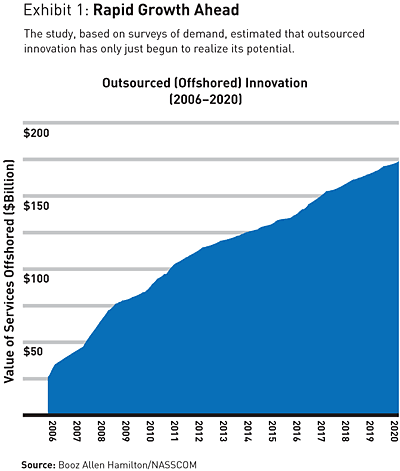
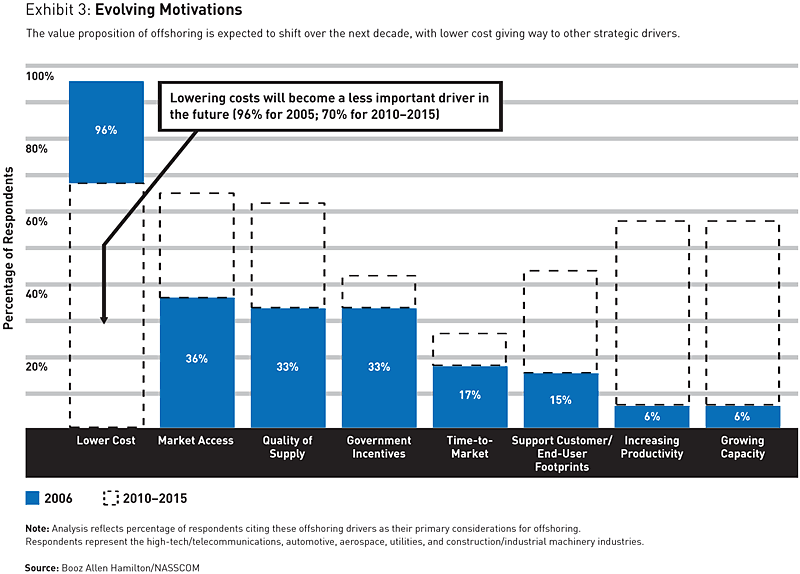
The Booz Allen/NASSCOM study provides comprehensive insight into the market for offshored engineering and technical services. According to the study, current global spending on offshored engineering is $15 billion. By 2020, the figure will expand by an order of magnitude to $150 billion to $225 billion (see Exhibit 1), with the growth coming from emerging markets such as India, China, and Russia. And although the impetus to reduce labor costs accounts for more than 90 percent of offshored innovation work in emerging markets today, that goal will give way during the next 10 years to more strategic priorities: market access, resource quality, increased productivity, and expanded capacity. The research shows that this trend will continue to pick up steam as more companies realize that the decision to offshore engineering processes can lead to real gains in quality and productivity over in-house levels.
The study examined the market for engineering services — product and component design, plant design, process engineering, and plant maintenance and operations — across a number of sectors: automotive, aerospace, technology/telecommunications, utilities, and construction and industrial machinery, which together account for the bulk of the world’s corporate R&D spending. Among the other findings of the study:
• The rapid pace of global spending on engineering services shows no signs of slowing. There are two main drivers: 1) the growing demand for ever more complicated consumer and industrial products, particularly in India and China; and 2) the increased electronic and software content of everything from toys to airplanes that makes for more offshorable engineering work.
• Western economies are facing a severe shortage of skilled high-tech workers, especially engineers. In part, this is the result of an aging work force; in part, it stems from a 10-year-long pattern in which fewer students in the United States and Europe have chosen engineering as a profession. Though the demand has picked up, the education trends have not yet reversed in the West. Companies in developed nations may have no alternative but to look overseas for talent and capacity.
• China is producing far more tech-savvy workers than is the U.S. (650,000 a year in China versus 220,000 in the U.S.). India, meanwhile, produces 95,000 graduates a year in electrical, information technology, and computer-science engineering — the kind in highest demand — while the U.S. turns out 85,000 a year. As demand climbs for engineering skills, any company that relies on engineers will have to fill part of that demand in Asia. The Booz Allen/NASSCOM study estimated that as many as 6 million engineers are available in emerging markets to take on R&D assignments of all sorts. Twenty-eight percent are in India, and 11 percent are in China.
• India enjoys an advantage over China and others because it has already optimized the business of IT offshoring, which can be easily adapted to serve the engineering sector. India alone could expand its revenues from engineering services by 25 to 30 times, reaping a market potential of $50 billion in 2020.
• As the market expands, new players will step into the ring. Eastern European countries will play an increasingly important role in catering to markets in Western Europe. Within the next decade, the low-cost position currently held by India could shift to countries such as South Africa, Philippines, and Vietnam.
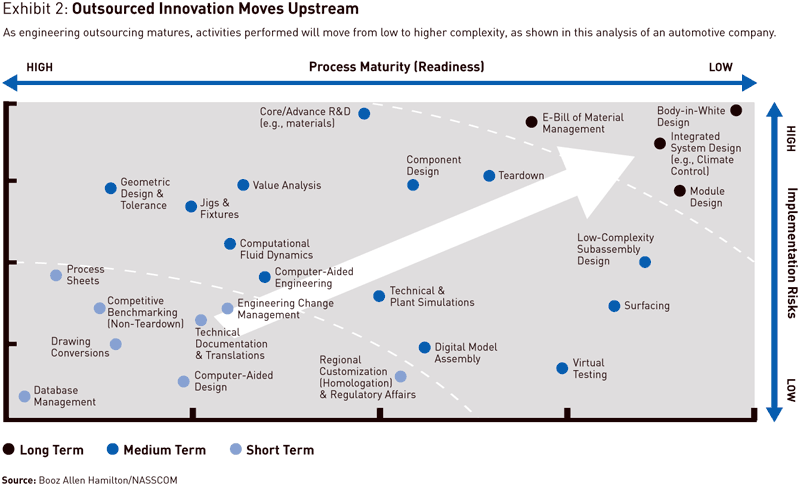
• Outsourced innovation will move upstream. The activities performed today for aviation and automotive clients, for example, tend to be rudimentary: documentation, basic simulations, and basic computer-assisted design and computer-assisted engineering work. But by 2010, highly complex engineering, such as composite structure design and thermomechanical analyses for aerospace companies, could be commonly outsourced. And by 2015, outsourcing whole processes and systems — the design of simple climate-control systems for low-end vehicles, for example — will be routine. (See Exhibit 2.)
• The expansion of offshored innovation services will lead to total job gains globally.
The implications of these findings for corporate decision makers are profound. The market environment has never been fiercer, with a continuously fragmenting customer base demanding an increasing number of ever more complex products. Today’s cars, for example, use far more intricate electronics — and more of them — than they did a decade ago. Even as managers must keep cutting costs, they face strategic pressures to boost quality and productivity and speed time-to-market. Squarely answering those challenges are the potential benefits of outsourcing innovation: labor arbitrage, added capacity, access to talent, increased productivity, market entry, and proximity to the customer or end-user. Companies will succeed only if they optimize their innovation footprint to exploit the full spectrum of competitive advantages now offered by emerging markets.
Not Just about Cost
Although labor arbitrage will continue to be an important factor — the pressure to cut costs shows no signs of abating — it will increasingly share importance with more strategic drivers in the decision to outsource engineering services. By 2015, the proportion of companies that are outsourcing primarily to reduce spending will drop 26 percent, while the share of those motivated primarily by other benefits, such as boosting capacity, will multiply by as much as 10 times. (See Exhibit 3.)
A host of industry leaders are already expanding their innovation footprint to tap into the skills and creativity in the emerging world. One major automotive component supplier is aggressively expanding its network into China and India. At its automotive R&D innovation site in Bangalore — one of the largest in India — 3,000 employees are working on high-end electronic control units, tools, and diagnostics. A second facility is planned for Coimbatore (about 150 miles south of Bangalore) by 2010, where 6,000 employees will work on software and engineering. Toyota has set up a center for small truck design in Thailand, its first non-Japanese product design facility, but likely not its last. And of all the regions in its network, Cisco is winning the most U.S. patents for new products developed at its Indian R&D operation.
Locating R&D facilities in emerging economies gives companies a number of site-specific benefits. Proximity to burgeoning markets makes for an easier and more responsive process for customizing products to those markets, and it makes it easier to meet varying regulatory requirements. For example, Nokia can simply develop cell phones for the Chinese market out of its product-design facility in Beijing. And, as different regions develop their own areas of expertise, such as small cars and fuel-efficient engines in India and China, and commercial aircraft design in Russia, companies can exploit those strengths by building facilities to tap into nearby pockets of expertise. Furthermore, several countries are offering appealing incentives to lure R&D spending. And Beijing will not grant a company access to its market unless it sets up shop locally.
Flexibility is also an important factor. Offshore R&D facilities can serve as a low-cost safety valve in dealing with demand fluctuations. One large automotive supplier that participated in the Booz Allen/NASSCOM study described how its offshore facilities came into play when it had to cope with major design changes late in the product-development cycle. Those changes led to a serious work overload, which the supplier was able to hand off to its offshore operation, thus ensuring that the product got to market on time.
Balancing the Demands
Establishing a global innovation footprint, with all its potential benefits, can add new dimensions of sometimes maddening complexity. Such variables as market demand can shift without warning. Regulatory requirements vary from country to country and are always subject to change. Developing worldwide innovation operations is an intricate process, but the Booz Allen/NASSCOM study reveals that certain truths apply no matter what other factors may be in play. Consider:
• Innovation outsourcing requires engaging talent in new ways. Outsourced engineering work tends to be far more complicated than most of its nonengineering IT, manufacturing, and business process counterparts. It requires a high degree of technical sophistication and familiarity with sector-specific hardware and software. Competition for talent is fierce; some companies have experienced turnover as high as 40 percent per year. Well-educated engineers and programmers will stick around only as long as their minds are engaged and they are properly recognized and rewarded for their work.
• “Where” is critical. Companies must carefully choose offshored sites to optimize a mix of factors: access to a qualified work force, access to technology clusters or academic institutions, access to desirable markets, proximity to production facilities, and the presence of a welcoming business environment. One leading automotive supplier built its software and design center in India, its production facilities in Germany, and its main engineering centers in the U.S. and Germany — all to tap into appropriately skilled talent pools. But it tests cars in northeast China, rather than the more traditional choice, Sweden, because China’s winters are snowier (thus providing more challenging road tests) and its labor is less costly.
• IT infrastructure can make or break the network. The success of any global innovation network relies on mobility and the transferability of information across systems. That places a premium on standardized tools and processes to ensure that the network operates efficiently and effectively. (This raises a whole other set of security issues that can be addressed both by encryption and other technology-based solutions and by organizing the process to protect valuable intellectual property.) Apart from IT, it is also important to build physical infrastructure such as labs and testing facilities.
• Governance structure can help manage risk. Offshore innovation operations can take a number of shapes, each with trade-offs. Captives (wholly owned offshore operations) offer the most seamless network and the greatest security for intellectual property, but cost the most up front and take the longest time to set up. Joint ventures and strategic partnerships can be less costly to set up, but are harder for one partner to control. And third-party vendors are the quickest and least expensive way to launch an operation, but controlling risk is much more difficult because the client doesn’t actually manage the enterprise.
The Booz Allen/NASSCOM study found, by the way, that there is no trade-off in skills and performance from one business model to another. Once a company has found the right model, productivity and quality often exceed in-house levels. One automotive supplier that offshored 20 percent of its engineering found that 5 percent more often than American designers, its Indian contractors came up with designs that met specifications the first time out and did not need to go back to the drawing board. And they did that despite having a decade less experience on average than the auto supplier’s own team.
The study found that companies that had met and managed each of these considerations were most likely to prosper from offshoring innovation. One major automotive company that took part in the Booz Allen/NASSCOM study expects to save as much as 50 percent by outsourcing its power-train engineering and is seeing real improvements in quality. An industrial machinery maker is saving 60 percent by offshoring its electronics engineering and has quadrupled its rate of new product introduction.
Neither of these success stories would have been possible without an engineering program that broke the old rules about keeping what’s core in-house. For any company to compete in the 21st century, it must develop the kind of flexibility, agility, reach, and market-sensing ability that a global innovation footprint enables.
|
Biotech: India’s Innovation Generation Gap |
|
More than two decades ago, when the field of biotechnology was in its infancy, Prime Minister Indira Gandhi assembled a task force made up of scientists of Indian origin to figure out how to position India as a leader in that revolution. As a member of the task force, I came to see firsthand that India has great potential to become an independent power in innovation. But I also learned why our country is at least 15 years away from realizing that potential. We helped launch a nationwide effort to improve the quality of science, with an emphasis on molecular biology, by investing in infrastructure and training. We encouraged the formation of a number of small biotech labs and consulted with biotech companies as well, always in hopes of turning them into engines of discovery. Instead, just about every Indian biotech company came to focus solely on manufacturing. For example, a company might obtain the genetic material needed to make hepatitis B vaccine (which is very expensive to make in the United States), and then manufacture it for export and domestic consumption. Biotech in India is now primarily a manufacturing outsourcing industry. It makes drugs and diagnostics, synthesizes molecules, conducts clinical trials, and otherwise provides sophisticated goods and services that already exist in the Western world. Indian companies can do all these things quickly, inexpensively, and efficiently. But Indian biotech does not create new drugs or molecules or processes; it’s not patenting new ideas. It’s basically a services business, and there’s no reason to expect that to change anytime soon. It’s not lack of capital that holds us back. Biotech is a very expensive business, but there’s plenty of money looking for investment opportunity in India. The problem is the capability shortfall. For example, only a handful of people in the country can conduct advanced stem cell research; therefore, there’s no sense in setting up a company whose product will require that kind of staffing. This problem is rooted in an Indian culture still heavily premised on bureaucracy. Across just about every facet of society — education, government, business — rules and regulations value seniority over many other qualifications. In too many Indian companies, little premium is placed on innovation and creativity. Thus, there’s not enough incentive for innovative, let alone groundbreaking, work. The same is true in academia. American universities are geared toward promoting curiosity-driven research, which is the hallmark of innovative inquiry. They place an extraordinary premium on innovation. That is why biotech innovation occurred first at Stanford; the University of California, San Francisco; MIT; Columbia; and other great research institutions. The American pharmaceutical industry exploits that excellence by securing strong ties with these schools. But in India, the relationship between pharmaceutical companies and academia is almost nonexistent. Indeed, most Indian universities are ill equipped to support advanced scientific research. Our task force has proposed that the government give out a large number of postdoctoral fellowships to send Indian scientists abroad to institutions like the Salk Institute, where cutting-edge work is taking place. Here at the Salk Institute, where I’m on the faculty, postdoctoral fellows from around the world do basic research in such areas as cancer, AIDS, and Alzheimer’s disease. Many have gone on to continue their work, usually in faculty positions, in their home countries. Our proposal would help Indian researchers pick up the modes of thinking that lead to breakthroughs and bring that expertise back to India. China is much better than India at this “export–import talent model,” because it’s easier for a scientist to split locales, working part of the year in the U.S. and part in China. But bureaucratic obstacles and scarcity of lab space make that much more difficult in India. Furthermore, a Chinese scientist can return home and command a salary to match his or her American paycheck — even if that means earning 10 times the salary of a local scientist. That’s just not done in India. The culture does not accept that sort of preferential treatment. To develop an innovative capability, India will have to develop a new mind-set: It must support risky research financially and in spirit, and it must reward breakthroughs with appropriate recognition. This shift will not happen overnight, but it can be made. We must start by retooling the education system. We also have to invest in the science infrastructure and encourage students to develop their curiosity. Doing so will help reverse the “brain drain.” How many great researchers have abandoned India to find intellectual satisfaction and financial success abroad? In the case of biotech, India will not get the best minds to return unless it can guarantee lab space, funding, adequate equipment, and intellectual camaraderie. Building up the scientific infrastructure of major Indian universities will go a long way toward meeting those guarantees. Our committee has also proposed that major universities in India set up technology transfer offices to encourage researchers to start thinking like entrepreneurs. When a graduate student gives a presentation at Salk, he or she will always consider patenting the idea or discovery he or she has come up with. It’s a given. In India, that’s not the case. But we can encourage innovative thinking by giving researchers an incentive: making it easy for them to patent and protect their ideas. India has an opportunity right now to lure back people who could turn its biotech industry around. Funding in the U.S. has become very tight, and that could drive scientists to return to India in search of greater job security. It is worth considering a proposal to bring 100 young Indian-born scientists who are now working in the U.S. to India next year for a three-day symposium. The symposium would showcase the best of Indian science and offer tours of the world-class facilities that many institutions are building. Great efforts are going on in India to overcome the constraints I mentioned, and we want more researchers to know about it and become a part of it. The biggest game changer will be the first success story. Once an Indian biotech company comes up with a breakthrough molecule or a blockbuster drug, we’ll see a rush of activity. Researchers, investors, and business leaders will come together to establish a new generation of innovative biotech companies. Success, after all, breeds success. |
Reprint No. 06305
Kevin Dehoff (dehoff_kevin@bah.com), a vice president with Booz Allen Hamilton in New York, is a global leader of the firm’s innovation business. He has spent more than 14 years helping clients improve efficiency and effectiveness in product development.
Vikas Sehgal (sehgal_vikas@bah.com), a principal with Booz Allen Hamilton in Chicago, works with clients on strategies for innovation and emerging markets.