
Who Manages Manufacturing?
Long-term strategist, juggler of diverse tasks, or productivity champion — the role of operations chief can deeply affect a company’s direction.
(originally published by Booz & Company)
 |
|
Illustration by Leigh Wells |
It’s an apt analogy because it highlights the habit that many companies have of taking their manufacturing leadership for granted. But beyond that, the analogy suggests that the head of manufacturing could make a much greater strategic contribution, especially in determining a company’s short- and long-term potential. On a cruise ship, for example, a thorough understanding of the engine room’s capabilities might prompt the captain to choose a different route to reach the ultimate destination. The captain and the engine room chief, working together, might even conclude that they could take the ship farther than originally planned.
The same is true for corporate leadership where manufacturing is concerned. And that’s where the opportunity lies. In rethinking the responsibilities of the manufacturing head, many companies have an opportunity to revitalize their operations and to bring new capabilities to their strategic focus.
To be sure, that would represent a great leap from the current state of affairs. The role of manufacturing chief has evolved, over the past two decades, in an almost haphazard fashion. Simply put, many chief executives don’t know what is going on in the engine room and aren’t even aware that they should care. Still, a handful of the most successful companies today have begun to realize that the path to best performance depends on reclaiming manufacturing as a core competence with strategic value. And, increasingly, the catalyst for this shift is the manufacturing leader.
How many manufacturing chiefs have stepped up to the challenge to play such a role? Not many. Some are not invited; others have not accepted the invitation. But although this trend remains very much a work in progress, one thing is already clear: Recasting the role of the manufacturing leader — providing a deliberate answer to the question of who manages manufacturing — is a high-leverage prerequisite to winning back the manufacturing advantage that many companies need.
To bring some clarity to the role played by manufacturing executives, in early 2006 Booz Allen Hamilton conducted in-depth surveys and interviews with heads of manufacturing in more than 50 companies based in Europe, the United States, and South America. We asked respondents about their experiences as leaders, their understanding of costs, their use of time, and their prioritization of tasks, as well as their perception of the overall manufacturing organization and its role within the corporation.
Not surprisingly, the survey indicated that the manufacturing chief is not easily portrayed: There is no established model for the background, skill set, or priorities of the head of manufacturing. For example, the range of functions varies dramatically from one company to the next, extending from supply chain planning, which is a natural overlap, to parts of sales and marketing, which represents a less logical leap. In short, the production chief position is populated by professionals who bring highly diverse skills to the job and apply vastly different leadership styles, consequently getting very different results.
But no matter how their roles differ, these heads of manufacturing tend to have a common set of challenges. They must maintain a delicate balance between competing priorities, focusing on the direct needs of plant management while addressing the broader issues of optimizing assets, coordinating with other functions, and determining manufacturing’s role within the corporation. Seldom do they have sufficient time to deal with the fundamental causes of their day-to-day problems, which exacerbates those short-term concerns, leaving even less time for long-term planning. And the information (such as cost analysis) on which they base decisions is typically insufficient.
Our survey results highlighted all of these stress points within manufacturing organizations. But although the mandate to save a company’s manufacturing base can seem overwhelming, some companies are finding ways to rise to the challenge. The difference between those that succeed and those that fail has to do with the way the manufacturing function is structured, the responsibilities and tactical vision of the manufacturing chief, and the level of integration between operations decision making and strategic decision making for the enterprise as a whole.
Position in Limbo
Organization charts have no clearly delineated area for manufacturing. Direct responsibility for the manufacturing function can reside with a chief operating officer (COO), with a senior executive who oversees only manufacturing, with a business unit general manager, or with a country or regional chief. Two-thirds of survey respondents’ manufacturing plants report directly to a corporate-wide COO or senior vice president (SVP) of manufacturing, and the rest report to the leader of a division, business unit, or region.
This ambivalence about the head manufacturing position even extends to its name. Unlike other positions with consistent titles, such as chief financial officer or chief information officer, the head of manufacturing in any given company may be called an operations director, manufacturing director, production director, senior vice president, or chief operating officer.
Many Jobs in One
Regardless of who oversees the manufacturing function, it’s likely that manufacturing is just one item on a busy agenda. In fact, to judge from the results of our survey, a manufacturing head who had to worry solely about factories might feel as if he were on vacation. In constructing the survey, we asked about seven typical supply chain–related functions: product R&D, process R&D, sourcing, supply chain planning, logistics and distribution, sales and marketing, and customer service. Not only did our respondents agree that they were involved in several (sometimes all) of these functions, but they also named additional activities in other areas. These included human resources, accounting and finance, information technology, and recruiting. (See Exhibit 1.)
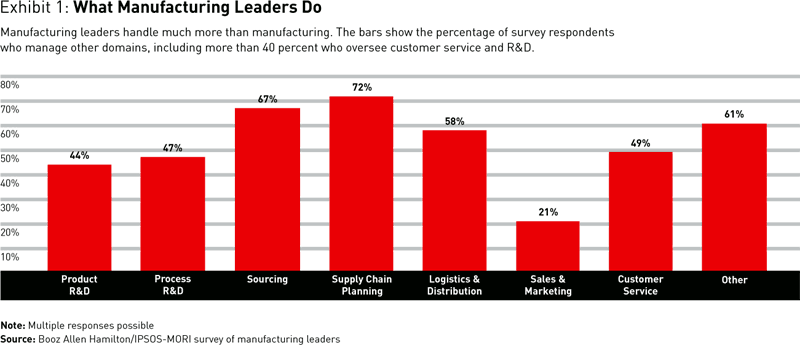
The range and reach of the manufacturing chief’s job vary even within industries. In aerospace, for example, Airbus’s SVP of manufacturing is responsible only for manufacturing, whereas his closest equivalent at Boeing has been in charge of both manufacturing and the supply chain at various points in the company’s history. In pharmaceuticals, one Pfizer SVP is solely in charge of manufacturing, whereas his equivalent at Novartis also has all of the technical functions under his wing. And in food, Cadbury has regional manufacturing SVPs, whereas others in the industry have local manufacturing chiefs.
A European producer of light commercial vehicles offers an example of how a manufacturing executive can productively dedicate time to other functions. The head of manufacturing for one product line realized that the vehicle design limited the potential for improved productivity and quality in subsequent vehicles. Solving this problem immediately would have meant working closely with the leaders of research and development. But they had more immediate priorities: an accelerated development time and strict cost targets.
Since the head of manufacturing couldn’t enroll R&D directly in the cause, he felt he had no choice but to invest his own time unilaterally. He expanded his responsibilities by becoming a “business intelligence champion.” He toured Japanese plants that had embraced lean manufacturing techniques; he reverse-engineered competitors’ vehicles; and he asked his production team leaders to systematically analyze their assembly operations. In all three places, he looked for improvement ideas that might be relevant not only to operations, but also to product development. When he presented a list of recommendations for a revised product line to the company’s R&D leaders, they recognized its value and began to enhance the design, removing many of the obstacles to better productivity and quality in future vehicles. The manufacturing executive returned to operations.
But in other cases, the manufacturing executive can be stretched too far. At one automotive supplier, which was facing a huge market downturn and losing some of the company’s key clients, the manufacturing director decided to dedicate a significant percentage of his time to accomplishing two goals: helping the commercial director create and evaluate new products, and pushing the technical engineers to develop in-house robots to perform a crucial production stage.
This set of priorities seemed to make sense. Working with the commercial director was important because of the highly technical nature of the product that the company sold, and robotics promised to increase productivity and reduce labor costs. But the strategy backfired for two reasons. First, the company unexpectedly was offered the opportunity to use idle capacity by offering a new series of products whose inherent characteristics were totally different from those of the original. As a result, the robots that were being tested on the original products’ specifications were useless. Second, and even worse, this focus on time-consuming — and ultimately unnecessary — activities diverted the manufacturing director’s attention from other relevant operations. Consequently, the company had a hard time delivering on its promises to new customers; performance in plant changeover time, scheduling, and maintenance processes deteriorated during that period; and overall asset effectiveness and delivery scheduling slipped.
There are ways to create a more holistic view of the overall business within the manufacturing function without wasting time. A leading Brazilian beer company instituted a program in which all manufacturing executives take part in a company-wide marketing and sales program to encourage a customer-oriented culture. The process is very well structured. Every year, for one day, the executives participate in the sales operation. Accompanied by a salesperson, they ride in a delivery truck as it makes its rounds between distributors and retailers. This allows manufacturing executives to get out into the market and get a feel for what is happening through informal conversations. Company executives claim that since this program was started, the manufacturing function has been more willing to respond and adjust to requests made by marketing intelligence and R&D areas. They consider the investment of one day a year more than worthwhile.
Similarly, a tobacco company decided to involve manufacturing executives in focus groups so that they could understand some of the seemingly “crazy” ideas that marketing came up with, ostensibly based on customer preferences. For instance, manufacturing executives learned how much customers were bothered by tobacco leaves’ not being densely compacted in the cigarette. After that, they developed shop-floor solutions to avoid this quality problem.
Uncertain about Costs
One of the most significant results of our survey was the wide gap separating the respondents’ belief in the importance of cost management as a competitive edge, and the actual impact of day-to-day cost analysis practices. An overwhelming majority (91 percent) of respondents identified cost competitiveness as a high priority. This was well ahead of the next two items on the list: how to deal proactively with safety/quality issues and what type of measurement system to use to track performance. (See Exhibit 2.) But whereas cost competitiveness was at the top of the agenda of the manufacturing chiefs we surveyed, they tend to know little about their competitors, and they generally don’t use competitive information as a regular component of their decision making. Only a third of respondents said that they understood their own detailed cost structure or those of their competitors very well. More than half (56 percent) said that they understood their own manufacturing cost structure well but not those of key competitors — that is, they run their plants with very limited understanding of what their competition is doing.
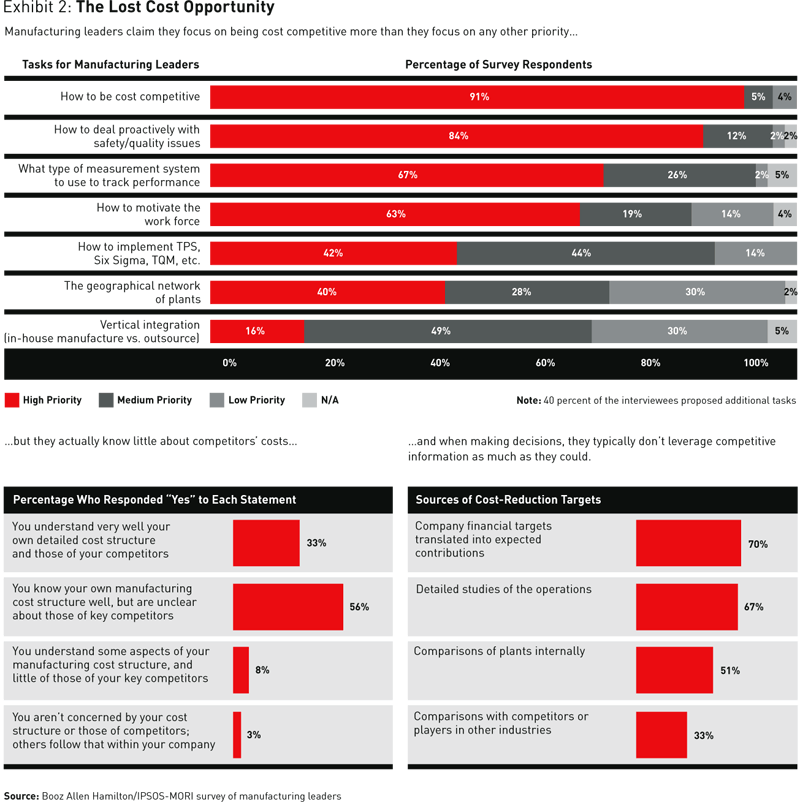
This lack of competitive information seems to have an impact on companies’ decision-making process. In two out of three cases, only internal information drives their cost-reduction decisions and target setting. Companies thus overlook the benefits that could be gained from benchmarking competitors in the industry and thus from understanding many more real sources for potential improvement.
A thorough assessment of cost competitiveness can lead to critical changes in strategy that reach well beyond the boundaries of manufacturing. For example, a manufacturing company in Latin America, keen on acquiring one of its competitors, conducted a five-week analysis of its rival’s financial underpinnings. The company built a multidimensional picture of its competitors’ cost structures by pooling readily available information about its strategic planning, manufacturing, and commercial functions. On the basis of this data, which had not been analyzed in such depth before, management realized that proceeding with the acquisition would not bring significant new capacity and would merely force a consolidation of the industry — a consolidation that would be inevitable anyway as less-efficient players exited the market. Even worse, in bankrolling the acquisition the company would be saddled with the lowest margins and the highest costs in the industry.
Alternatively, a rapid cost-reduction program could offer savings of 4 to 7 percent in manufacturing expenses. The company took the obvious path: It abandoned the acquisition and focused instead on its own costs.
Another example, involving a European manufacturer of parts for automobile seats, shows how analysis of cost competitiveness can create sustainable competitive advantage. The parts company had improved its cost position through various rounds of streamlining exercises, achieving impressive results each time and stretching the organization to its limits. Yet in every case, after a few months, the benefits were consumed in negotiations for new vehicle contracts or lost through price concessions in bidding wars against other suppliers.
Ultimately, the company poured substantial resources into researching its competitors’ activities in terms of scale, technology, and the location of operations. From this, the company concluded that a radical standardization of components could clearly differentiate it from its rivals. Standardization, by reducing manufacturing complexity and increasing scale, would allow the company to slash prices for its primary customers.
Although wary of the risk that the market would reject its new tactic, the manufacturer opted to go ahead with standardization. It was a well-placed bet. On the wings of this strategy, the company became the global leader in its industry and outperformed its competition with such strong scale-based cost benefits that no competitor could possibly copy the technique and catch up for many years.
Path to Manufacturing Chief
The profile of manufacturing leaders is changing. Our survey showed that they have varied education credentials. Fifty-four percent of respondents hold degrees in technical studies, 30 percent in business administration, and 27 percent in other areas, including the natural sciences (some hold more than one degree). In our experience, this represents a higher number of individuals with a background in business education in this position than in the past — a positive sign, since manufacturing heads will increasingly be called upon to make strategic decisions.
Even more important is the diversity of roads that respondents took to reach their current positions. (See Exhibit 3.) Historically, the head of manufacturing was promoted from the shop floor or had some technical experience. Today, many companies want their head of manufacturing to have a broader range of experience, including, perhaps, a stint in marketing or finance. This approach makes it more likely that manufacturing executives will generate positive results by addressing a broader cross-functional agenda, rather than falling prey to a silo mentality.
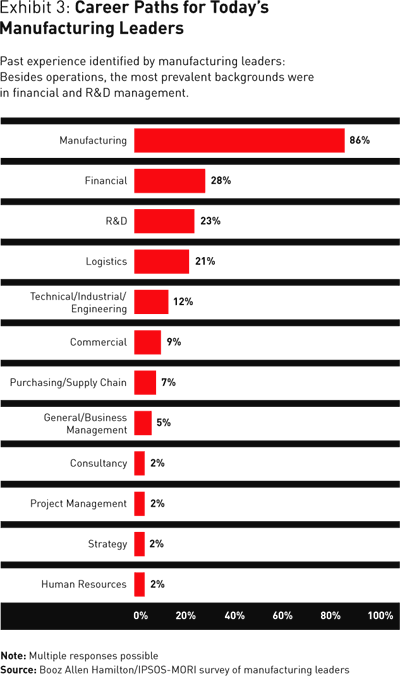
A leading European manufacturer of commercial vehicles reaped these benefits when the CEO assigned a former manager of sales and marketing to head production. Instead of a traditional honeymoon-period transition — concentrating on incremental shop-floor gains and the usual toolbox of operations enhancements — the executive used his sales and marketing skills to question the many myths that were holding back real manufacturing improvements. He raised questions that had not previously been addressed: What were the real customization needs for individual market orders? What were the effective order requirements on delivery speed and accuracy? What were the cost and price implications of recent changes in the company’s market and in the needs of their major clients?
With an uncompromising customer-focused view, the executive encouraged his production team leaders and managers to reconsider every routine and detail of the production process and every element of customization in components and design of vehicles. The resulting redesign of the production system included new physical plant layouts, new material and material flows, new work processes, and new targets. This ultimately evolved into a sustained transformation program. In contrast to many such programs, it was driven by market needs and resulted in substantial competitive advantages by fulfilling market requirements at a very effective cost.
A cross-functional background is not necessarily a magic bullet. There is no single background or skill set for the head of manufacturing that will guarantee success. The broader the background, however, the greater the likelihood that the judgment brought to bear on complex decisions will be robust enough to justify them in the long run.
A Short Leash
When a company undergoes transformation, the manufacturing function is often expected to perform like any other function — even though major changes in manufacturing processes take at least 18 months to start showing results, whereas a marketing or accounting department can reorganize in much less time. In our survey, 42 percent of respondents said that any given investment in manufacturing must produce positive returns within 18 months to be considered successful. Slightly fewer respondents (40 percent) said that they have two to three years to show returns, and only 16 percent said that company management gave them longer than five years to generate a return. This shortsightedness can affect the long-term success of a company’s manufacturing operations.
For manufacturing to overcome this challenge, the production chief must be able to emerge from the function’s silo and convince top management of the value of long-term strategic change. Indeed, a long-term approach to manufacturing, supported by the company’s leaders, can transform not only the function, but the organization. One of the more ambitious efforts of this type involved an American aluminum company, which selected an international group of manufacturing executives to travel around the world benchmarking and collecting best practices. They then translated these findings into a proprietary production system based on lean manufacturing and a judicious mix of TQM, Six Sigma, and other traditional quality improvement tools. This change was expanded into a company-wide business system, which calls for applying the logic to all processes in the organization.
However, this implementation didn’t happen overnight, and it is still being refined and improved. Insiders estimate that it took approximately 10 years to put the process firmly in place. It simply takes that long to institutionalize the kinds of techniques and practices that guarantee continuous improvement and responsiveness, especially those designed to capture and retain a broad spectrum of technical knowledge about variability and key performance drivers.
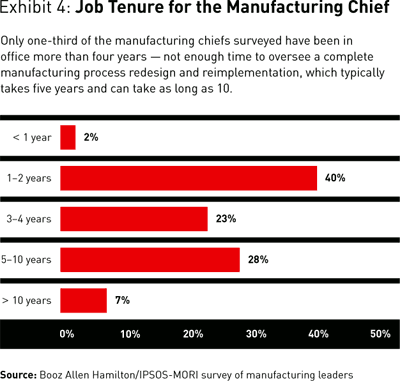
Today, most heads of manufacturing do not have that much time. Even if they were allowed to initiate long-term agendas, their job instability precludes their seeing the agendas through. (See Exhibit 4.)
A lack of long-term perspective is evident in the limited amount of time that manufacturing chiefs devote to strategic decision making as opposed to daily fire fighting. (See Exhibit 5.) This is unfortunate, but not surprising. We have often observed that within manufacturing, strategy brainstorming is seen as a discrete process that happens once every three years, rather than what we believe it should be — an ongoing reflection on the business, on competitors, and on innovative approaches to solving problems within the function.
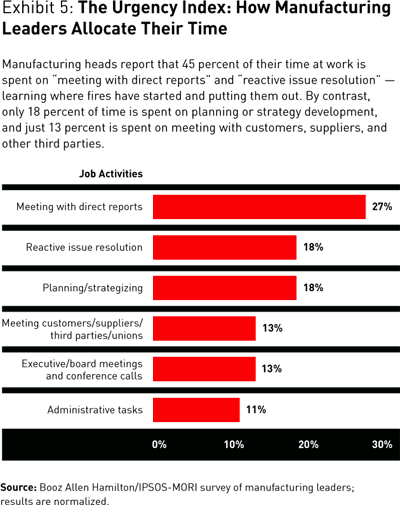
Another issue is the amount of meeting time that takes place internally as opposed to externally. More hours spent with suppliers, customers, and competitors can be a significant source of intelligence for manufacturing executives and help broaden their perspective. Manufacturing executives in a European chemical company, for example, sought out a few major customers to help them decide whether to open a plant in China.
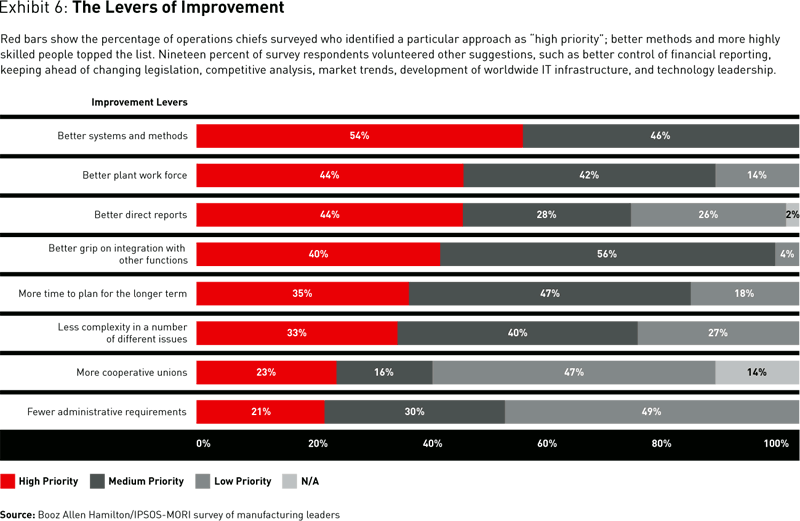
Finding more time for reflective thinking in a hectic agenda can greatly benefit manufacturing executives, because many of their priorities are strategic, from implementing better manufacturing systems and methods to getting a better grip on integration with other functions. (See Exhibit 6.)
In fact, focusing on strategic issues can, in the long run, decrease the time necessary for operational and tactical problems. For example, consider the VP of manufacturing in one fashion apparel company who had been given responsibility for logistics, sourcing, and R&D, in addition to having seven plants under his control. As a former plant manager, this executive had always taken a very hands-on approach to management, involving himself closely in the day-to-day running of the plants. When he acquired the other functions, however, this style was no longer feasible: In less than three months, the poor executive was flooded with a backlog of routine problems to solve across all areas.
As it turned out, the time crunch was the best thing that could have happened to this executive and the management function. It forced him to let his plant managers worry about short-term problems while he devoted his time to long-term, strategic issues. He ended up rethinking the footprint strategy, revamping the product-allocation strategy, redesigning the format for key performance indicators (KPIs), and institutionalizing a management model that allowed him to selectively address problems in specific plants, at specific points in time, instead of trying to manage the whole network every hour of every day.
This attention to empowering his employees, leveraging analytics, and managing his own time appropriately paid off with positive results in terms of cost, quality, speed, and flexibility. “I really took the risk and faced the unpleasant sensation of not having my hands into everything,” he said. “It seems to be working.”
A Broad Agenda
Although there is no fixed set of criteria for the person who will fill the role of manufacturing head or for the duties required in that role, there certainly are qualities to look for. The new manufacturing leader must cover both “big-M manufacturing” (strategic planning, supply chain management, product design, capacity management, interplant coordination, plant scheduling, and work-force organization) and “small-m manufacturing” (cutting, shaping, grinding, assembling, and chemical processing). In addition to having the skills to oversee these tasks, this type of well-rounded “engine room” leader must have the business sense to understand and adjust the role of manufacturing in the context of the broader strategic needs of the company.
When a manufacturing organization is lucky enough to find this superhero, we have three words of advice: Give it time. Manufacturing represents a complex mix of physical and human systems; quick fixes are possible, but companies that aren’t willing to invest time and resources now will end up paying later. That is why it’s so important to have a transparent, company-wide agenda for the head of manufacturing, an agenda that recognizes the inherent trade-offs among cost, quality, speed, and flexibility.
Finally, the head of manufacturing can balance the obligation to interact with other functions by helping executives from those functions understand manufacturing. Although the idea may be daunting to all involved, it is a good practice to let marketing and sales executives run a factory for a short time and truly learn the complexity of plant management.
Today, there is more reason for hope in the manufacturing sector than many people think. Productivity is on the rise in heavy industry. During the last 30 years, manufacturing has seen a consistent reduction in costs, an increase in throughput, an improvement in service quality, a rise in scalability to meet future growth, and a greater degree of flexibility to introduce new products and services quickly. This has happened because manufacturing leaders have been driven to think strategically within their function, if only to compete effectively. Now, many companies are ready to expand that contribution more explicitly, making manufacturing part of the larger team. A great deal can be accomplished when the engine room chief steps out from belowdecks and joins the other leaders at the helm.
|
The Michelin Way in Manufacturing |
|
Humility is critical to achieving industrial excellence. Although it may be difficult for a plant director or manufacturing senior vice president to hear, it’s important to accept that manufacturing operations are not the center of the organization. Industrial excellence is achieved primarily when there is alignment between a company’s manufacturing activities and its global strategy. As manufacturing executives, we need to ask ourselves these kinds of strategic questions: What are the activities that our manufacturing operation should perform at a level of excellence to help the global strategy of the company? How can we perform these activities to build a sustainable competitive advantage for the company? What processes and machines are needed to best support this set of activities? At Michelin, we think, contrary to popular belief, that there is not a single model of industrial excellence. After all, manufacturing activities and processes should be based on a company’s unique needs and circumstances; they cannot be generically applied across organizations. As a plant director for Michelin’s Roanne factory, I conducted an annual internal and external diagnosis to help identify the processes we needed to improve so they could dovetail with the company’s overall strategy. Since then, our company has set up an ambitious program called “The Michelin Manufacturing Way” to standardize processes across Michelin’s network of plants, to deploy world-class practices in those processes, and to align the organization toward delivering concrete results in areas like innovation, product development, productivity, costs, inventory, and time-to-market. In our experience, the act of designing solutions is extremely simple compared to the complexity of implementing them. The Michelin Manufacturing Way, like industrial excellence in general, relies on a key component other than processes and programs: recruiting and developing the best people and making sure they maximize their potential, both as individuals and in building the competencies of the team. General George S. Patton used to describe great management with two words: direction and speed. Although a manufacturing organization’s direction should mainly be the result of a good strategic analysis, its speed comes mostly from the people within the plant and from their willingness to perform at a high level and to improve the factory’s activities and processes each day. The development of empowered organizations enables managers to share responsibility with the workers through delegation and accountability for local performance. It also fosters powerful teams in which the best employees elevate the performance of the weakest. As a plant director, I spent a lot of time trying to give employees and teams the motivation to work toward continuous improvement, which is essential for industrial excellence. There are many tools on the market (Six Sigma, kaizen, TQM, and the like) that can be used to develop and train employees, but the use of these tools is not an end in itself. The tools should be a means for building the willingness to improve. For example, throughout our Roanne factory, we implemented a full set of steering processes consisting of scorecards and performance boards on the shop floor; these were used to assess the daily and monthly performance of the plant. We also implemented monthly performance appraisals to build individual employee accountability. This was a huge amount of work, and we were very proud of achieving it in a 900-employee plant within six months. In fact, most of this project was devoted to training all the workers and coaching the managers, aspects that are often downplayed in an implementation like this. At some point we even decided to close the factory for two days to provide a meaningful block of time for training. This training effort in our 30-year-old plant helped employees build a shared willingness to act as a team for the greater good of our company. We all know that industrial life is not placid. New products, process renewals, regulatory changes, and the ever-increasing speed of change outside the factory bring new challenges to the plant floor every day. Besides well-designed strategic analysis, the only way to properly confront and manage all these challenges is to build, as widely as possible within the organization, a willingness and competency to act toward continuous improvement. This, more than all the tools available on the market, is a requirement for industrial excellence. Thierry Chiche (editors@strategy-business.com) is vice president of manufacturing, passenger-car and light-truck tires, Europe, for Michelin Group, and oversees 17 plants throughout Europe. Previously, he was plant director of Michelin’s Roanne factory, a 900-employee plant located in France. |
Reprint No. 06308
Author profiles:
Peter von Hochberg (von_hochberg_peter@bah.com) is a vice president of Booz Allen Hamilton based in Düsseldorf. He has extensive experience in consulting with clients on manufacturing and lean production, focusing on automotive OEMs and suppliers, and industrial goods manufacturers.
Marcello Rodrigues (rodrigues_marcello@bah.com) is a principal with Booz Allen Hamilton in Rio de Janeiro.
Mr. Rodrigues focuses on supply chain optimization, supply chain design, manufacturing transformation, and strategic sourcing.
Georgina Grenon (grenon_georgina@bah.com) is a senior associate with Booz Allen Hamilton based in Paris. She is the director of business development and intellectual capital efforts involving manufacturing and cross-industry supply chain issues.
Also contributing to this article was Booz Allen Hamilton Principal Kaj Grichnik.