
Best Business Books 2006: Strategy
The Growth Conundrum
 Andrew Campbell and Robert Park,
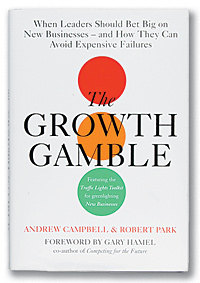
The Growth Gamble: When Leaders Should Bet Big on New Business — and How They Can Avoid Expensive Failures
(Nicholas Brealey, 2006)
Vijay Govindarajan and Chris Trimble,
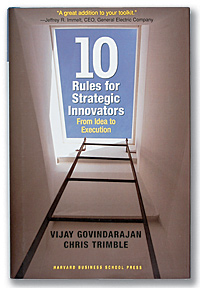
10 Rules for Strategic Innovators: From Idea to Execution
(Harvard Business School Press, 2005)
Jack G. Hardy,
The Core Value Proposition: Capture the Power of Your Business Building Ideas
(Trafford, 2006)
Today, growth occupies a top spot on most management agendas, and it is no wonder. Extraordinary gains in revenue and profits are a defining characteristic of the companies that achieve the most definitive (and elusive) standard of success: above-average returns to shareholders. To meet shareholders’ demands for revenue and earnings growth, managers are increasingly looking outside their core business for growth opportunities — particularly through the creation of new businesses and acquisition of potential growth platforms.
But the sad truth is that most such attempts to grow fail. In fact, the value destroyed by failures generally outweighs the value created by the occasional success. Growth through acquisition of additional “legs” is an example. Although acquisitions tucked into a company’s current core business often create value through new avenues of growth, numerous studies have documented their substandard returns. An even more problematic approach, “let a thousand flowers bloom” — spawning numerous innovative ventures with the expectation that a few might succeed — can destroy the most value. Thankfully, this method, popular at the height of the dot-com bubble when corporations tried to ape venture-capital firms, has largely fallen out of favor. Unfortunately, a somewhat abridged version based on the hope that “if we plant it, it will grow” lives on in general calls for business model innovation. Like its forebear, this approach has produced few successes but many value-destroying costs.
Why do all these initiatives fail? In part, because the development of valuable new businesses is the toughest challenge in business — far more difficult than sustaining an existing enterprise. Existing businesses benefit from inertia: customers won’t switch unless they are given a good reason, few employees leave voluntarily unless their compensation falls significantly below market rates, and returns on sunk investment may persist at substandard levels as long as a company can’t generate more cash by selling the assets. In contrast, rapid growth requires a dramatically superior value proposition that gives customers of other companies a reason to switch, sufficiently attractive compensation to attract large numbers of new employees, and returns on capital that draw new investors. Our own research shows that rapid growth typically requires a company to be about 20 percent better than would be required to sustain the business.
The other principal reason, in our view, is the lack of an effective strategy. Most new businesses (or acquisitions to establish a growth platform) are launched with little more than a high-level concept and a commitment to create a more “agile, innovative” organization: “If you plant it, it will grow.” But successful businesses don’t just grow. They are developed with intentionality and ongoing decision making to enable adaptation and learning. More than just organizational imperatives or a high-level concept, a powerful strategy must answer key conceptual and operational questions: What is the new business’s primary objective (not just a financial target, but something grounded in the underlying economics; e.g., reliable, low-cost commuter travel)? What will the initial business model look like? (Or, for existing businesses, What changes to the business model should be made?) And how will each aspect of the business model maximize the probability of success? Finally, because successful business model innovations rarely turn out exactly as planned, fleshing out the initial model is only one part of the operational decision making. Establishing an ongoing decision process for how the initial model will adapt and change is essential to improving its chances of success.
Unfortunately, most currently fashionable theories of strategy aren’t this specific. Many writers seem to be satisfied with the near-tautology that being a sufficiently agile innovator yields great results, and dismiss any company with poor results as a poor innovator. Tautologies don’t help managers deliver better performance.
Fortunately, three current books offer valuable insights for growth through new business innovation. Anyone involved in business innovation will benefit from the practical guidance and case studies offered in these titles.
 The Conceptual Approach
The Growth Gamble: When Leaders Should Bet Big on New Business — and How They Can Avoid Expensive Failures opens with a sobering review of the experience of major corporations trying to launch a new business. It draws on the authors’ broad statistical study, as well as in-depth reviews of various companies, to show how growth initiatives often turn into unsuccessful gambles. At Royal Philips Electronics, for example, 42 significant investments in new businesses over three decades produced five major contributors to shareholder value and 15 smaller successes (mostly part of divisional new business efforts), but the total expenditure for these new businesses probably exceeded the value of the successes.
Authors Andrew Campbell and Robert Park urge caution, encouraging managers to focus on growing the core business and to resist committing to new business innovation merely because growth is slowing. For corporate leaders who decide to gamble, however, the book includes a database of 54 examples of significant new businesses created by 44 different companies. The authors suggest four “traffic lights” for determining whether a growth initiative is strategically sound. Don’t proceed if any of the traffic lights is red; look for business opportunities where most of the traffic lights are green; treat yellow lights as a caution.
-
Do we have a significant advantage (green), small or uncertain advantage (yellow), or significant disadvantage (red) in this new business?
-
Is the profit pool unusually profitable (green), average (yellow), or paltry (red)?
-
Do we have leaders (and sponsors in the parent company) who are clearly superior in this new business (green), comparable to competitors (yellow), or relatively weak (red)?
-
Is the impact on our existing businesses likely to be positive (green), uncertain (yellow), or negative (red)?
Although none of the traffic lights may seem novel, the real power of The Growth Gamble lies in the detail that it offers about how to evaluate each stoplight. To assess value advantage, for example, look at the unique contribution of the business you want to start, compare it to the value of the competition’s offerings, and then consider the possible value in trading your business off to someone else. (Collecting a royalty can capture most of the value of a company’s unique contribution without the risk of developing a business.) Also consider the inevitable cost — to both your operating staff and your corporate team — of learning any new business.
The Growth Gamble offers some interesting insight about how successful business innovations achieve their objectives. Not surprisingly, most of the successful new businesses Mr. Campbell and Mr. Park studied were near-adjacencies to the core business. But it was a relatively small majority — about 60 percent. Another 15 percent grew out of “saplings”: activities that were already under way but weren’t yet considered core business, like Hewlett-Packard’s computer business (started to provide a reliable supply of minicomputers to support HP’s test business) or Boots’s line of over-the-counter pharmaceuticals. Another 15 percent of the successes were “rare games,” where demand outstrips supply for many years and the main advantage comes from investing early, like Barclays’ early entrance into credit cards. Because most managers look for near-adjacencies when exploring growth through new business innovation, the large number of successful alternatives suggests other attractive opportunities.
The authors offer less help on the operational aspects of strategy. For example, rather than trying to accelerate idea generation, they argue, companies should embrace the natural flow of concepts from within the company. They recommend using the traffic lights to link top-down and bottom-up processes — increasing clarity in the former while imposing discipline on the latter. But they do not illustrate the more intentional, dynamic processes that lead to successful new innovation.
The Growth Gamble’s appendix is a bonus. Mr. Campbell and Mr. Park review 10 other books, hypothesizing the advice each author would give to one company, and contrasting that advice to their own. Not only did the appendix stimulate us to read some books we didn’t know about, but it also clarified the differences in content and emphasis among authors who seem to be saying many of the same things.
 Strategic Operating Questions
Ten Rules for Strategic Innovators: From Idea to Execution is the best book we’ve seen on the “how-tos” of creating an innovative new business, and thus the single best strategic book of the year. The authors’ five case studies — Corning, the New York Times, Analog Devices, Hasbro, and an unnamed manufacturer of computer printers — reflect our own experience with clients. In short, this book rings true. Furthermore, the 40 percent success rate the authors observe is the same we’ve found in our work on strategic innovations.
To turn a powerful idea into a successful business, authors Vijay Govindarajan and Chris Trimble, both of Dartmouth’s Tuck School of Business, recommend: “forget, borrow, and learn.” Forget assumptions, mind-sets, and biases from the traditional core business, because a new business (as opposed to a business extension) must be fundamentally different from a company’s traditional core business. Borrow assets like existing customer relationships, distribution channels, supply networks, brands, credibility, manufacturing capacity, and technological expertise from the core business, because those assets confer a significant advantage over entrepreneurial startups. Learn to make ideas — some of which may not be new — work together in ways that are fresh to your industry. And learning quickly minimizes the time to profitability, lowers risk exposure, and maximizes the chance to overwhelm the competition.
The authors argue that the key measure of learning is the ability to predict future performance. They recommend “theory-focused planning,” a process based on the scientific method designed to test a series of predictions until they lead to sufficiently reliable forecasts. They also recommend holding leaders of potential strategic innovations accountable for learning, not for profitability and growth. After all, the value created by a strategic experiment is primarily a function of its likelihood and speed of success (i.e., its ability to learn), not its profitability and growth during the experiment. Those metrics are better applied to existing businesses.
The heart of 10 Rules is detailed guidance about the “organizational DNA” of the new strategic enterprise. “In the context of strategic innovation,” the authors write, “organizational DNA matters because CEOs cannot be on call to solve every problem that NewCo faces. They cannot make every decision; instead they must shape decisions by encoding assumptions, values, and decision biases into NewCo’s DNA at the time it is created.” This DNA includes the familiar elements of staff, structure, systems, and culture. Ten Rules excels in its ability to provide actionable organizational guidance for designing these elements, and for linking the assessment of the causes of problems to recommendations of solutions in the context of real cases.
A Better Value Proposition
Although 10 Rules offers the best discussion we’ve seen about the operational side of strategic innovation, it ignores the conceptual content of any new business endeavor. Jack G. Hardy’s The Core Value Proposition: Capture the Power of Your Business Building Ideas helps fill that gap.
Mr. Hardy believes that the key operational objective of any growth-based initiative is to create a much better value proposition, as seen through the eyes of customers, than competitors provide. To achieve that objective, he recommends focusing on five elements of a “core value proposition”: the core idea, the benefits for customers, the target market, the desired perception (“How do we want to be perceived by customers, employees, and suppliers?”), and the reward. As few business writers seem to do, he understands that “what’s in it for us” will be different for owners, employees, partners, and shareholders. He then describes a framework, called a “focus funnel,” that helps decision makers choose among alternatives. Select your five most powerful ideas first, then pick the three most powerful for customers, and finally the single most attractive core value proposition.
Mr. Hardy is a self-professed “marketing guy” who started out at Young & Rubicam and IMC, and later served as marketing director and then CEO of the Western hemisphere for Colgate-Palmolive. His little, self-published book is a compilation of his experience, powerful in its brevity and clarity. It is obviously intended to be primarily a handbook, guiding managers and entrepreneurs to conceive and execute a single, powerful idea successfully. It is not a comprehensive strategy book, but to be fair, Mr. Hardy didn’t set out to write one. What he has done is provide a powerful set of tools for addressing the conceptual “what?” of business model innovation. His advice is also consistent with our own experience. For example, his focus funnel demonstrates the limits of brainstorming. The individual ideas produced in a brainstorm are seldom powerful enough to be the core of a successful integration; it’s the post-brainstorm refinement and synthesis of the concepts that germinate powerful core value propositions.
The Growth Gamble, 10 Rules, and The Core Value Proposition provide complementary guidance. For corporate managers trying to satisfy investors’ demands for growth, The Growth Gamble focuses on answering “what to grow?” The Core Value Proposition goes into further detail, explicating “how to decide what?” (think of it as “how to make a seed”). And then 10 Rules guides managers in the details needed to charter and learn from new business experiments — how to keep them growing. Planting a new business does not mean it will grow. These books show how to go beyond mere commitment into the kind of strategically driven cultivation that yields profit and revenue growth in the end.
Author profiles:
Chuck Lucier (chuck@chucklucier.com) is senior vice president emeritus of Booz Allen Hamilton. He is currently writing a book and consulting on strategy issues with selected clients. For Mr. Lucier’s latest publications, see www.chucklucier.com.
Jan Dyer (jan@chucklucier.com) works in partnership with Chuck Lucier at www.chucklucier.com. She is an alumnus of Booz Allen Hamilton, where she spent 11 years consulting with corporations in a variety of industries.