

Books in Brief - Summer 2007
Ideas that take hold, how strategy can lead to failure, rebounding from career failure, and AIG under Hank Greenberg.
(originally published by Booz & Company)Made to Stick: Why Some Ideas Survive and Others Die
By Chip Heath and Dan Heath
Random House, 2007
304 pages
 |
|
Illustration by Lars Leetaru |
 The authors contend that for an idea to stick, it first has to get the audience’s attention by being unexpected; for the audience to understand it, the idea must be made concrete; and for the audience to agree with or believe it, it must be credible. People will care about the idea if it is emotionally resonant, and they are more likely to act on it if it is presented in the form of a story — a mini-simulation of how the idea works.
This framework, prefaced by the injunction to make things simple, spells out what the authors call their SUCCESs checklist (simple, unexpected, concrete, credible, emotional, story), and it forms the chapter headings for the book. As one would hope from the book’s title, the authors’ framework and illustrations stick in the reader’s mind, and the SUCCESs “formula” is a helpful mnemonic for those considering the potential impact of any important message.
The Strategy Paradox: Why Committing to Success Leads Corporations to Failure (And What to Do about It)
By Michael E. Raynor
Doubleday, 2007
320 pages
 What’s the opposite of success? According to Michael E. Raynor, distinguished fellow with Deloitte Consulting LLP, it is not failure, but mediocrity. In The Strategy Paradox: Why Committing to Success Leads Corporations to Failure (And What to Do about It), he makes a persuasive case that both success and failure result from firms’ making powerful commitments to particular courses of action whose efficacy is uncertain. If they do not make these commitments, the result is likely to be mediocrity. This is the essence of the strategy paradox: To capture value, a firm’s strategies must resist easy imitation by others; products assembled from off-the-shelf components, for example, can be widely copied. Those based on proprietary technologies developed over time, however, are difficult to emulate, because of the commitment and persistence required. But this very commitment to actions that may ultimately turn out wrong places the strategy at risk of failure.
Traditional thinking about corporate strategy has emphasized the powerful continuity between strategy making, or formulation, at the top of the organization and operations, or implementation, at the bottom of the organization. Although this relationship, and indeed the ability of the corporate office to formulate powerful strategies, has been questioned, critics have rarely been able to suggest with any clarity what the role of the corporate office should be and how it should fit with the activities of the firm’s operations. Raynor’s research and conceptual framework fill this gap. He suggests that the role of the corporate office in a multidivisional firm is to deal with strategic uncertainty — strategic risks and opportunities — through the use of what he calls “real options,” whereas the role of the operating divisions is to focus on extracting value from the options that are exercised. This combination of activities can create strategic flexibility through the use of scenarios designed to anticipate the future, the formulation of optimal strategies to address various possible futures, the determination of the options needed, and the management of a portfolio of such options. Whereas traditional strategy posits prescient senior executives picking winners before the start of a “horse race,” the process Raynor advocates is akin to placing bets on a horse race well after the start: Executives identify winning scenarios but withhold commitment until the pool of likely winners shrinks, maximizing the chances of a successful bet.
The author’s recommendations are amply backed up by both theoretical and empirical support from telling re-analyses of classic corporate duels, such as the struggle in the VCR market between Sony (Betamax) and Matsushita (VHS). Betamax was a failure despite Sony’s inspiring vision, customer focus, superior technology, careful analysis, and flawless execution: The market developments that laid it low — unexpected network effects of the movie rental business, abetted by the torrid increase in the production and distribution of adult titles — were unforeseeable, and Sony failed because it had committed too early, before these events unfolded. Trying to make sense of the concept of corporate strategy over the past 50 years has been a bit like looking through a child’s kaleidoscope — every turn has revealed a glimpse of new colors and relationships. With this book, Raynor has made considerable progress toward presenting us with a more comprehensive framework that, while preserving parts of the old, has presented corporate strategists with an exciting vista of the new.
Firing Back: How Great Leaders Rebound after Career Disasters
By Jeffrey Sonnenfeld and
Andrew Ward
Harvard Business School Press, 2007
306 pages
 The rise of celebrity CEOs has been accompanied by the rise of celebrity academics and consultants who chronicle their triumphs and now, in Firing Back: How Great Leaders Rebound after Career Disasters, examine their recoveries from failure.
Jeffrey Sonnenfeld is the Lester Crown Professor of Management Practice at Yale University’s School of Management. His coauthor, Andrew Ward, is a member of the management faculty at the Terry College of Business at the University of Georgia. Sonnenfeld is also the founder and president of the Yale Chief Executive Leadership Institute, where his facilitation style in the institute’s popular blue-ribbon executive seminars has been compared to those of TV talk show hosts Phil Donahue and Oprah Winfrey. His close relationship with and easy access to many well-known senior executives has been the envy of many fellow academics.
The result of this cooperation is an ambitious but uneven book that does not fully deliver on its promises. At the outset, the authors undertake to examine why some prominent leaders recover from disasters while others do not. Although several leaders in the latter group are identified, their careers subsequent to derailment and the reasons for their failure to recover (if, indeed, they wanted to recover) are never considered. Thus, although the academic frameworks of the barriers to recovery from failure — societal attitudes, corporate cultures, psychological stresses, and the specific causes for departure — are discussed in the first half of the book, it is difficult to assess their relative importance. Although it is undoubtedly true that there is more to be learned from failure than from success, the authors never tell the reader what the survivors extracted from their experience that those who “perished” did not.
In addition, despite a nod to academic concerns about the American emphasis on rugged individualism and heroic leaders, the authors unabashedly place their subjects in high-flown, heroic contexts. “Great leaders,” they write, “are usually driven by a quest for immortality — a deep-seated psychological need to validate their existence...by seeking to make a contribution that will outlast their mortal body and not be readily eroded by the sands of time.” The five “fundamental components of resilience” they identify are fight — not flight, recruiting others into the battle, rebuilding heroic stature, proving one’s mettle, and rediscovering heroic mission. Whether these are strategies that can be employed by anyone or competencies present only in those who survived career setbacks is unclear. Perhaps the best a reader can take away from this book is that there is no such thing as seamless, unalloyed success: Things do fall apart, and every career in management is a roller-coaster ride, but the differences between those who rebound from disasters and those who do not remain to be discovered.
Fallen Giant: The Amazing Story of Hank Greenberg and the History of AIG
By Ron Shelp with Al Ehrbar
Wiley, 2006
228 pages
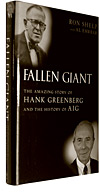 Maurice “Hank” Greenberg and American International Group Inc. (AIG), the company he ran for 37 years, were little known by anyone outside the insurance industry or Wall Street until March 2005, when Greenberg was asked by his board to resign after running afoul of Eliot Spitzer, at the time New York’s crusading attorney general. The spat that followed and the litigation that continues to this day have shined a bright light on the unusual history of the giant insurer AIG and the practices of its legendarily tough boss. In Fallen Giant: The Amazing Story of Hank Greenberg and the History of AIG, former AIG executive Ron Shelp teams up with business journalist Al Ehrbar to tell the tale.
AIG began its life in Shanghai in the 1920s as the brainchild of a gregarious serial entrepreneur, Cornelius Vander (C.V.) Starr. At that time, the city had been carved up into several foreign concessions that were magnets for entrepreneurs of all stripes and nationalities. Within 10 years, Starr had a team of multinational managers running insurance offices across East Asia. He owned two newspapers and was a major land speculator. The rough-and-tumble of business in China was to lay the foundation for a maverick corporate culture. This culture encouraged the exploitation of new opportunities via political connections and was penurious about costs, using a hardball approach to handling claims. Powerful political connections have always been a feature of AIG, and during World War II several of its executives had close ties to the OSS, the precursor of the CIA. The company’s origins and international sprawl also fostered an exceedingly complex corporate structure, the opacity of which would come back to haunt both Hank Greenberg and AIG.
Hank Greenberg’s career is a story of a rise from humble origins in a working-class Jewish family; in 1942, underage, he enlisted and became an Army ranger, landing on Omaha Beach on D-Day. After his military service, he studied as a lawyer before becoming an expert on accident and health insurance. When C.V. Starr offered him a job in 1960, he jumped at the chance. He soon proved his business acumen, and he was appointed CEO on Starr’s death in 1968. Under Greenberg’s leadership, AIG became an insurance powerhouse, making its shareholders and executives extraordinarily wealthy. Shelp, who joined the company in 1973, marveled at the way AIG used its clout with governments, both U.S. and foreign, to its advantage. His treatment of Greenberg’s legendary temper and imperial working style is sympathetic, and he argues that the man’s business achievements totally overshadow any personal foibles. In the post-Enron regulatory environment, however, the business style and practices that had propelled AIG and Hank Greenberg to the summit proved to be vulnerabilities, allowing Eliot Spitzer to play David to Greenberg’s Goliath. 
Reprint No. 07212
Author profile:
David K. Hurst (david@davidkhurst.com) is a contributing editor of strategy+business. His writing has also appeared in the Harvard Business Review, the Financial Times, and other leading business publications. Hurst is the author of Learning from the Links: Mastering Management Using Lessons from Golf (Free Press, 2002).
