
Design for Frugal Growth
With the right kind of organization, you can expand while cutting costs.
 |
|
Illustration by Dave Plunkert |
The control of costs had been its greatest strength. But it was now the greatest weakness. The company had spent so many years trying to reduce expenses that this imperative was hardwired into its practices, processes, and organizational design. When executives tried to shift gears, to expand into new markets and introduce new products, those old ways of doing business also had to change.
That was the story of the Amberville Corporation, a major U.S. brand-name consumer packaged goods (CPG) manufacturer. (This company is fictional, a composite of three companies; although all three have been disguised, the details are based on in-depth observation and are typical of many companies in the industry.) Like many other consumer products companies, Amberville had once been an avid innovator, responsible for many new household-name products. But its priorities had swung, like a pendulum, from growth in the 1980s to cost cutting in the 1990s. Now, in 2006, the pendulum was swinging back to growth.
But the company was ill-equipped for the transition. To keep costs down and control its large and far-flung product line, Amberville had built up a vast central operation at headquarters. New product launches had to be approved at four different levels: brand, division, region, and headquarters. Senior executives in functional areas were expected to weigh in at least twice during the development cycle on such issues as capital costs and feasibility. Managing the computer systems and functions to support dozens of brand-based and regional operations groups was an immense task involving hundreds of people and a major focus on HR systems, reporting relationships, and recruiting programs.
Meanwhile, consumers were growing increasingly sophisticated. They wanted more information about Amberville’s products. So did institutional customers, such as schools and restaurant chains. Some Amberville marketers saw the opportunity to build Web sites and use other online channels to connect directly with consumers. But these efforts faltered amid the sheer complexity of multiple product categories. And their failure led many people in the company to conclude that even the business units that were closest to Amberville customers had lost their market focus and speed.
There was other evidence that all was not well. For example, when the company expanded its branded line of ice cream, the unit was consistently slower than competitors in launching new flavors. Business unit leaders spent much of their time looking inward, negotiating with the executives at headquarters who made the final decisions about personnel, product launch timelines, and many other operational issues.
Amberville’s dilemma is typical of many consumer packaged goods companies in North America and Europe today. Their most familiar home markets are stagnant; for the past 20 years, consumption of consumer goods in most product categories has grown only at the rate of population growth plus inflation. And consumer behavior is fragmenting; supermarket shoppers are increasingly likely to switch stores and brands. At the same time, mergers and acquisitions among manufacturers have consolidated the industry, creating larger competitors with global reach. But new consumers in emerging nations — those in Asia, Latin America, eastern Europe, and the Middle East — are eager for products. Simultaneously, around the world, global retail chains like Tesco and Wal-Mart are applying their expertise at squeezing manufacturers’ margins.
As consumer packaged goods companies have struggled to create and execute growth strategies, investor expectations for the sector have remained high, and raiders continue to stalk the producers of popular brands. It’s no wonder that the industry has devoted its attention, for at least a generation, to reducing cost, streamlining operations and creating economies of scale by consolidating research, manufacturing, and distribution. This approach has paid off in the past; most CPG companies have survived. But now, having turned themselves, in effect, into supercharged cost-cutting machines, how can these companies suddenly invest in the risky arenas of emerging markets and fundamental innovation? And if they can’t, how will they compete when frugality alone is no longer sufficient?
Although the choice between growth and frugality is passionately debated in many companies, it represents a false dichotomy. Growth and cost efficiency should reinforce each other. Logically, cost efficiencies should make it easier to devote more resources to growth, and the launch of new products and services should lead to innovations in efficiency. Why don’t things work that way in practice? Often because of organizational designs that, consciously or not, were put in place during the years of cost cutting. A CPG company, in particular, cannot move forward unless its leaders can diagnose and fix the barriers to growth that have gradually become a fixture of their enterprise.
The Limits of Good Intentions
When leaders in the sector begin a growth initiative, they often start by declaring a commitment to the new strategy, enlisting employee hearts and minds, and assuming that some kind of cultural and behavioral transformation is needed. But they overlook the organizational design, which actually drives behaviors and indirectly determines whether the rest of the growth strategy can be executed correctly.
For example, in many large organizations, the way the incentives are set up frequently clashes with the growth strategy. The corporate leaders promote bold and big innovations. But they leave in place the target demanding that all new products show a profit within two years or face being shut down. This creates almost irresistible incentives for business unit leaders to provide “work-arounds” that make them appear to generate the requisite profits, at least in the short run. They might bury costs in the most successful product lines or manipulate shipping times so that the numbers will look more favorable.
At Amberville, the core demanded a major new commitment to customer service from the business units, and they all complied — but in a halfhearted way that faded from view within six months. It would be easy to say that the local business unit leaders were resistant to change, but the truth was much more complicated. These leaders saw the value of customer service, but they had neither control nor influence over the customer service process, they lacked easy and regular communication with the leaders of that function, and their incentives favored other priorities. It was much easier to focus on other ways to deliver the results against which they would be measured. All the goodwill and strategic understanding in the world could not overcome those organizational disabilities.
The leaders at Amberville did, however, ultimately change their behavior, and not just superficially. They revamped the organization in ways that dramatically increased revenues without increasing investment. We have seen the same sorts of results firsthand in several other consumer products manufacturers in recent years. One independent condiment company, after redesigning itself, doubled its value in less than five years. All of these manufacturers have initiated significant changes in their day-to-day practice through a shift in their organizational design — specifically, by setting in place five critical enablers of accountable, innovative, autonomous, and linked behavior. (See Exhibit 1.)
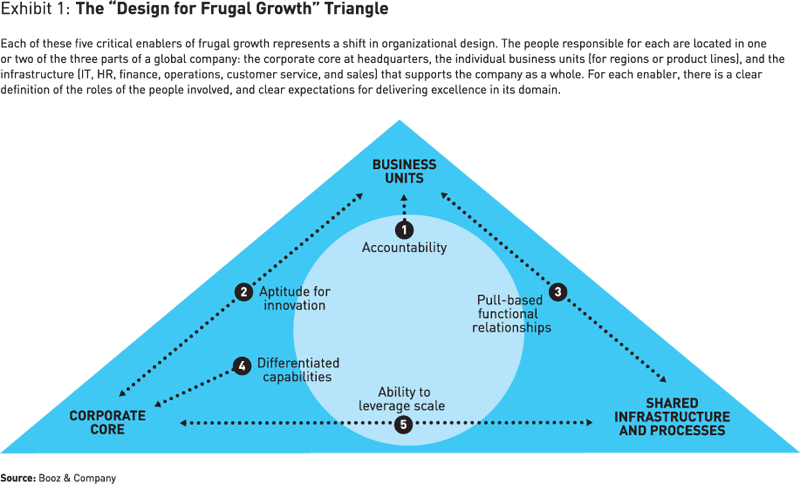
The list of enablers in the growth triangle will not be a surprise to many managerial veterans. These factors are known for their impact on growth in a variety of industries. Who could argue with having truly accountable business units, a genuine capacity for customer-focused innovation, functions that successfully serve the needs of the frontline business units, capabilities that meet the needs of a differentiated customer base, or the ability to take practices and products to scale around the world? But companies often struggle to achieve these enablers, and sometimes give up trying. With a substantial shift in organizational design, the behaviors and practices of frugal growth naturally follow.
Accountable Business Units
Just before its redesign, Amberville had 25 global divisions, all located in the company’s headquarters in the United States. Over the course of the following year, they were reconfigured into 64 market-facing business units — some devoted to regions such as southeast Asia, others to product brands in categories such as ice cream and chewing gum. Quadrupling the number of Amberville’s business units also meant quadrupling the number of business leaders, and giving each responsibility for his or her operations.
Businesspeople often talk about “owning” their assignment, but it’s not always clear what that means. At Amberville, “ownership” meant taking on a dramatically increased level of accountability. The managers of business units now defined their market, operations, and strategic space to decide how they would deliver superior growth. Business units were granted greater control over the cross-functional resources assigned to them, including the sales and customer service staff. Business unit managers could deploy these resources flexibly on the basis of shifts in market needs. Information technology staff were assigned to work with each business unit to help it obtain faster, more complete access to market and customer data.
Before the reorganization, the P&L-based budgets for marketing, R&D, sales, and other functions had been set by the core, and the business units had to operate within these limits. For example, if a business unit had received US$100 million for its R&D budget, that was the limit of its innovation spending. Now, each business unit leader had a top-line revenue and a bottom-line profit target. All the funds in between could be deployed as needed. If one product’s strategy depended heavily on innovation, the business unit leader could invest $150 million in R&D, taking the money from other functions. Meanwhile, a business unit whose strategy was based on operational excellence might cut back on R&D and invest instead in production skills.
Amberville’s core was now treating the business units the same way a heavily involved private equity investor might treat its favored companies. The business unit leaders rapidly learned firsthand what it was like to be an entrepreneur. They defined their strategy, they executed it, and they reaped personal rewards if they succeeded and suffered personal consequences if they failed to deliver their targets. Their own money wasn’t at risk, but their career advancement was, and they had fewer institutional means of masking poor performance. Business unit leaders came to think of their new system as “autonomy with boundaries”: They could accomplish much more on their own, but their limits and reporting responsibilities were clearer and less ambiguous than they had been before.
Meanwhile, the jobs of the division heads and core leaders shifted from operational involvement to guidance. They could approve requests for funds, help develop investment plans, give advice on the hiring of key players, and assist with customer relationship development. They did not have the authority to create strategies or manage operations, but their own careers were closely dependent on the success of the more junior business unit leaders. “It’s like being a football coach,” said one core leader. “You’re not directly playing, but you’re still responsible for the business. If your team loses three years in a row, you’ll still get fired.”
Amberville’s experience is typical. When business units — whether organized by geographic region or product and service category — are accountable for their strategy and operations, they deliver superior growth. They can execute their plans far more quickly, without having to wait for approval and second-guessing the internal politics of the core. They have more to gain from delivering results, and no place to hide when performance falls short. Decision rights go to those who have the closest understanding of consumers and the external market. Because accountable business unit leaders pay close attention to business practices, the learning curve of the entire operation accelerates. Indeed, the business unit becomes more skilled at reducing overhead than ever before, because its leaders know that they can rapidly apply their cost savings to profitable investments as they see fit. So much for cost and growth consciousness being at odds.
Providing this type of virtual entrepreneurship to business units requires several organizational shifts. The local line leaders need the authority to make decisions, the capabilities to take consumer information into account, and a sustained trust that the core will not block progress and will appreciate results. The IT and information-management systems are consciously designed to deliver the right information to the right parts of the organization at the right time. For example, extensive day-to-day data stays in the business unit; if it reached the corporate core, that would be an invitation to micromanage. But quarterly reports to the core include more detail than in the past, so that division heads and business unit leaders can talk about long-range patterns in customer response or costs.
One powerful means of creating autonomy with boundaries is the “CEO contract”: an agreement with the business unit leaders that specifies top- and bottom-line targets, along with the rewards (including personal bonuses) for achieving those targets and the penalties for missing them. The Amberville CEO contract was a very informal document, with three critical features. First, every business unit leader got one. Second, each contract was specifically designed for its business unit, spelling out particular goals for revenues, profit, and two or three other numerical metrics. Third, the contract specified the qualitative metrics that encouraged teaming across the organization.
This last feature of the CEO contract helped mitigate one unfortunate tendency of accountable business units: their natural disinclination to share ideas, knowledge, or resources with the rest of the company. For example, shared advertising expenses, particularly for major marketing events, had long been a bone of contention. Every business unit was expected to pay a share, but some divisions benefited far more than others. Now, thanks to the contract, it was made clear: There would be only a limited number of shared ad campaigns, but each division would contribute.
The contract also established a few minimum standards and policies that protected the corporation, such as employee safety practices. For example, many factories in emerging nations do not require people to wear safety goggles on the shop floor, but Amberville factories always did, because the performance contract insisted on it. In other respects — for example, in the details of plant construction and the design of the assembly line — the local business unit maintained control.
Aptitude for Innovation
In consumer products, the most profitable innovations vary widely by category. In food, for example, rapid introduction of new flavors can be critical. There are also opportunities for breakthrough innovation, as Groupe Danone discovered with its Activia yogurt line, which contains live bacteria with a claim of aiding digestion. More opportunities for breakthrough innovation exist in personal and home care, as Procter & Gamble Company has shown with products including the Swiffer mop and antiwrinkle creams. (See “P&G’s Innovation Culture,” by A.G. Lafley, s+b, Autumn 2008.)
But the most critical factor is the connection of innovation to consumer insight. The most effective way to facilitate this connection is with a change in the organizational relationship between the business units and the corporate core. The corporate core should be funded to conduct longer-range research that business units would not undertake (for example, the kind of fundamental research in biotics that led to the launch of Activia). Individual business units should develop the product extensions and process innovations that they need to stay close to their consumer markets. And some internal market-style mechanism should allow successful innovations to be quickly shared across the enterprise.
At Amberville, the R&D staff at the corporate core had traditionally worked on three- to five-year projects that they had proposed themselves. Business unit leaders had usually reacted by saying, in effect, “This has nothing to do with what we are trying to do.” Now, as part of the redesign, Amberville created an internal R&D market where innovation leaders sought buyers for their ideas. If they could not interest a business unit leader, they were free to take the idea outside the company.
Pull-based Functional Relationships
One aspect of organizational design that inhibits growth is the relationship between business units and functions. Although functions often operate in all three components of the organization — the core, the business units, and the infrastructure all have information technology, human resources, and finance staffs — the highest leverage lies in the relationship between business units and the infrastructure.
The way to increase the value of support services is through pull-based functional relationships. The business units pull services from the infrastructure, specifying their requirements and sometimes codesigning them, instead of having the services pushed on them in a company-wide package.
Pull-based functional relationships have existed for years. Many businesspeople still find the idea discomfiting; it means giving internal functions the autonomy to behave like a third-party provider. But a well-designed pull-based functional relationship becomes like the relationship between a loyal customer and a regular supplier. The supplier (the functional infrastructure team) cares about the customer’s opinion; the customer (the business unit leader) treats the functional staff as he or she would treat any favored external supplier, not like an internal team forced to jump through hoops. This level of mutual respect, when it occurs, is a far cry from the unfortunate dynamic in many companies, in which the business unit leaders and the functional infrastructure team tend to see each other as adversaries.
How can a company enable this type of relationship? One approach is to employ the same kind of service-level agreement (SLA) that companies use for shared services and outsourcing vendors. The trick is setting up the SLA internally and making it simple but effective. This contract establishes the types of services to be delivered, the internal cost of providing them (which can increase as the service improves), and the requirements for each side. At Amberville, SLAs are now required for all functional services, including logistics, finance, and IT. Any functional team, reporting through the infrastructure chain of command, effectively has a pool of 64 customers — the business units — and an incentive to learn from its services to each of them.
Differentiated Capabilities
No organization can be best at everything. The capabilities of a company are limited by the resources available, the skills of its population, the evolution of its existing infrastructure, and its experience. Choices must be made at the corporate core about the capabilities in which the organization will invest and the support to give them. The most important capabilities to invest in are those that distinguish a company from its competitors — or, as Alexander Kandybin and Surbhee Grover put it, those that can’t be copied. (See “The Unique Advantage,” s+b, Autumn 2008.)
One well-known example of a differentiated advantage is the “hot-fill” capability that PepsiCo Inc. gained in 2001 when it merged with the Quaker Oats Company (and thus acquired the Gatorade brand). Hot-fill technology, used to bottle beverages such as juices and vitamin drinks without the need for preservatives, had previously been limited to relatively small brands such as Snapple (which had invented it); now Pepsi rolled out the technology in its Tropicana brand and in a new joint venture in bottled teas with Lipton, which was the first offering of its kind and which has since enjoyed an advantage over competitors.
A portfolio of capabilities is built primarily at the corporate core, because it involves significant long-term investment. (As with Pepsi, it may also involve acquisition.) The first step is a systematic evaluation of the “leverageable” assets of the company, those distinctive capabilities that determine what types of growth might be supported. Capabilities can be found in a wide range of functions, such as supply chain, manufacturing, product development, consumer insight, marketing, brand management, and customer management. Business units may be invited to collaborate in this assessment, making the case for the capabilities that they find most useful in the market. But ultimately, the corporate core makes these choices and investments.
The difficulty of this task and the critical role of the core executive team are often underestimated. Not every capability is a candidate for the core portfolio; some contribute strongly to growth while others lag. Corporate leaders must place bets on which business units will be most adept at using, learning from, and developing the company’s distinctive skills and technologies. These business units need aggressive funding; others should be more consciously managed for the bottom line, with a short-term focus on innovation.
Ability to Leverage Scale
As consumer products companies meet global demand, they bring capabilities along. Products and brands must be customized for new markets. A wide variety of retailers must be engaged as customers. And old practices must be adapted to new cultures and locales.
Leveraging of knowledge and capabilities on this global scale requires direct networking among business units, removing the bottleneck at the corporate core. Because Amberville had never built up those sorts of contacts, its leaders studied companies, like Johnson & Johnson, that had a good track record. J&J moves people among its business units frequently, encouraging employees to maintain their presence in informal networks with their former coworkers.
Amberville is now finding its own ways to foster global networking. For example, its Middle East business unit leads research and development in the frozen-drinks category, because several frozen-drink researchers are located there; the rest of the regions adapt the flavors that come out of their work.
Management fashion is full of stark choices: Centralize or decentralize? Global or local? Cost or growth? There’s a long-standing proverb in the system dynamics field: “You can have everything you want, but not all at once.” In the 1990s, many consumer products companies decided that they would give up growth in order to have the security of lower expenses. Now they are riding the pendulum back to growth. But in the end, those who succeed in growing their company will do so with all their frugality intact. With an organization design in place that balances the roles of the core, the business units, and the functional infrastructure, they should be able to have it all.
Reprint No. 08305
Author profiles:
Jaya Pandrangi is a principal with Booz & Company in Cleveland. Her work focuses on strategy as well as sales and marketing effectiveness for consumer products companies.
Steffen Lauster is a partner with Booz & Company in Cleveland who focuses on strategy development and revenue management initiatives for consumer products clients in the U.S. and Europe.
Gary L. Neilson is a senior partner with Booz & Company in Chicago. He helps companies diagnose and solve problems associated with strategy implementation, organizational effectiveness, and efficiency.
Also contributing to this article was Booz & Company Partner Leslie Moeller.