
How to Win by Changing the Game
Investing in a capabilities-driven strategy will equip your company for growth in uncertain times.
 |
|
Illustration by Lars Leetaru
|
The Wm. Wrigley Jr. Company stuck to its gums for more than a century. The company, founded in 1891, specialized in chewing gum; it did not branch out into mints, candies, or breath strips until 1999. Over the years, Wrigley built up its core capabilities in a way that few other companies could match: It focused innovation on new flavors and developed a consistent ability to influence retailers to display its products prominently on the candy racks. Thus, by the early 1980s, Wrigley had achieved operating margins twice those of competitors more than 15 times its size. This was quite an accomplishment, especially in an industry (consumer packaged goods) that has historically relied on scale, in both manufacturing and marketing, for its profitability.
Wrigley, in effect, was one of the few consumer packaged goods enterprises that prospered on its own terms, instead of adapting its plans to mimic its competitors. This paid off handsomely for the company’s shareholders in April 2008, when chocolate giant Mars Inc. swept in with a rich US$23 billion all-cash offer. So irresistible was the lure of this deal that investing sage Warren Buffett committed $4.4 billion of the purchase price and a further $2.1 billion to purchase a stake in the Wrigley division.
THE STRATEGY+BUSINESS COLLECTION: THE EXECUTIVE GUIDE TO STRATEGY
 This article is featured in the strategy+business compendium “The Executive Guide to Strategy,” designed exclusively for smartphones and tablets. The collection features our best thinking on creating and implementing the right strategy for your organization—with insights from top leaders including Capable Strategist author Ken Favaro, HBS Professor Cynthia Montgomery, strategy expert Ram Charan, and Kellogg School’s Mohanbir Sawhney.
To download, select your device:





The key to Wrigley’s enviable position was not its single line of products — there are many single-category companies that are less successful — but rather its distinctive capabilities. One bit of evidence for this was Mars’s decision to leave Wrigley as a stand-alone business after the deal, indicating that the acquisition was motivated primarily by the leverage that capabilities can offer. Mars knows chocolate and candy. Wrigley knows gums and candy. Together, the combined company knows how to launch and market confectionary products. Mars then transferred its nonchocolate brands, Starburst and Skittles, to Wrigley’s portfolio to consolidate and leverage these differentiating capabilities. Mars CEO Paul Michaels summed it up best when he said the deal was “not about being bigger — it’s about being the best.”
When most corporate leaders hear about using capabilities as a strategic advantage, they tend to think internally. They assume that building capabilities is a job for their human resources, training, or R&D departments. Or they squander their efforts on a variety of unrelated skill- and technology-building initiatives that don’t fit well together and don’t address the real needs of customers or reflect the company’s overall direction. By contrast, the Wrigley story — and similar examples in financial services, automobiles, transportation, health care, and many other industries — suggests that an effective capabilities-driven strategy is outward-looking. It starts and ends with customers. It involves building up a portfolio of ideas, skills, and competencies that, when put together, enable the company to consistently attract its primary customers.
A portfolio of capabilities might include intellectual capital — ideas, patents, products, and distinctive practices — but those elements are not enough. Patents expire. Premium products become commoditized. However, a distinctive combination of skills, tools, or processes, deployed in day-to-day business, will tend to get better over time, at a pace that prevents competitors from catching up. Wal-Mart’s supply management prowess, Southwest Airlines’ asset utilization expertise, Toyota’s mastery of the automotive production system, and Procter & Gamble’s ability to leverage innovation across product categories have all benefited from continuous improvement. Honed and strengthened over years (or sometimes decades), these focused bundles of capabilities confer and support a “right to win” in their companies’ respective industries.
A true capabilities-driven strategy is the most reliable way for a company to thrive when the rules of the game for its industry are in flux. Instead of looking inward at the capabilities you already have and trying to discern your strengths, start by looking outward at the capabilities you need. What must you be able to do to reach the customers you fundamentally want to attract? By designing a portfolio of skills and tools needed to win customers, you can end up changing the game instead of playing by the rules.
The Case for Capabilities
As we write this article, in October 2008, much of the global financial-services industry is in crisis, and it is not clear how wide or deep the economic fallout will be. At the same time, many economic fundamentals remain unchanged. Emerging markets are still growing; an enormous amount of financial capital is still looking for investment vehicles; and productivity in many parts of the world continues to increase. Some industries, such as energy and heavy construction, are doing very well right now; even in the most “difficult” industries, such as manufacturing and financial services, some companies are thriving even as others collapse.
As the crisis unfolds, it is becoming more important to distinguish the companies that are managed effectively from those that have just managed to get by in good times. Those that seem positioned to win — P&G, Toyota, Wal-Mart, and Southwest, along with other well-regarded companies — have spent the past years explicitly building up a coherent portfolio of capabilities as the center of their strategy. When situated in a well-designed portfolio, capabilities naturally drive value for a company; they also drive decisions about mergers, acquisitions, high-level executive talent, divestitures, alliances, and other strategic concerns.
Capabilities have been ignored by many companies over the years, because many leaders don’t have experience in building them and because they are often regarded as nonessential. Strategies based on scale used to be sufficient in most operations-oriented enterprises. As a senior executive, if you gained enough heft in your industry (through aggressive M&A or cost cutting to drop prices), you could capitalize on economies of scale that ensured both production efficiencies and market clout. Leverage over retailers gave you better access to customers; leverage over advertising agencies gave you enhanced access to marketing media; and a larger amount of innovation investment gave you (or so it seemed) a greater likelihood of developing breakthrough products.
But the ability to establish competitive differentiation through scale has begun to erode. The rise of outsourcing and offshoring, along with more sophisticated telecommunications and the use of strategic alliances, allows smaller and newer firms to punch beyond their weight, competing with larger or more established companies. In marketing, one-on-one customer processes and more differentiated digital media have similarly leveled the playing field. And in many larger companies, economies of scale are often undermined by higher overhead costs or entrenched bureaucracy.
There’s no such thing as free capabilities; they require concerted investment. But they become far more cost-effective when they help corporate leaders decide where to expand and where to cut back. For example, Honda Motor Company has built much of its profitable growth around expertise in designing and manufacturing small high-performance engines. From motorcycles and lawn mowers, the company moved up to automobiles and light sport-utility vehicles. But it has drawn the line at larger V-8 engines that it believes lie outside its core business. “We kept asking ourselves what value Honda would bring to the customer [in] that category [of engine]. There was just no benefit for us,” noted Dan Bonawitz, head of corporate planning in the United States, in an August 2008 New York Times article.
As a result of this focus, combined with the public’s increasing demand for fuel efficiency, Honda has emerged as the only car company to register sales gains in the U.S. in 2008. Through the first seven months of the year, Honda’s revenues were up 3 percent in a market that had fallen 11 percent. In addition, whereas its American counterparts have hemorrhaged billions of dollars, Honda’s bottom line has never been stronger; it reported record profits of nearly $1.7 billion during the first quarter of FY08.
Portfolio Coherence
Will a capabilities-driven strategy yield similar results for any company? That depends on many factors — and the largest is probably the coherence of the company’s capabilities portfolio. Many corporations maintain a portfolio of complementary businesses. But few understand how to build a portfolio of mutually reinforcing capabilities that cross business unit lines, and that distinguish the company as a whole.
Kimberly-Clark Corporation’s customer immersion and design center represents one leading-edge example. Retailers visiting the center can walk into a virtual version of their store and interact with products on the shelf just as consumers would. Using 3-D virtual-reality technologies, Kimberly-Clark can mock up a typical Target store, for instance, complete with the red bull’s-eye logo and signage, and experiment with different merchandising, assortment, pricing, shelving, and execution options. The center allows all consumer-oriented Kimberly-Clark business units and product lines, including diapers, paper towels, and feminine care products, to benefit from its capabilities in retail-based consumer insight. Staffers can learn directly from retail customers and thus improve many subtle but high-leverage aspects of product innovation and marketing: design and packaging, in-store locations and displays, product differentiation, and more. Other parts of the company also benefit; for example, as Information Week reported in September 2007, Kimberly-Clark’s internal R&D staff bring in their specs and watch the products they are building come to life.
Other companies that build coherent portfolios of capabilities enjoy similar advantages. Procter & Gamble’s “open innovation” program, Connect + Develop, allows the company to exploit the product, packaging, and cost innovation capabilities of external firms along with its own — and the program coherently fits with its human capital and expansion strategies. (See “P&G’s Innovation Culture,” by A.G. Lafley, with Ram Charan, s+b, Autumn 2008.) Unilever’s distribution network incorporates its strong global supply chain capabilities in the developing world, where, according to the Economist in January 2008, the company generates 44 percent of its annual revenues.
Building a portfolio of an enduring, unified set of capabilities means making a variety of decisions — including those regarding acquisitions, divestitures, human capital investments, recruiting, IT and other technologies, and alliances — in terms of how well they fit with the company’s other efforts to expand its skill and prowess. If those decisions are managed well, then a portfolio coherence strategy need not result in a substantial increase in a company’s overall investment. In fact, it can be a major source of cost savings, because it eliminates investments that do not help position the company for long-term advantage.
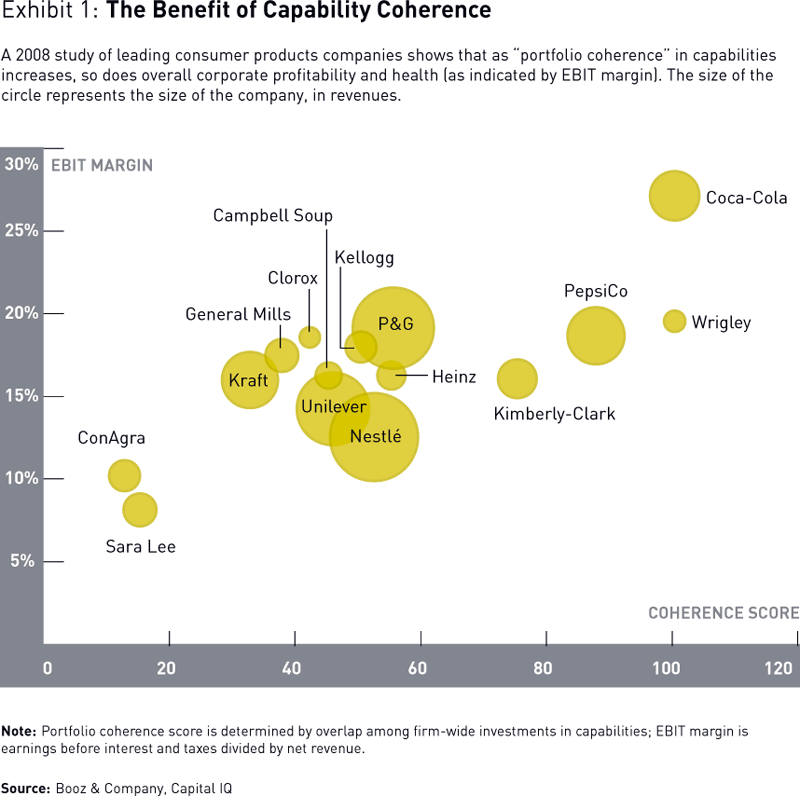
Perhaps that’s why research suggests that companies that have defined and leveraged their capability coherence typically enjoy higher operating margins. That correlation, at least, held true in a recent Booz & Company study of consumer packaged goods companies. (See Exhibit 1.) The clear relationship between portfolio coherence and operating margin performance — regardless of revenues — suggests that capability coherence will increasingly drive corporate strategy over the next five to 10 years.
Identify, Build, Divest
How, then, do you institute a capabilities-driven portfolio? You articulate those capabilities that could help you succeed in your key markets, and then deliberately allocate the bulk of your support to them. Your thinking might unfold through a step-by-step process.
• Identify the capabilities you need to build. Start by identifying the drivers of demand in your market — those that will most help you deliver the products and services that people need and want. How engaged are the customers of this category? How diverse are the product or service segments? How large is the potential market, and what is its core interest? For a basic food staple like milk or bread, for example — a highly commoditized product with relatively low consumer engagement — investing in small-scale innovation capabilities will not generate enough returns, but retail placement capabilities could. So could significant innovation capabilities that could break the commodity barrier.
Wrigley has long understood that adults and children respond to different flavors, but the ability to innovate in particular domains (such as sugar-free gum or the use of candy coatings) is important to both audiences. Wrigley wisely built up that capability to meet its customers’ demands. So did Jeep. This division of Chrysler LLC, with highly engaged customers who understand a lot about the special qualities of its vehicles, has kept up its innovation in off-road travel. No matter what other features Jeep offers, every car must be Rubicon Trail–rated: that is, capable of navigating a well-known and difficult off-road vehicle trail near Lake Tahoe, Calif.
Sometimes lack of market demand makes a capability less valuable. Disposable-diaper manufacturers in some emerging countries built their capabilities for low-cost production and product expansion, hoping to lower the price of diapers and thus expand their markets. But gradually they discovered that, for most diaper-purchasing parents, it was cheaper to hire someone to clean up the baby’s messes than to buy a disposable diaper at any price.
Once you have articulated your highest-potential markets, identify the few enterprise-wide capabilities that could, in combination, enable you to satisfy customers in all your key businesses. Focus on capabilities that would characterize your entire company, not just one business unit. General Electric Company, for example, is best known for its approach to leadership development and Six Sigma, not for its approach to turbine manufacturing or television scheduling. Spell out the ways in which these capabilities would distinguish your company. Don’t simply say that you want to develop more innovation or channel expansion capabilities; stipulate precisely what tools or processes will enable superior performance.
On the innovation front, for instance, is your objective to unleash rapid innovation in product attributes (such as food flavors, automobile cupholders, and credit card benefits)? Do you hope to establish more fundamental technological innovation, to lead the next wave of telecommunications or industrial manufacturing? Or are you seeking business model innovation — new ways of cooking, driving, spending — that will influence how customers fundamentally use your product?
Most likely, you already have some of the capabilities you need; otherwise, you wouldn’t be in business. But you are probably not deploying them effectively in every part of your organization, and there are probably other natural opportunities that you are overlooking. For example, if you have a highly skilled procurement and outsourcing function, this might help you begin developing an overseas innovation footprint. (See “Beyond Borders: The Global Innovation 1000,” by Barry Jaruzelski and Kevin Dehoff, s+b, Winter 2008.)
In the early 2000s, leaders in Pfizer Inc.’s consumer health-care unit engaged in the exercise of capabilities identification. At the time, the unit was the producer of Listerine, Nicorette, and several other household-name brands, but it did not have the kind of growth that these brands would suggest. The leaders undertook a capabilities-driven strategy, focused on combining capabilities for clinical testing with deep consumer insight. This allowed them to make the kind of differentiated product claims that would matter most to their customers. For example, Pfizer advertised that Listerine, when added to brushing and flossing, reduced plaque. Backed up by innovations that in turn had been made possible by investments in R&D capability, this approach brought Listerine (and several other Pfizer products) to large new groups of customers.
Other parts of the company were also guided by this capabilities-driven strategy. For example, professional recommendations often play an important part in consumers’ decisions about over-the-counter products. Pfizer used its scientifically backed claims to gain professional support to include in consumer marketing campaigns. This pursuit also meant developing a capability to license some of its products to health-care practitioners around the world, rapidly screening and prioritizing candidates on the basis of both commercial and technological considerations.
The strategy was dramatically successful. Business expanded fivefold in five years; then, in 2006, Pfizer’s consumer health-care unit was sold to Johnson & Johnson for $16.6 billion (more than 20 times earnings).
• Fill in the gaps. The second step in the process of instituting a capabilities-driven portfolio is to focus on the product development investments and business acquisitions that would give you the capabilities you need most, while complementing the capabilities you already have. Along the way, increase your own capacity to learn and execute.
In the financial-services arena, Bank of America Corporation has spent years building up a massive, omnipresent retail banking footprint throughout the country. Now that it has an extensive capability for attracting retail customers, it is developing a complementary ability to create new financial-services products for them. In 2005, Bank of America acquired MBNA, making it one of the world’s largest credit card issuers; in the summer of 2008, it stepped in to purchase Countrywide Financial (the largest originator and servicer of housing loans in the U.S.); and in September, it agreed to purchase Merrill Lynch & Company (probably the major investment bank most known for promoting its services to “mass affluent” consumers). The latter two acquisitions were made as a response to the financial crisis, but both were wholly consistent with the bank’s focus on consumer banking capabilities. Indeed, in his early statements about the Merrill Lynch purchase, Bank of America CEO Kenneth D. Lewis indicated that Bank of America was most interested in gaining retail brokerage capabilities.
In our experience, those companies that do not build a portfolio of complementary, reinforcing capabilities often lose to those companies that do. Accordingly, Bank of America beat analysts’ forecasts for the second quarter of 2008 and announced that Countrywide was expected to turn a profit for the year. (Few banks could have achieved the same synergy with Countrywide, because they would not have built up the same prowess at retail banking.) On July 22, 2008, Lewis was quoted in the New York Times as saying, “We are actually having great success in the marketplace given that others are so inwardly focused.”
• Divest businesses that don’t fit. This final step in building a capabilities-driven strategy is where you save money. Streamline or sell those businesses that do not exploit or further the development of your highest-priority capabilities. The challenge for most management teams is marshaling the confidence to focus — to disproportionately invest in the few capability areas that make a difference, rather than spreading your selling, general, and administrative expenses across all possible bets.
Most of the companies mentioned in this article have visibly (and sometimes painfully) let go of businesses that did not fit their capabilities portfolio. Bank of America’s retrenchment from its institutional businesses provides one example. In 2008, the bank sold its prime brokerage operations on the heels of extensive layoffs in its investment banking operations. P&G has similarly been selling its food businesses — Sunny Delight, Jif, and, most recently, Folgers — as it focuses its portfolio on health and beauty and consumer health care, where it has built distinctive innovation capabilities that are not applicable to the food categories.
Thinking outside the Cave
As many senior executives will confirm, this focus on capabilities is easy to write about but surprisingly difficult to execute, especially in highly turbulent times. But the alternative is worse. This is not the time to find a cave and hibernate until the economic storm passes — for it’s unlikely the storm will pass anytime soon, and a capabilities-driven strategy is the only way to remain equipped for perpetually stormy weather.
Take care to build those capabilities you genuinely need, rather than those that do not serve your customers — even if some of the latter feel important or mattered in the past. Remember that capabilities do not manifest themselves overnight; they take time to grow. That’s why foresight — particularly the ability to anticipate future industry dynamics and customer needs — is so crucial.
As you look for ways to foster growth, consider every move through the lens of your ultimate aspiration: your ability to thrive by consistently attracting customers. To achieve that goal in today’s global business environment, it’s not only what you do that matters — it’s how well you are equipped for it. 
Reprint No. 08401
Cesare Mainardi is the managing director of Booz & Company’s North American business and a member of the firm’s executive committee. He works with companies in the consumer products industry to help them achieve major business transformations.
Paul Leinwand is a partner with Booz & Company based in Chicago. His primary area of focus is developing strategy and growth programs in the consumer packaged goods and retail sectors. He chairs the firm’s marketing advisory council.
Steffen Lauster is a partner with Booz & Company in Cleveland who focuses on strategy development and revenue management initiatives for consumer products clients in the U.S. and Europe.
Also contributing to this article were Booz & Company Partners Leslie Moeller and J. Neely, Principals Jaya Pandrangi and Juan Carlos Webster, and Consulting Editor Tara Owen.