
Books in Brief - Spring 2009
Fixing the mortgage meltdown, mastering disruptive change, inculcating a sense of urgency, and exploring drama at the Economist.
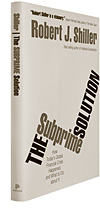
(originally published by Booz & Company)The Subprime Solution: How Today’s Global Financial Crisis Happened, and What to Do about It By Robert J. Shiller Princeton University Press, 2008, 208 pages
After a brief review of the history of U.S. housing policy, Shiller contrasts the comprehensive measures taken in the early 1930s to stabilize that decade’s collapse in the housing market with what he calls the “ad hoc, band-aid” remedies administered since the current collapse began in the fall of 2007. He suggests three goals for any lasting solution to the problem: improving the financial information infrastructure; extending the scope of financial markets to cover a wider array of risks; and creating retail financial instruments such as “continuous-workout mortgages” and home-equity insurance to provide greater security to consumers. He outlines several ways of accomplishing these goals and reinforcing the social contract — the implied agreement that a society will protect its members from major misfortune. His contribution to the first goal has been to assemble data on the long-term performance of U.S. house prices, something that had not been available before. It reveals that between 1997 and 2006 real house prices (i.e., net of inflation) grew by a staggering 85 percent. They will fall — it seems certain — for some time.
The Subprime Solution was perfectly timed to capture the demand for explanations of the housing market turmoil in 2007 and the first three quarters of 2008. But it was too early to cover the dramatic events of October 2008 and the much larger global crisis that followed. The author’s views, however, do presage what was to come. No doubt he is already working on a sequel, which will command a deservedly large readership.
|

 Shiller is a disciple of the prospect theory of Daniel Kahneman and Amos Tversky and the field of behavioral economics that it has spawned. (See “
The Innovator’s Guide to Growth: Putting Disruptive Innovation to Work By By Scott D. Anthony, Mark W. Johnson, Joseph V. Sinfield, and Elizabeth J. Altman Harvard Business Press, 2008, 320 pages
The great attraction of disruptive innovation theory is not only its basis in solidresearch, but also the compelling reasons it provides for the failures of large,successful organizations to innovate and to protect themselves from disruptive attacks launched by much smaller competitors. Management complacency and incompetence, the perennial reasons given for this failure, are not a sufficient explanation. Clayton Christensen showed how energetic, competent managers can be led astray by following the best management advice and paying too much attention to their customers. The result is incremental innovation and, as companies attempt to go up-market to produce higher-margin products, a tendency to “overshoot” customer needs, opening the door for new competitors to take away market share by making cheaper, cruder products that are “good enough.” The Innovator’s Guide to Growth is a model of clarity, presented in four sections: identifying opportunities, formulating and shaping ideas, building the business, and building capabilities. Chapters are devoted to each of the components of these topics. Opportunities, for example, come from identifying non-consumers — potential customers whose demands have been overshot by the product — and from studying the real needs that those people want the product or service to fulfill. Each of the book’s sections contains clues to a disruptive product offering that might meet a hitherto unfilled need. The book includes useful questionnaires, and each chapter concludes with a summary, application exercises, and a list of “tips and tricks.” And yet, although one can’t disagree with anything the book says, it lacks the sense of excitement and discovery of three predecessor volumes that Christensen coauthored with colleagues. Why should this be? In part it’s because the advice is aimed at as broad a readership as possible, and is designed to be context free. This, in turn, affects the language used. English philosopher Gilbert Ryle made a distinction between what he called task or action verbs and achievement or success verbs. Kick and hunt are task verbs (they refer to doing something); score and find are their achievement counterparts (they refer to goals, desirable outcomes). The Innovator’s Guide to Growth is packed with achievement verbs — identify, develop, formulate, build, master — that sound admirable but offer no clue as to how to accomplish them in specific contexts. This problem is endemic to management handbooks and reflects the limitations of the how-to genre more than any particular shortcomings on the part of the authors.
|
 Leadership and innovation have been the most popular management topics in academic research and business media over the past few years, and Harvard Business School Professor Clayton Christensen’s theories of disruptive innovation have been the hottest ideas in this hot area. Now, with The Innovator’s Guide to Growth: Putting Disruptive Innovation to Work, a team of two consultants, an academic, and a business practitioner have produced a handbook — with a foreword by Christensen — that extends the theories to show how an established organization can grow through disruption. Scott D. Anthony and Mark W. Johnson are president and chairman/cofounder, respectively, of Innosight, a consulting company formed by Christensen and his associates to promote the concept. Joseph V. Sinfield is a senior partner of Innosight, as well as an assistant professor of civil engineering at Purdue University, and Elizabeth J. Altman is vice president of strategy and business development for Motorola Mobile Devices.
A Sense of Urgency By John P. Kotter Harvard Business Press, 2008, 208 pages
In A Sense of Urgency, Kotter expands on an idea from his 2002 book, The Heart of Change: Real-Life Stories of How People Change Their Organizations. He argues that only a true sense of urgency can replace the complacency that pervades most organizations. This true urgency is one that energizes people with a “powerful desire to move and win, now.” Kotter outlines one strategy and four tactics for creating such an attitude. The strategy is to focus relentlessly on external issues and actions, to make progress every day, and to purge low-value activities, focusing on people’s hearts rather than their minds. The first of the four tactics is to “bring the outside in,” by using emotionally compelling means to dramatize what is happening in the external world; the second is to personally behave with urgency every day; the third is to find opportunities in crisis; and the fourth is to deal with the “NoNos” — people who continually downplay the need for urgency. The strategy and tactics for creating urgency are well illustrated by stories and cases in a book that has been designed for light reading. Yet it is disappointing to once again see “complacency” raised to the status of a root cause of ineffectual change efforts. Like the charges of “greed and corruption” on Wall Street, “complacency” is an emotionally satisfying accusation, but hardly the best starting point for the search for complex causes and their remedies. People become complacent for many reasons, including experiencing contextual constraints and social incentives that maintain their behavior. Until we understand and address these constraints and the social determinants of behavior, complacency will always be with us.
|
 In a time of global economic crisis, it might seem superfluous to read a book about the importance of a sense of urgency in organizational change. But John P. Kotter, the Konosuke Matsushita Professor of Leadership Emeritus at Harvard Business School, would argue that such current events have a tendency to promote what he calls a false sense of urgency. This condition compels people who are “anxious, angry, and frustrated” to indulge in frenetic activity that includes nonstop meetings and wall-to-wall PowerPoint presentations, but the same people are often focused on myriad internal issues that work at cross-purposes.
Inside Project Red Stripe: Incubating Innovation and Teamwork at the Economist By Andrew Carey Triarchy Press, 2008, 232 pages
The new book by author and publisher Andrew Carey, Inside Project Red Stripe: Incubating Innovation and Teamwork at the Economist, has close connections to theater. The project was launched in 2006 to develop and bring to market innovative Web-based ventures. The opening listing of the members (there are six) is presented under the heading “Dramatis Personae.” After the cast list comes an injunction on how not to read the book. The author’s role, he explains, was akin to that of a modern anthropologist who, unable to pass judgment on the behaviors of other people, could only record what he saw and felt while living among them. The resulting work is a book about books — a meta-book. Lacking a chronological narrative, the work is not designed to be read sequentially. Indeed, its nonlinear format pushes the reader toward the free online version. This Web site offers an interactive, gamelike process of leaps and recursions, zooming in and zooming out. You can’t exactly choose your own adventure in Project Red Stripe, but you can choose how to structure the experience of the inherently messy, pulsing nature of the creative process in which the medium mimics the message. The book itself is a series of reflections on the innovation process that highlights the limitations of the conventional, paint-by-numbers, management-by-proverb, “how-to” approach of most management books — especially when dealing with a story such as this one, in which the team is tasked with exploring ideas in the universe of Web 2.0/3.0. There are few answers here but lots of good questions. They are expressed in the form of dilemmas at the end of each section, underlining the fact that management decisions are highly contextual, and that what you choose to do will depend upon the situation you are in. Many of these decisions look like trade-offs; more of one side leads to less of the other. What one is really looking for, of course, is creative integrations, where both sides are reconciled in the form of both…and, rather than compromised by either…or. When Six Characters in Search of an Author was first performed in Rome in 1921, it got a decidedly mixed reception, with cries of “madhouse” from the audience. Today it is hailed as a pioneering classic. Inside Project Red Stripe will surely experience the same initial response. The project itself was widely regarded as a failure; the team came up with a Facebook-like social networking site for charitable organizations, but there was no clear way to make money out of it. Most readers (and every innovation expert) will have his or her own take on the reasons for the failure. But readers’ responses to this work may be a litmus test for their own ability to live with the frustration and uncertainty of the creative process. After all, failure is the norm in life, but failure in the short term often lays the groundwork for success in the long run. It is the archetypal structure of some of our favorite narratives: Success comes through failure. Any entrepreneur will confirm this. (Just ask Thomas Edison.) The complete story of the six characters on this team and their project cannot be written — yet. A glorious failure in fact may become a future classic in its telling. Reprint No. 09111 Author profile:
David K. Hurst is a contributing editor at strategy+business. His writing has also appeared in the Harvard Business Review, the Financial Times, and other leading business publications. Hurst is the author of Crisis and Renewal: Meeting the Challenge of Organizational Change (Harvard Business School Press, 2002). |