Managing with the Brain in Mind
Neuroscience research is revealing the social nature of the high-performance workplace.
Illustration by Leigh Wells
Naomi Eisenberger, a leading social neuroscience researcher at the University of California at Los Angeles (UCLA), wanted to understand what goes on in the brain when people feel rejected by others. She designed an experiment in which volunteers played a computer game called Cyberball while having their brains scanned by a functional magnetic resonance imaging (fMRI) machine. Cyberball hearkens back to the nastiness of the school playground. “People thought they were playing a ball-tossing game over the Internet with two other people,” Eisenberger explains. “They could see an avatar that represented themselves, and avatars [ostensibly] for two other people. Then, about halfway through this game of catch among the three of them, the subjects stopped receiving the ball and the two other supposed players threw the ball only to each other.” Even after they learned that no other human players were involved, the game players spoke of feeling angry, snubbed, or judged, as if the other avatars excluded them because they didn’t like something about them.
The strategy+business Collection: Don’t Blame Your Culture
 This article is featured in the strategy+business app “Don’t Blame Your Culture,” available for smartphone and tablet devices. The app pulls together s+b’s best writing on organizational culture and change, featuring Jon Katzenbach, TV chef Jamie Oliver, former P&G CEO A.G. Lafley, and more, explaining why companies resist wholesale change, and how to make the most of the culture you have.
To download, select your device:




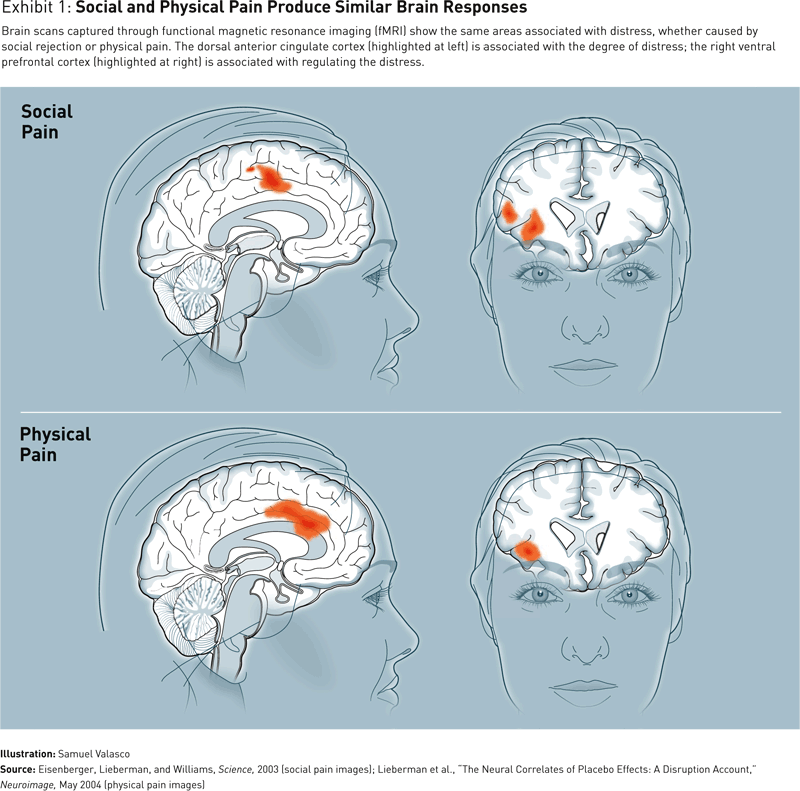
This reaction could be traced directly to the brain’s responses. “When people felt excluded,” says Eisenberger, “we saw activity in the dorsal portion of the anterior cingulate cortex — the neural region involved in the distressing component of pain, or what is sometimes referred to as the ‘suffering’ component of pain. Those people who felt the most rejected had the highest levels of activity in this region.” In other words, the feeling of being excluded provoked the same sort of reaction in the brain that physical pain might cause. (See Exhibit 1.)
Eisenberger’s fellow researcher Matthew Lieberman, also of UCLA, hypothesizes that human beings evolved this link between social connection and physical discomfort within the brain “because, to a mammal, being socially connected to caregivers is necessary for survival.” This study and many others now emerging have made one thing clear: The human brain is a social organ. Its physiological and neurological reactions are directly and profoundly shaped by social interaction. Indeed, as Lieberman puts it, “Most processes operating in the background when your brain is at rest are involved in thinking about other people and yourself.”
This presents enormous challenges to managers. Although a job is often regarded as a purely economic transaction, in which people exchange their labor for financial compensation, the brain experiences the workplace first and foremost as a social system. Like the experiment participants whose avatars were left out of the game, people who feel betrayed or unrecognized at work — for example, when they are reprimanded, given an assignment that seems unworthy, or told to take a pay cut — experience it as a neural impulse, as powerful and painful as a blow to the head. Most people who work in companies learn to rationalize or temper their reactions; they “suck it up,” as the common parlance puts it. But they also limit their commitment and engagement. They become purely transactional employees, reluctant to give more of themselves to the company, because the social context stands in their way.
Leaders who understand this dynamic can more effectively engage their employees’ best talents, support collaborative teams, and create an environment that fosters productive change. Indeed, the ability to intentionally address the social brain in the service of optimal performance will be a distinguishing leadership capability in the years ahead.
Triggering the Threat Response
One critical thread of research on the social brain starts with the “threat and reward” response, a neurological mechanism that governs a great deal of human behavior. When you encounter something unexpected — a shadow seen from the corner of your eye or a new colleague moving into the office next door — the limbic system (a relatively primitive part of the brain, common to many animals) is aroused. Neuroscientist Evian Gordon refers to this as the “minimize danger, maximize reward” response; he calls it “the fundamental organizing principle of the brain.” Neurons are activated and hormones are released as you seek to learn whether this new entity represents a chance for reward or a potential danger. If the perception is danger, then the response becomes a pure threat response — also known as the fight or flight response, the avoid response, and, in its extreme form, the amygdala hijack, named for a part of the limbic system that can be aroused rapidly and in an emotionally overwhelming way.
Recently, researchers have documented that the threat response is often triggered in social situations, and it tends to be more intense and longer-lasting than the reward response. Data gathered through measures of brain activity — by using fMRI and electroencephalograph (EEG) machines or by gauging hormonal secretions — suggests that the same neural responses that drive us toward food or away from predators are triggered by our perception of the way we are treated by other people. These findings are reframing the prevailing view of the role that social drivers play in influencing how humans behave. Matthew Lieberman notes that Abraham Maslow’s “hierarchy of needs” theory may have been wrong in this respect. Maslow proposed that humans tend to satisfy their needs in sequence, starting with physical survival and moving up the ladder toward self-actualization at the top. In this hierarchy, social needs sit in the middle. But many studies now show that the brain equates social needs with survival; for example, being hungry and being ostracized activate similar neural responses.
The threat response is both mentally taxing and deadly to the productivity of a person — or of an organization. Because this response uses up oxygen and glucose from the blood, they are diverted from other parts of the brain, including the working memory function, which processes new information and ideas. This impairs analytic thinking, creative insight, and problem solving; in other words, just when people most need their sophisticated mental capabilities, the brain’s internal resources are taken away from them.
The impact of this neural dynamic is often visible in organizations. For example, when leaders trigger a threat response, employees’ brains become much less efficient. But when leaders make people feel good about themselves, clearly communicate their expectations, give employees latitude to make decisions, support people’s efforts to build good relationships, and treat the whole organization fairly, it prompts a reward response. Others in the organization become more effective, more open to ideas, and more creative. They notice the kind of information that passes them by when fear or resentment makes it difficult to focus their attention. They are less susceptible to burnout because they are able to manage their stress. They feel intrinsically rewarded.
Understanding the threat and reward response can also help leaders who are trying to implement large-scale change. The track record of failed efforts to spark higher-perfomance behavior has led many managers to conclude that human nature is simply intractable: “You can’t teach an old dog new tricks.” Yet neuroscience has also discovered that the human brain is highly plastic. Neural connections can be reformed, new behaviors can be learned, and even the most entrenched behaviors can be modified at any age. The brain will make these shifts only when it is engaged in mindful attention. This is the state of thought associated with observing one’s own mental processes (or, in an organization, stepping back to observe the flow of a conversation as it is happening). Mindfulness requires both serenity and concentration; in a threatened state, people are much more likely to be “mindless.” Their attention is diverted by the threat, and they cannot easily move to self-discovery.
In a previous article (“The Neuroscience of Leadership,” s+b, Summer 2006), brain scientist Jeffrey Schwartz and I proposed that organizations could marshal mindful attention to create organizational change. They could do this over time by putting in place regular routines in which people would watch the patterns of their thoughts and feelings as they worked and thus develop greater self-awareness. We argued that this was the only way to change organizational behavior; that the “carrots and sticks” of incentives (and behavioral psychology) did not work, and that the counseling and empathy of much organizational development was not efficient enough to make a difference.
Research into the social nature of the brain suggests another piece of this puzzle. Five particular qualities enable employees and executives alike to minimize the threat response and instead enable the reward response. These five social qualities are status, certainty, autonomy, relatedness, and fairness: Because they can be expressed with the acronym SCARF, I sometimes think of them as a kind of headgear that an organization can wear to prevent exposure to dysfunction. To understand how the SCARF model works, let’s look at each characteristic in turn.
Status and Its Discontents
As humans, we are constantly assessing how social encounters either enhance or diminish our status. Research published by Hidehiko Takahashi et al. in 2009 shows that when people realize that they might compare unfavorably to someone else, the threat response kicks in, releasing cortisol and other stress-related hormones. (Cortisol is an accurate biological marker of the threat response; within the brain, feelings of low status provoke the kind of cortisol elevation associated with sleep deprivation and chronic anxiety.)
Separately, researcher Michael Marmot, in his book The Status Syndrome: How Social Standing Affects Our Health and Longevity (Times Books, 2004), has shown that high status correlates with human longevity and health, even when factors like income and education are controlled for. In short, we are biologically programmed to care about status because it favors our survival.
As anyone who has lived in a modest house in a high-priced neighborhood knows, the feeling of status is always comparative. And an executive with a salary of US$500,000 may feel elevated...until he or she is assigned to work with an executive making $2.5 million. A study by Joan Chiao in 2003 found that the neural circuitry that assesses status is similar to that which processes numbers; the circuitry operates even when the stakes are meaningless, which is why winning a board game or being the first off the mark at a green light feels so satisfying. Competing against ourselves in games like solitaire triggers the same circuitry, which may help explain the phenomenal popularity of video games.
Understanding the role of status as a core concern can help leaders avoid organizational practices that stir counterproductive threat responses among employees. For example, performance reviews often provoke a threat response; people being reviewed feel that the exercise itself encroaches on their status. This makes 360-degree reviews, unless extremely participative and well-designed, ineffective at generating positive behavioral change. Another common status threat is the custom of offering feedback, a standard practice for both managers and coaches. The mere phrase “Can I give you some advice?” puts people on the defensive because they perceive the person offering advice as claiming superiority. It is the cortisol equivalent of hearing footsteps in the dark.
Organizations often assume that the only way to raise an employee’s status is to award a promotion. Yet status can also be enhanced in less-costly ways. For example, the perception of status increases when people are given praise. Experiments conducted by Keise Izuma in 2008 show that a programmed status-related stimulus, in the form of a computer saying “good job,” lights up the same reward regions of the brain as a financial windfall. The perception of status also increases when people master a new skill; paying employees more for the skills they have acquired, rather than for their seniority, is a status booster in itself.
Values have a strong impact on status. An organization that appears to value money and rank more than a basic sense of respect for all employees will stimulate threat responses among employees who aren’t at the top of the heap. Similarly, organizations that try to pit people against one another on the theory that it will make them work harder reinforce the idea that there are only winners and losers, which undermines the standing of people below the top 10 percent.
A Craving for Certainty
When an individual encounters a familiar situation, his or her brain conserves its own energy by shifting into a kind of automatic pilot: it relies on long-established neural connections in the basal ganglia and motor cortex that have, in effect, hardwired this situation and the individual’s response to it. This makes it easy to do what the person has done in the past, and it frees that person to do two things at once; for example, to talk while driving. But the minute the brain registers ambiguity or confusion — if, for example, the car ahead of the driver slams on its brakes — the brain flashes an error signal. With the threat response aroused and working memory diminished, the driver must stop talking and shift full attention to the road.
Uncertainty registers (in a part of the brain called the anterior cingulate cortex) as an error, gap, or tension: something that must be corrected before one can feel comfortable again. That is why people crave certainty. Not knowing what will happen next can be profoundly debilitating because it requires extra neural energy. This diminishes memory, undermines performance, and disengages people from the present.
Of course, uncertainty is not necessarily debilitating. Mild uncertainty attracts interest and attention: New and challenging situations create a mild threat response, increasing levels of adrenalin and dopamine just enough to spark curiosity and energize people to solve problems. Moreover, different people respond to uncertainty in the world around them in different ways, depending in part on their existing patterns of thought. For example, when that car ahead stops suddenly, the driver who thinks, “What should I do?” is likely to be ineffective, whereas the driver who frames the incident as manageable — “I need to swerve left now because there’s a car on the right” — is well equipped to respond. All of life is uncertain; it is the perception of too much uncertainty that undercuts focus and performance. When perceived uncertainty gets out of hand, people panic and make bad decisions.
Leaders and managers must thus work to create a perception of certainty to build confident and dedicated teams. Sharing business plans, rationales for change, and accurate maps of an organization’s structure promotes this perception. Giving specifics about organizational restructuring helps people feel more confident about a plan, and articulating how decisions are made increases trust. Transparent practices are the foundation on which the perception of certainty rests.
Breaking complex projects down into small steps can also help create the feeling of certainty. Although it’s highly unlikely everything will go as planned, people function better because the project now seems less ambiguous. Like the driver on the road who has enough information to calculate his or her response, an employee focused on a single, manageable aspect of a task is unlikely to be overwhelmed by threat responses.
The Autonomy Factor
Studies by Steven Maier at the University of Boulder show that the degree of control available to an animal confronted by stressful situations determines whether or not that stressor undermines the ability to function. Similarly, in an organization, as long as people feel they can execute their own decisions without much oversight, stress remains under control. Because human brains evolved in response to stressors over thousands of years, they are constantly attuned, usually at a subconscious level, to the ways in which social encounters threaten or support the capacity for choice.
A perception of reduced autonomy — for example, because of being micromanaged — can easily generate a threat response. When an employee experiences a lack of control, or agency, his or her perception of uncertainty is also aroused, further raising stress levels. By contrast, the perception of greater autonomy increases the feeling of certainty and reduces stress.
Leaders who want to support their people’s need for autonomy must give them latitude to make choices, especially when they are part of a team or working with a supervisor. Presenting people with options, or allowing them to organize their own work and set their own hours, provokes a much less stressed response than forcing them to follow rigid instructions and schedules. In 1977, a well-known study of nursing homes by Judith Rodin and Ellen Langer found that residents who were given more control over decision making lived longer and healthier lives than residents in a control group who had everything selected for them. The choices themselves were insignificant; it was the perception of autonomy that mattered.
Another study, this time of the franchise industry, identified work–life balance as the number one reason that people left corporations and moved into a franchise. Yet other data showed that franchise owners actually worked far longer hours (often for less money) than they had in corporate life. They nevertheless perceived themselves to have a better work–life balance because they had greater scope to make their own choices. Leaders who know how to satisfy the need for autonomy among their people can reap substantial benefits — without losing their best people to the entrepreneurial ranks.
Relating to Relatedness
Fruitful collaboration depends on healthy relationships, which require trust and empathy. But in the brain, the ability to feel trust and empathy about others is shaped by whether they are perceived to be part of the same social group. This pattern is visible in many domains: in sports (“I hate the other team”), in organizational silos (“the ‘suits’ are the problem”), and in communities (“those people on the other side of town always mess things up”).
Each time a person meets someone new, the brain automatically makes quick friend-or-foe distinctions and then experiences the friends and foes in ways that are colored by those distinctions. When the new person is perceived as different, the information travels along neural pathways that are associated with uncomfortable feelings (different from the neural pathways triggered by people who are perceived as similar to oneself).
Leaders who understand this phenomenon will find many ways to apply it in business. For example, teams of diverse people cannot be thrown together. They must be deliberately put together in a way that minimizes the potential for threat responses. Trust cannot be assumed or mandated, nor can empathy or even goodwill be compelled. These qualities develop only when people’s brains start to recognize former strangers as friends. This requires time and repeated social interaction.
Once people make a stronger social connection, their brains begin to secrete a hormone called oxytocin in one another’s presence. This chemical, which has been linked with affection, maternal behavior, sexual arousal, and generosity, disarms the threat response and further activates the neural networks that permit us to perceive someone as “just like us.” Research by Michael Kosfeld et al. in 2005 shows that a shot of oxytocin delivered by means of a nasal spray decreases threat arousal. But so may a handshake and a shared glance over something funny.
Conversely, the human threat response is aroused when people feel cut off from social interaction. Loneliness and isolation are profoundly stressful. John T. Cacioppo and William Patrick showed in 2008 that loneliness is itself a threat response to lack of social contact, activating the same neurochemicals that flood the system when one is subjected to physical pain. Leaders who strive for inclusion and minimize situations in which people feel rejected create an environment that supports maximum performance. This of course raises a challenge for organizations: How can they foster relatedness among people who are competing with one another or who may be laid off?
Playing for Fairness
The perception that an event has been unfair generates a strong response in the limbic system, stirring hostility and undermining trust. As with status, people perceive fairness in relative terms, feeling more satisfied with a fair exchange that offers a minimal reward than an unfair exchange in which the reward is substantial. Studies conducted by Matthew Lieberman and Golnaz Tabibnia found that people respond more positively to being given 50 cents from a dollar split between them and another person than to receiving $8 out of a total of $25. Another study found that the experience of fairness produces reward responses in the brain similar to those that occur from eating chocolate.
The cognitive need for fairness is so strong that some people are willing to fight and die for causes they believe are just — or commit themselves wholeheartedly to an organization they recognize as fair. An executive told me he had stayed with his company for 22 years simply because “they always did the right thing.” People often engage in volunteer work for similar reasons: They perceive their actions as increasing the fairness quotient in the world.
In organizations, the perception of unfairness creates an environment in which trust and collaboration cannot flourish. Leaders who play favorites or who appear to reserve privileges for people who are like them arouse a threat response in employees who are outside their circle. The old boys’ network provides an egregious example; those who are not a part of it always perceive their organizations as fundamentally unfair, no matter how many mentoring programs are put in place.
Like certainty, fairness is served by transparency. Leaders who share information in a timely manner can keep people engaged and motivated, even during staff reductions. Morale remains relatively high when people perceive that cutbacks are being handled fairly — that no one group is treated with preference and that there is a rationale for every cut.
Putting on the SCARF
If you are a leader, every action you take and every decision you make either supports or undermines the perceived levels of status, certainty, autonomy, relatedness, and fairness in your enterprise. In fact, this is why leading is so difficult. Your every word and glance is freighted with social meaning. Your sentences and gestures are noticed and interpreted, magnified and combed for meanings you may never have intended.
The SCARF model provides a means of bringing conscious awareness to all these potentially fraught interactions. It helps alert you to people’s core concerns (which they may not even understand themselves) and shows you how to calibrate your words and actions to better effect.
Start by reducing the threats inherent in your company and in its leaders’ behavior. Just as the animal brain is wired to respond to a predator before it can focus attention on the hunt for food, so is the social brain wired to respond to dangers that threaten its core concerns before it can perform other functions. Threat always trumps reward because the threat response is strong, immediate, and hard to ignore. Once aroused, it is hard to displace, which is why an unpleasant encounter in traffic on the morning drive to work can distract attention and impair performance all day. Humans cannot think creatively, work well with others, or make informed decisions when their threat responses are on high alert. Skilled leaders understand this and act accordingly.
A business reorganization provides a good example. Reorganizations generate massive amounts of uncertainty, which can paralyze people’s ability to perform. A leader attuned to SCARF principles therefore makes reducing the threat of uncertainty the first order of business. For example, a leader might kick off the process by sharing as much information as possible about the reasons for the reorganization, painting a picture of the future company and explaining what the specific implications will be for the people who work there. Much will be unknown, but being clear about what is known and willing to acknowledge what is not goes a long way toward ameliorating uncertainty threats.
Reorganizations also stir up threats to autonomy, because people feel they lack control over their future. An astute leader will address these threats by giving people latitude to make as many of their own decisions as possible — for example, when the budget must be cut, involving the people closest to the work in deciding what must go. Because many reorganizations entail information technology upgrades that undermine people’s perception of autonomy by foisting new systems on them without their consent, it is essential to provide continuous support and solicit employees’ participation in the design of new systems.
Top-down strategic planning is often inimical to SCARF-related reactions. Having a few key leaders come up with a plan and then expecting people to buy into it is a recipe for failure, because it does not take the threat response into account. People rarely support initiatives they had no part in designing; doing so would undermine both autonomy and status. Proactively addressing these concerns by adopting an inclusive planning process can prevent the kind of unconscious sabotage that results when people feel they have played no part in a change that affects them every day.
Leaders often underestimate the importance of addressing threats to fairness. This is especially true when it comes to compensation. Although most people are not motivated primarily by money, they are profoundly de-motivated when they believe they are being unfairly paid or that others are overpaid by comparison. Leaders who recognize fairness as a core concern understand that disproportionately increasing compensation at the top makes it impossible to fully engage people at the middle or lower end of the pay scale. Declaring that a highly paid executive is “doing a great job” is counterproductive in this situation because those who are paid less will interpret it to mean that they are perceived to be poor performers.
For years, economists have argued that people will change their behavior if they have sufficient incentives. But these economists have defined incentives almost exclusively in economic terms. We now have reason to believe that economic incentives are effective only when people perceive them as supporting their social needs. Status can also be enhanced by giving an employee greater scope to plan his or her schedule or the chance to develop meaningful relationships with those at different levels in the organization. The SCARF model thus provides leaders with more nuanced and cost-effective ways to expand the definition of reward. In doing so, SCARF principles also provide a more granular understanding of the state of engagement, in which employees give their best performance. Engagement can be induced when people working toward objectives feel rewarded by their efforts, with a manageable level of threat: in short, when the brain is generating rewards in several SCARF-related dimensions.
Leaders themselves are not immune to the SCARF dynamic; like everyone else, they react when they feel their status, certainty, autonomy, relatedness, and fair treatment are threatened. However, their reactions have more impact, because they are picked up and amplified by others throughout the company. (If a company’s executive salaries are excessive, it may be because others are following the leader’s intuitive emphasis, driven by subconscious cognition, on anything that adds status.)
If you are an executive leader, the more practiced you are at reading yourself, the more effective you will be. For example, if you understand that micromanaging threatens status and autonomy, you will resist your own impulse to gain certainty by dictating every detail. Instead, you’ll seek to disarm people by giving them latitude to make their own mistakes. If you have felt the hairs on the back of your own neck rise when someone says, “Can I offer you some feedback?” you will know it’s best to create opportunities for people to do the hard work of self-assessment rather than insisting they depend on performance reviews.
When a leader is self-aware, it gives others a feeling of safety even in uncertain environments. It makes it easier for employees to focus on their work, which leads to improved performance. The same principle is evident in other groups of mammals, where a skilled pack leader keeps members at peace so they can perform their functions. A self-aware leader modulates his or her behavior to alleviate organizational stress and creates an environment in which motivation and creativity flourish. One great advantage of neuroscience is that it provides hard data to vouch for the efficacy and value of so-called soft skills. It also shows the danger of being a hard-charging leader whose best efforts to move people along also set up a threat response that puts others on guard.
Similarly, many leaders try to repress their emotions in order to enhance their leadership presence, but this only confuses people and undermines morale. Experiments by Kevin Ochsner and James Gross show that when someone tries not to let other people see what he or she is feeling, the other party tends to experience a threat response. That’s why being spontaneous is key to creating an authentic leadership presence. This approach is likely to minimize status threats, increase certainty, and create a sense of relatedness and fairness.
Finally, the SCARF model helps explain why intelligence, in itself, isn’t sufficient for a good leader. Matthew Lieberman’s research suggests that high intelligence often corresponds with low self-awareness. The neural networks involved in information holding, planning, and cognitive problem solving reside in the lateral, or outer, portions of the brain, whereas the middle regions support self-awareness, social skills, and empathy. These regions are inversely correlated. As Lieberman notes, “If you spend a lot of time in cognitive tasks, your ability to have empathy for people is reduced simply because that part of your circuitry doesn’t get much use.”
Perhaps the greatest challenge facing leaders of business or government is to create the kind of atmosphere that promotes status, certainty, autonomy, relatedness, and fairness. When historians look back, their judgment of this period in time may rise or fall on how organizations, and society as a whole, operated. Did they treat people fairly, draw people together to solve problems, promote entrepreneurship and autonomy, foster certainty wherever possible, and find ways to raise the perceived status of everyone? If so, the brains of the future will salute them.
Reprint No. 09306
Author profile:
- David Rock is the founding president of the NeuroLeadership Institute. He is also the CEO of Results Coaching Systems, which helps global organizations grow their leadership teams, using brain research as a base for self-awareness and social awareness. He is the author of Your Brain at Work (HarperBusiness, 2009) and Quiet Leadership: Six Steps to Transforming Performance at Work (Collins, 2006).