

CEO Succession 2011: The New CEO’s First Year
Big companies are once again appointing new chief executives in greater numbers, Booz & Company’s annual study finds. Here’s a close look at the incoming class, and some advice from veterans on how they can best navigate their crucial first year.

Illustration by Holly Lindem
As the worldwide economy recovers, the number of companies appointing new chief executives is on the rise. Just as the recovery has been unevenly distributed, however, so too are those new CEOs — not just geographically, but also in terms of their backgrounds and experience. More and more in the last several years, new chief executives are coming to their position from the outside, as boards of directors look for new blood from other companies and other industries, in hopes of introducing fresh thinking into their executive mix.
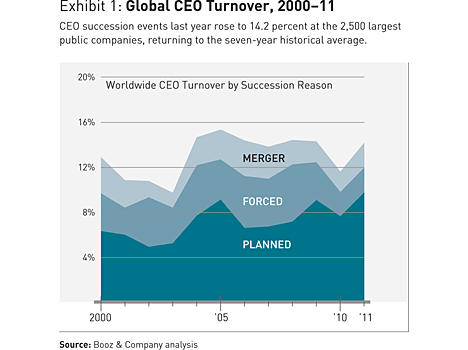
In 2011, the 12th consecutive year Booz & Company has been following the fortunes of CEOs at the world’s 2,500 largest public companies, 14.2 percent of those CEOs were replaced. Although that rate is sharply higher than the previous year’s turnover rate of 11.6 percent, it essentially represents a return to the seven-year historical average of just over 14 percent, and it is 1 percentage point higher than the overall 12-year average of 13.2 percent. (See Exhibit 1.) This recent return to form cannot be attributed to a single cause, but our analysis suggests that it is largely due to the improving economy in many parts of the world; turnover rates have typically been lower during periods of recession and significant stock market decline. This trend suggests that boards are more likely to keep their chief executive during times of economic uncertainty in order to maintain stability, and are more willing to make a leadership change when economic stability returns and the company outlook improves.
In recent years, to gain a better understanding of the evolving role of the CEO, we have focused on specific themes critical to that unique position. Two years ago, we looked at how the role changed over the decade of the 2000s, as tenures became shorter and more intense. Last year, we concentrated on how a company’s business portfolio and operating model affect the nature and duration of the CEO’s job. Given the increase in the succession rate among CEOs between 2010 and 2011, and the increase in the number of CEOs heading a company that is new to them, we chose this year to delve more deeply into the nature of the “incoming class” of CEOs — who they are, where they came from, and how they might best survive and thrive in that critical first year of their tenure.
To that end, in addition to our annual analysis of succession, we embarked on a detailed statistical analysis of first-year CEOs, and the results were intriguing. Outsiders, for example, accounted for 22 percent of all new CEOs in 2011, up from only 14 percent in 2007; at western European companies, 31 percent of new CEOs in 2011 were outsiders, compared with 22 percent at North American firms. We also interviewed 18 CEOs from around the world in order to gather their observations and suggestions on how to navigate a successful first year.
Changing Places
Of the overall 14.2 percentage rate for turnovers in 2011, 9.8 percent were planned, 2.2 percent were the result of the prior CEO’s dismissal, and 2.2 percent were the result of mergers or acquisitions. The data reveals differences in succession trends among companies of different sizes; differences in geographic areas, particularly in the way that mergers and acquisitions affect CEO turnover; and differences in the likelihood that companies will appoint a new chief executive from inside the company.
In 2011, the CEO turnover rate was highest among the 250 largest companies, as it has been, for the most part, since 2005. This trend has also been true over the past 12 years. On average, more than 14 percent of chief executives of the top 250 companies by market capitalization have turned over, compared with 12 percent of companies ranked 251 to 2,500 by market capitalization. (See Exhibit 2.) In addition, the boards of companies in these top tiers are more likely to dismiss (force out) their CEO. It seems that the bigger the company, the shorter the CEO’s tenure. Certainly, it is significantly harder — and more exhausting — to run a very large corporation than a smaller one; given that difficulty, it is not surprising that boards of big companies look more frequently for a new CEO.
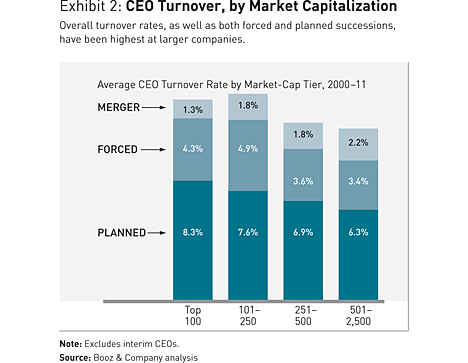
We found that the level of M&A-driven successions within each market-cap tier has a significant effect on the rate at which new CEOs are brought in. As you would expect, smaller companies — those ranked in the 501 to 2,500 market capitalization range — are more affected by M&A-related turnover. Certainly, larger companies don’t merge or get acquired at as high a rate as their smaller counterparts, although their CEOs are under considerably greater governance pressure.
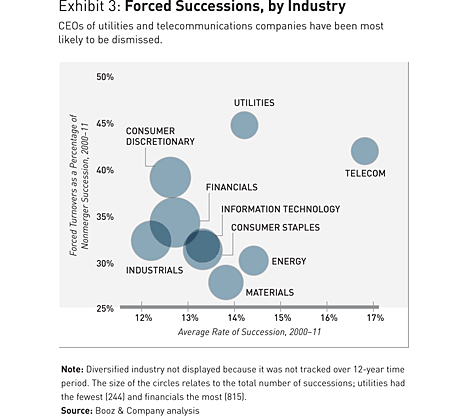
On an industry basis, last year, CEO succession events were most common in the energy sector, in which 19 percent of chief executives were replaced through either a planned or a forced event. Energy was followed closely by telecommunications and utilities, and successions were rarest among CEOs at diversified companies, where just 6 percent left. This should come as no surprise, because turnover rates have been consistently highest in the energy, telecom, and utilities industries over the past 12 years — all industries that have been subject to disruptive market forces. (See Exhibit 3.)
This Year’s Incoming Class
The overall trends last year in how public companies handled the transition to new top management, and the big increase in the number of new CEOs, may suggest that boards are increasingly seeking new leaders to help drive growth in a recovering global economy. If that is the case, however, it places a distinct — and arguably greater — burden on those newly elevated CEOs to prove themselves early in their tenure. The makeup of the 2011 class of incoming CEOs evolved in several ways in response to such pressures.
First of all, insider CEOs (those who came up through the ranks of the companies they now lead) continue to account for the lion’s share of CEO successions — which is understandable, given that insiders perform better than outsiders. Nevertheless, the percentage of insiders has been on the decline, as more and more companies turn to outsiders for their chief executives. In 2007, just 14 percent of CEOs came from outside their new company (one of the lower levels we have seen); last year, that number was 22 percent. This trend suggests that boards are putting more weight on CEO experience than they did before. Perhaps this is because more companies are making a real effort to shake up their culture at the senior executive level and are thus seeking CEOs with experience in other industries and other regions. It may also be that as companies increasingly set their sights on new markets around the globe, they discover that their insider candidates lack the experience necessary to carry them forward into unfamiliar territory. Moreover, boards appear to be taking seriously their fiduciary responsibility to cast their net beyond the usual pool of internal candidates. Whether these two countervailing trends — better-performing insiders and increasing numbers of outsiders — continue in the future will bear watching.
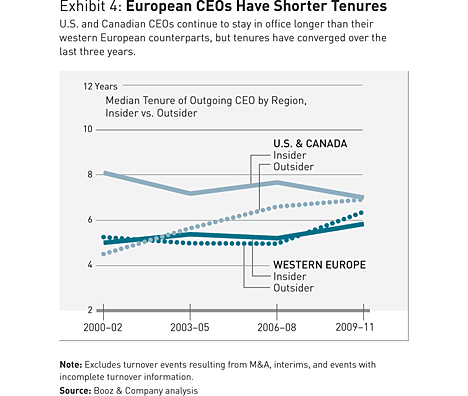
Additionally, although companies in western Europe hired new CEOs at just a slightly higher rate than did companies in the U.S. and Canada, the proportion of outsiders appointed as chief executives was significantly greater among western European companies than among companies based in North America — 25 percent and 18 percent, respectively, on average, over the past five years. This trend may suggest a growing disparity in governance philosophies between the two geographies. At the same time, we have observed over the past 12 years that U.S. and Canadian insider CEOs typically have served a longer term in office than their western European counterparts, but that the gap is narrowing — from three years in 2000–02 down to one year in 2009–11. (See Exhibit 4.)
The share of outsiders taking on a new CEO position also varies significantly by industry. Over the past five years, nearly a quarter of all companies in the utilities industry that brought in a new CEO chose that CEO from outside; they were followed closely by telecommunications and financial-services companies, at 23 percent. These three industries have hired among the highest proportion of outsiders over the past five years when compared with other industries. These numbers suggest that the recent turmoil and consolidation in these industries (brought on both by the financial crisis and by the industries’ ongoing search for new revenue from outside their core businesses) is forcing boards to look beyond the tried and true for executives who can take the business in new directions.
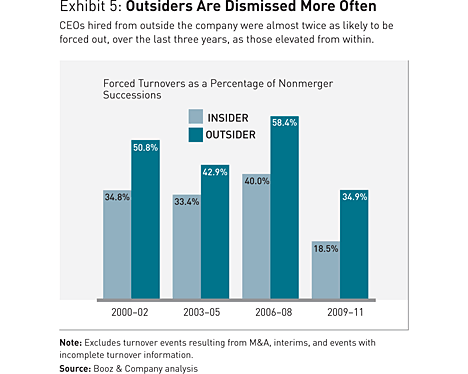
Despite the rise in the number of outsider appointments to the CEO post, our analysis indicates that over time, insiders have delivered better returns during their tenure. The likely reason: Insider CEOs’ “tribal knowledge” of their company and culture, and the strong internal relationships developed over the course of their career, increase the odds of successfully running the company. Moreover, from 2009 to 2011, outsiders were much more likely to be dismissed — only 18.5 percent of insiders were let go, compared with 34.9 percent of outsiders. (See Exhibit 5.) That suggests in part why the median tenure of an insider CEO in 2009–11 was almost a year longer than that of an outsider — 5.1 years versus just under 4.3 years — and why, over the past 12 years, insiders have consistently had a longer tenure than outsiders.
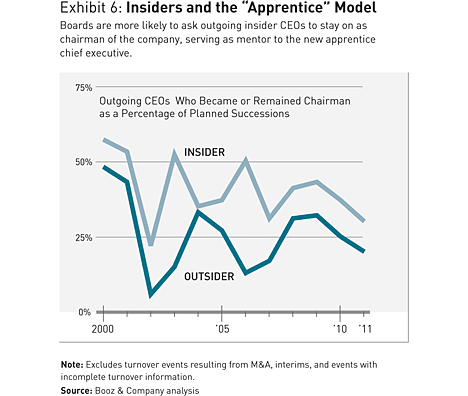
The proportion of CEOs who were also appointed (or remained) their company’s chairman has been declining over the long term, from a level near 45 percent early in the last decade to nearly half that level in recent years. The trend reversed slightly in 2011; the percentage of new appointments to the dual role rose to 14 percent. Despite this reversal, the fundamentals haven’t changed, and we expect the long-term decline to continue. Meanwhile, though the overall percentage declined slightly, a high proportion of outgoing CEOs continued to be appointed chairman as part of planned successions, especially in Japan, where nearly two-thirds of outgoing CEOs became chairman, and in North America, where 37 percent did. On the other hand, just 17 percent of European companies chose this “apprentice” succession plan, confirming their continued preference — or regulatory requirement — for an “independent” chairman.
Far more insider chief executives made the transition to the chairmanship following their tenure as CEO than did outsiders. The popularity of having the outgoing CEO mentor a new apprentice CEO suggests that many boards, especially those directing large companies, appreciate the complexity and pressure faced by new CEOs. The fact that a large proportion of apprentice CEOs are guided by an insider chairman only confirms our view that boards are continuing to try to strike a balance between continuity and the search for fresh blood at the highest level of their company. (See Exhibit 6.)
What the New CEO Can Expect
The 14.2 percent succession rate for 2011 means that some 350 chief executives among those at the world’s 2,500 largest public companies are new to their job. And as we know from prior analysis, nearly 90 percent of new CEOs, on average, have not been a CEO before. Some have spent their entire career at the company they are now running; others have had no experience with their new company at all. Some have run other companies; some are facing an entirely new level of responsibility with their new position. The challenges faced by this incoming class of CEOs during their first year will vary considerably, depending on where they came from, the nature and size of the company to which they have been appointed, and the geographies in which the companies operate. What can these new CEOs expect, given who they are and where they work?
Naming a new CEO from among executives who have been with their company for years is by far the most common type of succession — for good reason. They already know the ropes: They’ve worked for a few years with the executive team, they understand the company’s complex corporate culture, they’ve had some contact with the board, and they’ve proven themselves to be capable within the company they will lead. So they can expect to feel more comfortable in their new role, and to perform better than their counterparts from the outside. On the other hand, much will be new: Executives who used to be their equals are now their direct reports, they are now the face of the company as never before, they now report to a board rather than to just a single individual, and they know that the CEO’s relationship with the board has changed dramatically over the last 10 years. The new CEO must manage these different dynamics carefully.
Still, new insider CEOs can expect to remain in their new position longer than new CEOs from the outside. The length of their tenure, however, will likely depend on the industry — as we noted above, CEOs at energy, telecom, and utilities companies tend to turn over at significantly higher rates than do those in other industries. At the same time, insiders are more likely to be appointed to the role of chairman after their time as CEO than outsiders are.
For the most part, these trends hold true for new CEOs at companies below the top 250 in market cap, though there are some distinctions to be made. Although outright dismissals are few and far between at companies of all sizes, they are even less likely at these smaller companies. Still, outsiders are more likely to be let go than insiders. More CEOs at these smaller companies, compared with those at top 250 companies, are appointed as a result of some kind of M&A transaction, and their tenure may be shortened by M&A actions in the future. Overall, however, these CEOs can take some comfort in the fact that their tenure will likely be longer than the tenure of their counterparts at the biggest companies.
Advice for the Incoming Class
The details may vary, but the overall trends we have been following for the past several years are continuing. First, every CEO is facing a short and intense tenure, with significantly greater pressure to perform and less room for mistakes. That may be why increasing numbers of new CEOs have attained their position as a result of a carefully executed succession plan and, more often, have a chairman who was once CEO available to consult.
New CEOs will, of course, find themselves under particular pressure to perform. The first year of running a company will bring with it a common set of challenges, including when to enact major changes in strategy and personnel and how to manage one’s personal life. The first year also represents a window of opportunity: It is a time when all the company’s constituencies may be more expectant of — and open to — changes in emphasis and direction, and a time when the CEO can make an impression. In putting together this year’s CEO Succession study, we spoke to 18 CEOs, in a wide range of industries and geographies, who were happy to pass along their thoughts about the difficulties they faced, the successes they achieved, and what, in retrospect, they felt they might have done differently in their own first year. Below, we offer seven specific suggestions for how to weather the storms the first year is likely to bring. (For a fuller account of the CEOs’ advice, see “Navigating the First Year: Advice from 18 Chief Executives.”)
1. Deal with the obvious executive changes early. The conditions under which newly appointed CEOs take control vary enormously: Their new company may be in trouble or perfectly steady. The previous CEO may have been dismissed for underperforming or recently elevated to the chairmanship. Or the changeover may be the result of a merger or acquisition, and fraught with postmerger integration challenges. Whatever the situation, there will likely be executives who have their own agenda, and one or two who may begrudge having been passed over for the top spot, or whose presence is simply no longer required. As every CEO we spoke to noted, it is critical to deal with these executives early.
For Andre-Michel Ballester, the insider CEO of Sorin Group, a Milan-based maker of medical devices, moving quickly was vital — his immediate task was to restructure the unprofitable company, selling two of five divisions and creating a dramatically different corporate culture as soon as possible. “The first issue is to create a leadership team very quickly, making decisions on who are the keepers and who are the leavers in the first few weeks,” says Ballester.
Once these vital early decisions have been made, new CEOs should spend the rest of the first year putting together the team of top executives with whom they can work, and who will provide the support necessary as the company’s ongoing strategy is refined or changed.
2. Be wary of changing strategy too quickly, even if you think the current strategy is wrong. The temptation for new CEOs to put their own stamp on their company can be strong. Resist it, said many of the CEOs we spoke to. Take the time to make sure the company is on a sound footing before sending it off in a new direction.
That was the approach taken by Ronnie Leten when he became CEO of Swedish equipment manufacturer Atlas Copco in 2009, in the midst of the economic downturn. “My first thought on becoming CEO,” he says, “was to make sure we kept going, kept visiting the customers, safeguarded the business, and saved all the areas that needed to be saved.” Leten knew he had some restructuring to do to adapt to the new circumstances, but he didn’t want to confuse the organization. His advice: “Don’t jump to conclusions immediately. Take the time to look around so you can get a full overview of the entire situation.”
As first-year CEOs move to develop strategy, they should take the time to look forward three to five years, to what the company, and its markets, might look like then. Doing so will allow them to think in terms of confirming or resetting its strategic direction, and then to determine both the set of capabilities the company will need to give it the right to win in its chosen markets and how to build those capabilities. “Strategy should be thought of simply,” says Osman Sultan, CEO of du, the United Arab Emirates telecommunications company. “Where are we today, and where do we want to go?” And once you’ve taken the time needed to develop your strategic direction, don’t waver; rather, communicate with conviction your vision of where the company should be headed.
3. Make sure you understand how every part of the company operates, and how it is performing. New CEOs, even if they are insiders, are unlikely to be intimately familiar with the entire organization, particularly in the largest companies. So it is critical that they begin learning about and analyzing every part of the company early on in their first year. This will allow them to think about making any necessary changes to the leadership team, and to get a head start on developing the strategies and building the capabilities that will be needed to move the company forward.
This is perhaps an even more important step for new CEOs from inside the business, who risk the perception that they will limit their role to being the “superboss” of their previous territory. “I think it’s important, especially in the initial phase, that you don’t hang on to your old job,” says Severin Schwan, CEO of pharmaceutical giant Roche. “You need to move on, and to make sure that the organization immediately recognizes that you are now in a new role. Because people always think, ‘This is the guy from that unit, so he looks at things from a particular angle.’ You have to get rid of this perception.”
4. Build trust through transparency. Gaining the support of all the stakeholders is critical to success in the new CEO’s first year. Different constituencies will be watching closely, monitoring performance carefully; in the worst-case scenario, some will resent the new CEO’s rise to power. In this atmosphere, building trust is critical, and the best way to do that is to be as open as possible about plans and motives with all the critical players, and to move decisively in making the most pressing changes.
“Absolutely key is transparency with all your stakeholders,” says Roche’s Schwan. “The moment you put issues or risks on the table and speak about them openly — with the board, with your colleagues on the executive committee, with external stakeholders, media, and investors — that in itself creates trust. And that in turn triggers support: The moment you frame the topic, people become very interested in making it better and working at a solution.” And support is surely one of the most pressing needs of the new CEO.
Once gained, that trust will make the new chief executive’s job considerably easier, Schwan notes. “If you feel that you have the trust from key stakeholders, from your own team, from the board, from external stakeholders,” he says, “then the pressure is reduced. If you feel that the trust is being lost, then the pressure gets much higher.”
5. Be selective in listening to advice. As soon as his or her appointment is announced, the new CEO will inevitably be surrounded by people offering advice — board members, business unit leaders, customers, investors, even the press. Everyone has an agenda, but not all of the advice is in the best interests of the CEO or the company he or she has been hired to run. Few people will be able to see the whole picture of where the company stands and what it needs. And it can be difficult, if not impossible, to sort out the valuable advice from the worthless.
“Don’t listen too much to external advice,” says Ian Livingston, CEO of BT Group. “The truth be told, you’ve got to make your own call. It’s your decision, and most everyone actually knows that.”
Advice from key internal leaders, on the other hand, can be very useful, Livingston points out. “The best advice, actually, isn’t from shareholders, isn’t from brokers. The best advice I get is from CFOs and HR directors, because they’re people who have a view across the entire business.”
6. Yes, it is lonely, so find a sparring partner. A common theme among the CEOs we spoke with concerned the importance of finding someone, whether internal or external, from whom you can learn what you need to learn, or with whom you can discuss plans and people honestly and openly, knowing that the other person has no agenda other than your success. Increasingly, that role has been played by the current chairman, as we’ve noted. But no matter who that person is, or why the new CEO feels the need to turn to that person, every new CEO should look for a well-informed, objective sounding board.
Every CEO, for instance, will likely feel the need to learn on the job during that first year. Schwan found himself in that position when he became CEO of Roche. “I knew the organization, of course, and I was a member of the corporate executive committee, so I knew my peers, and I knew the board,” he says. But he had been working for the company’s diagnostics business, and felt he had much to catch up on regarding the latest science under way in the company’s pharmaceutical efforts. So he made a conscious decision to go deeper into drug R&D. “I was looking for somebody who could literally teach me, and I found a very senior pharmaceutical executive whom I knew from the past, and who had retired in the meantime. He had enormous expertise in the area, but he was also known to be able to explain things in straightforward terms. I contacted him and he was very helpful — even excited to help me.”
7. Manage your time and your life with care. It should go without saying that the demands on CEOs are enormous, in terms of both time and pressure — perhaps especially early on in their tenure, when those demands are also unfamiliar. Every moment is important, and CEOs get little or no rest from the intensity. “You go from one very important decision to another,” says BT’s Livingston. “You might be with a senior government minister and go straight to a major customer, then straight to talking to 500 senior managers. Folks will say, ‘Well, this is a really important meeting’ or ‘a really important thing.’ It’s just consistent intensity as opposed to any individual event.”
The effort to balance one’s work and home lives can be overwhelming, many of the CEOs we spoke to noted, and getting it right is vital to success in the first year.
“I think the stability, the support from home, makes a huge difference” for the new CEO, says BT’s Livingston. “What you can’t do is to divide your attention between the two at once. I know executives who go home every other weekend or something, and it can be very hard. If you don’t have a very stable, very supportive home life, it can become too much pressure to take.”
Roche’s Schwan believes that the pressure can get so intense that it can affect one’s health. “If you are not conscious about traveling, keeping these pockets for your family, switching off in a conscious way, you’ll get exhausted,” he says. “If you’re always working against your own biorhythms, you’ll get health issues. It happens all the time.” That’s why Schwan says he tries his best to keep his weekends free. “You have to keep a certain distance from your job. It’s not easy to switch off over the weekend. I know people who can go to bed and forget about the job and sleep extremely well. I wish I could always say that.”
The first year on the job will always be a tough one for CEOs. They must deal with a new and different set of stakeholders — the board, new direct reports, heads of potentially unfamiliar business units, potentially a new and unfamiliar chairman, and the shareholders and customers, too. And their responsibilities are now immense — to fix whatever might be broken, to reset corporate strategy, and to serve as the company’s public face.
For all those reasons, the first year is critical, and getting it right is key to the success of the rest of the CEO’s tenure. It is a brief window of opportunity during which the CEO must put his or her personal stamp on the company, and set it on course to navigate an uncertain future. Ahmad Abdulkarim Julfar, Group CEO of Etisalat, an Abu Dhabi–based telecom operator, puts it succinctly: “Whenever new CEOs see any kind of opportunity, they should jump on it immediately. Opportunities have expiration dates.”
So it is particularly important that new CEOs learn as much as they can from other CEOs who have experience dealing with these changing circumstances. Our hope is that new CEOs, and those who aspire to be CEOs in the future, will find our analysis of the succession data — and the advice offered by the chief executives we spoke to in preparing this study — helpful in making the most of their opportunity. 
Methodology
This study identified the world’s 2,500 largest public companies, defined by their market capitalization (from Bloomberg) on January 1, 2011. Our research team members — based in India, China, Romania, Chile, and the United States — then identified the companies among the top 2,500 that had experienced a chief executive succession event and cross-checked data using a wide variety of printed and electronic sources in many languages. For a listing of companies that had been acquired or merged in 2011, we also used Bloomberg.
Each company that appeared to have changed its CEO was investigated for confirmation that a change occurred in 2011, and additional details — title, tenure, chairmanship, and so on — were sought on both the outgoing and incoming chief executives (as well as any interim chief executives).
Company-provided information was acceptable for most data elements except the reason for the succession. Outside press reports and other independent sources were used to confirm the reason for an executive’s departure. Finally, Booz & Company staff worldwide separately validated each succession event as part of the effort to learn the reason for specific CEO changes in their regions.
Total shareholder return data for a CEO’s tenure was sourced from Bloomberg and includes reinvestment of dividends (if any). Total shareholder return data was then regionally market-adjusted (measured as the difference between the company’s return and the return of the local regional index over the same time period) and annualized.
Reprint No. 12207
Author profiles:
- Ken Favaro is a senior partner with Booz & Company based in New York. He leads the firm’s work in enterprise strategy and finance.
- Per-Ola Karlsson is a senior partner with Booz & Company based in Stockholm. He is managing director of the firm’s European business.
- Gary L. Neilson is a senior partner with Booz & Company based in Chicago. He focuses on operating models and organizational transformation.
- Also contributing to this article were Booz & Company senior partners Ivan de Souza, Karim Sabbagh, and Edward C. Tse; partners Stefan Eikelmann, Hilal Halaoui, Masahiro Kishida, David Levy, Greg Rotz, and Kazutoshi Tominaga; principals Carlos Gondim and Nadia Kubis; senior associate Marc Johnson; and senior consultant Jane Kim; and contributing editor Edward H. Baker.
