
The Care and Feeding of Shareholders
A review of Winning Investors Over, by Baruch Lev.
(originally published by Booz & Company)Winning Investors Over: Surprising Truths about Honesty, Earnings Guidance, and Other Ways to Boost Your Stock Price
by Baruch Lev
Harvard Business Review Press, 2012
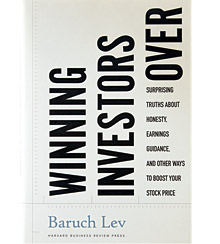
Observing how the CEOs and CFOs of most public companies spend their time, it’s easy to conclude that investors are their number one concern. So perhaps it shouldn’t come as much of a surprise that Baruch Lev, the Philip Bardes Professor of Accounting and Finance at New York University’s Stern School of Business, begins his new book on corporate investor relations with a CEO’s assertion that capital markets are “the most important thing.”
Winning Investors Over: Surprising Truths about Honesty, Earnings Guidance, and Other Ways to Boost Your Stock Price is an evidence-based how-to manual addressed to CEOs. It aims to help them deal honestly with shareholders, regaining and maintaining their trust, and resolving conflicts between owners and managers.
The book is a model of clear organization and is written in a breezy style. In 14 succinct chapters, with summaries and takeaways, it makes a persuasive case for transparent dealings between corporations and their shareholders, arguing that deviations from the straight and narrow will be punished sooner rather than later.
For example, although executives typically complain about the undervaluation of their shares, Lev argues that overvaluations are equally pernicious, encouraging illusions of genius, overreach, and eventual retribution from both shareholders and employees with worthless stock options. The solution: Executives should offer continual guidance to analysts and investors to maintain a realistic, fair evaluation of the corporation. This presupposes, of course, that insiders are better at forecasting future performance than outsiders!
Lev is opposed to earnings manipulation of any kind, and he stresses the value and importance of communicating to investors soft information that supports the corporate narrative, such as the company’s competitive position and the strength of its intellectual property. He is in favor of the use of pro forma statements and additional hard information in cases where generally accepted accounting principles might be misleading. Lev also suggests that executives adopt a “path-to-growth template” that uses a company’s high-level drivers of value to identify what other hard information to supply as a means of communicating progress before it shows up in financial results. (Same-store year-to-year sales would be a good example of such disclosure in the retail sector.)
The author’s take on corporate social responsibility (CSR) is particularly insightful. (See “What Can You Do Better?” by Paul Leinwand, s+b, Author’s Choice, Dec. 2, 2011, for another perspective on Lev’s book.) Lev argues that firms should undertake CSR initiatives only if the initiatives can provide a unique contribution on the basis of the firm’s capabilities. Further, in a welcome extension on Milton Friedman’s injunction that the only social responsibility of a business is to make a profit, Lev recognizes that companies consider CSR not just for its profit potential, but for other benefits conferred by being seen as a good actor.
Despite this enlightened perspective on CSR, Lev is vehement in his contention that the sole purpose of a business is to create long-term value for its shareholders, and he is impatient with the introduction of other stakeholders into the picture. This attitude seems to be at odds with his championing of some of the softer objectives of CSR. Nevertheless, he contends that only shareholder value offers the hard targets needed to manage performance and that managers are unqualified to make multiple trade-offs among shareholders, employees, customers, and communities. This may be music to investors’ ears, but will strike a sour note among the managers who are confronted with deciding those trade-offs. In addition, customers, employees, and communities are unlikely to be excited by a central corporate narrative based solely on the maximization of shareholder value.
This highlights the contrast between the neoclassical view of corporate purpose as a monolithic, monotonic task of maximization and a more fine-grained life-cycle perspective that recognizes that corporations go through different stages and that their value-creation processes and purposes will change over time. Lev uses the latter to good effect on several occasions, but then subordinates it to the ideological demands of neoclassical economics. Executives, who have to deliver sustainable results, don’t always have the freedom to follow ideological dictates, but they can learn many practical lessons in managing investors from Lev.
Author profile:
- David K. Hurst is a contributing editor of strategy+business. His latest book is The New Ecology of Leadership: Business Mastery in a Chaotic World (Columbia University Press, 2012).