
Toward Digital Democracy: A Strategist’s Plan for Fixing Flawed Elections
Election reform in the U.S. is the ultimate change-management project. One principle must guide it: Treat voters like customers.
 |
|
Illustration by Guy Billout
|
The United States has 12 months to create a voting system that works the way most people thought it was working.
A year ago, the general public learned what election officials in the United States have long known: The current setup is a mess. Old machinery, inaccurate registration rolls, ill-prepared poll workers, and convoluted procedures make it impossible for us to conduct an election with a completely accurate count. Moreover, the authority over the election system in the U.S. is so decentralized and disparate that no single solution can bring elections closer to what the voting public now demands.
But, vote we will — to elect 435 representatives and 33 senators this November and a president in 2004.
Debate over the subject of electoral reform has been vigorous but has resulted to date in little change. The California Institute of Technology and the Massachusetts Institute of Technology responded to what they called “a need for strong academic guidelines in the intersection of technology with democracy.” The National Association of Secretaries of State pulled together a report that reviewed current and proposed election reform best practices throughout the country. The U.S. General Accounting Office, the National Commission on Electoral Reform, and the Constitution Project’s Forum on Election Reform all identified topics for change. Late last summer, a week after the National Conference of State Legislatures insisted that states create their own electoral-reform guidelines, House Democrats issued a report recommending national standards for elections. Two days later, former U.S. Senator Bill Bradley cautioned about abandoning the status quo.
Although all the continuing discussions broadly address the issue of high- and low-level reform, most do not address the need for continuous improvement of the U.S. election system. And not one has looked for lessons from the one sector that has had plenty of experience not just in theorizing about change, but executing it: the business community. If election managers sit down to talk shop with their corporate counterparts, they will see that they face similar challenges — quality control, staff development, strategic planning and budgeting, customer service, and, yes, politics.
We come by our expertise through work we’ve done on projects with the Federal Election Commission, the National Association of Secretaries of State Election Reform Task Force, the State of Indiana’s Bipartisan Task Force on Election Integrity, the Secretary of the State of California, and election officials in four other states in cooperation with the Defense Department’s Federal Voting Assistance Program. We believe that election reform in the United States is the ultimate change-management project. Similarly, our e-business experience in both government and the private sector leads us to believe that automated-voting transactions are the ultimate electronic-commerce test. Unlike other electronic-commerce applications, voting transactions must remain anonymous as well as verifiable, auditable, secure, and private.
Although registration and voting must remain a core public function (like justice and defense), election administration can benefit by adopting basic corporate practices for strategy, organization, and technology.
The problems of the last national election involved more than technology. And future elections will have comparable difficulties if change is not initiated across all the key dimensions. In the pages that follow, we examine solutions that can lead to the construction of an electoral system that can uphold and sustain reform. Although there is no way to completely guard against error, sound business approaches that address three key elements — people, process, and technology — will greatly enhance the planning and execution of reform. (See Exhibit 1.)
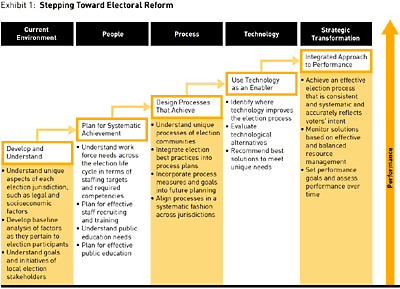
To avoid the problems of the last election, we need to understand and implement strategic planning and technology. To manage this change process, we must:
• Apply best business practices to the electoral process
• Introduce performance management standards
• Reform the voter registration process
• Move toward a digital democracy … carefully
Best Practices for Elections
In politics, as in business, the concepts for reform cannot be separated from the mechanisms that deliver reform. Just as the Internal Revenue Service has benefited from a customer-focused approach (reorganizing itself around the needs of distinct individual and corporate segments) whose origins lie in the commercial world, voting reform can benefit from a structure created with an eye toward customer centricity.
When the problem of electoral reform is viewed through the lens of best business practices, four basic reform opportunities emerge:
• Treat voters like customers. While maintaining election integrity, we must remove obstacles that deter eligible citizens who do want to vote. This stage of reform — involving straightforward, low-risk opportunities — includes such customer-centric questions as, What factors hinder citizens who want to register and vote? How can those factors be reengineered to encourage participation? Functions ripe for immediate action include voter education, registration-form and ballot design, absentee voting procedures, and poll-worker training. The key to successful reform is to change the system so it responds to its customers’ — the voters’ — behavior.
• View electoral reform as a series of sequential challenges, not just one discrete project. We recommend that election officials look at the electoral process just as a manager would regard a company’s supply chain, element by element. Such an analysis allows the separation of critical functions (registration, voter education, in-person voting, absentee voting) and players (citizens, government officials, political parties, and technology vendors) for analysis and improvement. A step-by-step breakdown of the voting system could take advantage of comparative statistical analysis and benchmarks to identify the specific issues in specific jurisdictions that need immediate attention and encourage key stakeholders to agree on the priorities for change.
• Build organizations that can uphold reforms. Election agencies at all levels should be molded into professional institutions that initiate and sustain better approaches to election management. Fresh perspectives and new technologies will have little impact if election agencies remain ad hoc and seasonal. In the past, the electoral enterprise was visible only at peak operating times (i.e., during elections), and then disappeared from view. The postelection furor in 2000 was an exception. From now on, the public will expect election authorities to continuously improve the entire voting experience — and this expectation mandates organizational and cultural changes.
• Develop a technology road map. Today, improvement in election technology is largely vendor driven. Future election infrastructure should allow the infusion of extant and emerging technologies into the electoral supply chain. If we do not use a road map, procurement decisions will be ill-informed and have unintended consequences that do not serve the voting customer. Will such offerings as direct-record electronic (touch-screen) machines actually reduce voter error and endure over time? Without a road map, it’s difficult to ascertain.
Collectively, these frameworks and methods represent the business perspective that has been absent in past approaches to electoral reform — but is absolutely essential to success. In the overwhelming majority of countries that have a more homogeneous election system, these recommendations would have even greater impact on the voting customer’s experience.
|
Six Lessons for Electoral Reform |
|
From our engagements with the Federal Election Commission, the National Association of Secretaries of State (NASS) Election Reform Task Force, the State of Indiana’s Bipartisan Task Force on Election Integrity, the Secretary of the State of California, and election officials in four other states in cooperation with the Defense Department’s Federal Voting Assistance Program, we have learned several counterintuitive lessons: 1 Voter anonymity is a significant obstacle to Internet-sponsored elections. Because privacy is such a sensitive issue for Americans, each stage of an election has to be designed to protect anonymity. In addition, the development of state-level databases might encounter opposition from privacy-conscious constituencies. The more stages that have to be secure, the more difficult it will be to conduct elections, even with such security measures as Public Key Infrastructure and biometrics. 2 Improve the registration process and you will improve the electoral process. The electoral supply chain is a step-by-step process that begins with registration. To enrich the system, you don’t need to improve all the different elements, or even focus on voting, the last part on the chain. Registration is the weakest link; improving it — particularly ensuring the enfranchisement of eligible citizens on election day — will certainly improve the entire electoral system. 3 Election reform in the United States inevitably involves playing some politics. Changes in the U.S. voting system often are complicated by the vested interests of any number of powerful existing constituencies: the incumbent election officials, the current vendors of election equipment, and the elected officials, to name three that often create a mighty argument for the status quo. 4 The market for voting technology is not big enough to drive new technology. Think about the numbers: The life cycle of any election system product may be 10 to 20 years — or five to 10 national elections. Low turnover leads to a market that does not stimulate significant R&D investment. The result: New technology will have to be borrowed from other electronic-commerce applications and adapted to the electoral infrastructure. 5 No company wants its Internet-enabled same-day voter registration system to go down in full public view. At least one leading technology manufacturer got out of the election-product market several years ago because the risk of failure on voting day — no matter how slight — was a risk it could not take. Either by design or habit, improvements to election systems will be slow and cautious. 6 The business model for elections is all but nonexistent. One of the problems of electoral reform is that there is no process map for the electoral system. Indeed, there are probably as many maps as there are different town, county, state, and national elections. Change often comes from observing the conduct of an election official in the next county or from a persuasive pitch from a vendor. Because there are few analytics, there are few reliable paths to initiate change. — M.G., E.R., C.S. |
Performance Management
Voting reform must begin with a coldly analytical examination of what’s right and what’s wrong. We use metrics every day in business. There’s no reason we can’t use them in evaluating electoral change, though the process promises to be daunting. Despite some recent calls to institute national voting standards and processes, the U.S. Constitution mandates that individual states oversee the rules that govern voting procedures for federal elections. Most states, in turn, have left counties and local governments in charge of voter registration and other aspects of election administration.
Some states are already acting on reform ideas. Florida legislators, anxious to repair the state’s image and electoral system, passed the Florida Election Reform Act of 2001 in May. By mandating statewide standards for ballot design, recount procedures, and absentee voting, it shifted authority from the counties to the state, centralizing election reform among state leaders and leaving counties to carry out the state mandates. The act also put real money behind specific reforms: $24 million for machine upgrades, $6 million for voter education, and $2 million for a centralized voter registration database.
Other jurisdictions, however, lack the resources or motivation for an across-the-board effort. How can the authorities who oversee elections decide where to invest their time and money?
We recommend the use of metrics to gauge the effectiveness of the system’s performance at different stages (preelection, election day, and postelection) and during different election scenarios (e.g., high turnouts and low turnouts during general and special elections, runoffs, and referendums). Results could be compiled into an election management scorecard similar to the Balanced Scorecard used by many corporations to track performance in the most critical parts of their operations. An election management scorecard could measure improvements (or slippage) in the management of internal processes, customer and employee satisfaction, and other areas of election management. For example, a large percentage of registration forms submitted with inaccurate or incomplete information, or sent to the wrong address, would suggest that registration requires attention (to both its internal processing and its customer interaction). Similarly, an election-day complaint rate substantially above the historical average might suggest that more voter information programs are needed.
For ballot casting itself, the rate of residual votes (ballots that are uncounted, unmarked, or marked incorrectly) is a valid metric. For absentee voting, metrics include the percentage of ballots returned with wrong information or after the deadline. Viewed across jurisdictions, metrics show where the most serious problems exist. For example, the national average for residual votes is two out of 100 ballots. Massachusetts and Maryland have fewer than 1 percent residual votes, whereas New Mexico, South Carolina, Georgia, and Illinois are above 3 percent. The rate can reach 20 to 30 percent in certain counties, indicating either that machines are malfunctioning or that voters don’t know how to use the machines properly.
Improving Registration
Reforming the entire voting process is all but impossible because it has so many different parts. Reforming part by part, however, can lead to substantive improvement that promises to make a significant difference for the average voter.
Because voting essentially begins with registration, it makes sense that reform should begin with that process. Voter registration rolls, if they are accurate, indicate who can and cannot vote. But rolls are hard to maintain and update, requiring constant attention. People die, relocate, and change their names — life events that require updates to registration rolls. Voters cannot be counted on to alert election officials to such changes. Furthermore, election agencies vary in the way they handle their rolls. Some still store registration forms in boxes and manually update registration. Others agencies, such as the one in Orange County, Fla., digitize all completed applications and never refer to the paper originals. Only rigorous performance analysis can find an optimum system for a particular locality.
A quick look at some numbers demonstrates the scope of registration problems. In 1998, Alaska had 437,000 people of voting age, yet it had 502,968 people on its rolls. In 2000, Los Angeles County officials projected that 25 percent of its registrations were duplicates, primarily caused by voters moving and reregistering. The Census Bureau estimates that, in 2000, 3 million registered voters nationwide did not vote because of registration problems.
The creation of state-level registration databases has emerged at the top of reformers’ must-do list. Officials charged with registration management would be smart to follow the examples of database-driven companies, such as credit-card marketers, and better track the voting population. In fact, some states have. Michigan created the Qualified Voter File (QVF) system in 1998 to centralize files managed by 1,700 local officials. The Michigan Department of State provided standardized hardware and software and gave access to the QVF files to Michigan’s 83 county clerks and to the clerks of all localities with a voting-age population of more than 5,000. The QVF includes 6.7 million voter registration records, collected from the department’s driver’s license/personal identification card files and the voter registration files of city and township clerks. The QVF system successfully lowered duplicate registrations. From a practical business perspective, records could be maintained faster and more accurately.
Public and private databases are powerful tools. But they require tight security and management, since they aggregate names, addresses, Social Security numbers, and dates of birth — all the elements needed for identity theft or fraudulent voting. Even well-guarded, centralized electoral rolls worry privacy advocates. Some states retain the right to sell the voter information they collect; others provide it, with limited safeguards, over the Internet. For example, a new Web site called www.registertovoteornot.com reveals New York City voter registration data when someone types a person’s last name and date of birth. The data had long been available to the public from the Board of Elections, but few people besides political-party representatives had ever bothered to ask for it.
We expect registration reform to occur in two distinct phases. In the near term, other states will emulate Michigan and look for new ways to assemble accurate, accessible databases. Virginia, for instance, is letting citizens log on to a secure site to check and update their registration status (e.g., their address) using a personal identification number (PIN) provided by the state’s Department of Motor Vehicles. Over the next four years, some states may test online registration. Although convenient and accurate (it eliminates the chore of deciphering messy handwriting), online registration opens a Pandora’s box of security risks related to the difficulty of verifying a person’s identity online.
A major problem with using the Internet for elections is assuring the voting public that results are true and accurate. Emerging technology, however, promises enhanced security that reduces the chance of flawed registration and tabulations.
For instance, the Defense Department’s Medium Assurance Public Key Infrastructure (PKI) technology has emerged as a principal means for achieving secure Internet transactions with any party, known or unknown. (See “Focus: The Defense Department’s Internet-Voting Test,” above.) Although PKI technology ensures a secure link across the Internet, it does not guarantee that the user is who he or she claims to be, since an unauthorized user could steal a person’s private key and obtain the PIN code.
Combining three types of identification and authentication mechanisms helps mitigate this security problem:
• Tokens (something you have): a diskette or smart card that stores a private key.
• Passwords (something you know): a verbal or alphanumeric identifier.
• Biometrics (something you are): measurable physical characteristics, such as a fingerprint, an iris, or facial features.
Biometric products in the workplace already are proving the technology’s viability. Examples include Walt Disney World’s use of hand geometry systems to authenticate season-pass holders; the Home Shopping Network’s use of voice authentication with its telephone-ordering system; and the New York Department of Social Services’ use of fingerprint authentication systems to verify the identity of entitlement program participants.
Stepping up to Digital Democracy
The decentralized, antiquated U.S. election process means that reformers should look for short-term, low-risk opportunities for change.
Voting technology in the U.S. hasn’t made a major leap forward since the turn of the last century. Hand-marked paper ballots for elections were used until 1892, when New York State adopted lever voting machines. These bulky closet-sized contraptions remain in widespread use, even though the last ones were built in 1982. Punch-card systems were introduced in the 1960s. Other mechanical and electronic systems followed in the 1970s.
Within most states, there has been little coordination in voting equipment from one county to the next. Each one bought whatever system it wanted, with little consideration of the eventual desirability of linking election machinery across a state.
For the 2000 election in Florida, 41 counties used optical scan machines (which read ovals filled in by voters), 24 counties used punch cards, one used lever machines, and one used paper ballots. The reform act signed by Gov. Jeb Bush in May imposed some order on this agglomeration by prohibiting punch-card systems.
At the same time, small-scale use of the Internet has met with some success in elections. In Alaska last year, the Republican Party was faced with the problem of overcoming such common voter deterrents as vast distances between homes and polling places, lack of transportation, and unreliable postal service. The state GOP used the Internet to conduct a presidential straw poll. Republicans were able to vote using a system developed by VoteHere.net, a private company financed in part by the Compaq Computer Corporation, Cisco Systems Inc., and Entrust Inc. Although the nature of the nonbinding straw vote was too informal to judge its efficacy fully, a number of voters were able to overcome previously unsurmountable logistics problems and cast a ballot.
In Arizona, the Democratic Party worked with Election.com (a company supported by Accenture and by VeriSign, a security-technology developer) in an Internet voting program that increased turnout in its statewide primary by an astonishing 676 percent over the 1996 primary. The party sent all 843,000 registered Democrats a personal identification number that let them access the party’s site or Election.com. Participants were prompted to answer several personal questions; answers were compared to information on registration cards. After authentication, a ballot appeared on screen. Voters selected their candidates and submitted their votes. Of the 86,000 Democrats voting, 36,000 cast votes online, 32,000 via mail, and an additional 18,000 voted in person.
Although the systems in those experiments allowed citizens to vote with relative convenience, full certification of a voting system requires much deeper engagement. Any equipment used in traditional elections must undergo a rigorous certification process by an independent testing organization. The purpose of this procedure is to provide third-party verification that the equipment meets the stringent requirements established by federal and state standards. There is no evidence that either of these systems would have passed such intense scrutiny and evaluation.
The Ultimate Change Management Project
Not too long ago, the Internet was perceived as a major transitional vehicle for business all over the world. In the last year and a half, it has proven to be something less than that. Similarly, although it’s tempting to view technology and online registration and voting as the cure for all electoral problems, once again, they may be something less than that. Most likely, online registration and voting will emerge slowly, moving incrementally from the research stage to larger tests, and, potentially, to at-home remote Internet voting.
Our analysis suggests that there are at least as many poor ideas as good ideas in the voting reform marketplace. Indeed, the Arizona online experiment proved that the Internet is no panacea for voting system problems. Computer servers regularly were congested and telephone help-desk lines often were busy. With a new technology in place, the program badly needed some sort of “lifeline” that would help voters make the best use of the system.
Such missteps are proof that, even with the best of intentions, some states and localities have made — and will continue to make — reform decisions that could haunt their electorates. Just as is true in business, being first to market with a new product does not always ensure success. The state of Oregon, for example, now conducts its elections entirely by mail. Until we better understand its impact on election credibility and integrity, we believe that widespread voting by mail is an idea rushed too quickly to market. Similarly, some localities are purchasing election-related technology without getting answers to some fundamental questions: What will election authorities do if, after limited state and local dollars have been spent, there are as many lost votes as in previous elections? What sorts of lawsuits will stem from poor reform decisions? Will part-time, volunteer election authorities be able to manage new technology placed in polling stations?
The lessons won’t come easily. Reformers in the U.S. are working at an operational disadvantage. The simple truth is that the world’s most influential democracy likely will be a follower, not a leader, in digital democracy. Because of a Constitutional bias toward decentralized election supervision — there are so many local, county, and state agencies coordinating elections in each state — the creation of a national digital election is a remote possibility. In countries such as Australia, Denmark, and Germany, Internet elections stand a greater chance of success because governmental authority — and election control — is more centralized.
The politicians and academics who have embraced electoral reform as their cause célèbre have platforms, passion, and the public’s attention. Yet, because they most often have not worked in business, they lack a manager’s experience with large-scale performance improvement.
Before any real change becomes effective, the managers of the electoral system will have to learn more about business — the principles that should be the foundation of the electoral process. They need to learn how to manage an electoral value chain. They must understand evolving voting customer demand. And they have to build organizations that emphasize continuous improvement and work to understand the promise of extant and emerging technologies.
By applying these practices, they can build an election system that is faithful to our founding principles and the envy of the rest of the world. 
|
Focus: The Defense Department‘s Internet-Voting Test |
|
The practicality of Internet registration and voting is fully dependent on how tightly we can create a fraud-proof system. In November 2000, the Department of Defense’s Voting Over the Internet (VOI) project showed that it is possible to use the Internet for limited, safe, secure voting in a presidential election. And that first-of-its-kind experiment in online elections will point to changes in future digital-democracy initiatives. The VOI project was organized by the Defense Department’s Federal Voting Assistance Program (FVAP), an agency that oversees registration and absentee voting by members of the military, their families, and other citizens living away from their voting home. For military personnel, the absentee process has been difficult and time-consuming — voters filled out a card; mailed it to local election officials; got back a paper ballot; completed the ballot; and mailed the ballot back. The inefficiencies of international mail often caused soldiers’ completed ballots to reach election officials too late, or without required postmarks. Election officials also had their gripes — illegible handwriting, missing signatures, and inaccurate addresses among them* Seeking to overcome the absentee obstacles, FVAP joined with state and local election officials to create the VOI project in 1998. Booz Allen Hamilton worked with FVAP to define the concept, design and implement an online system, and assess the results. The VOI test involved state election agencies in Florida, South Carolina, Texas, and Utah, and 15 counties in those states. Volunteers for the test — recruited by the military and the Department of State — had to be voting residents of the participating states and counties. Ultimately, 84 volunteers voted over the Internet, from locations in 21 states and 11 countries. The VOI system had three main components: the voters’ personal computers, an FVAP server, and servers at each local election office. The FVAP server linked the voters’ PCs to the local servers and allowed citizens to register, check their registration and voting status, and vote over the Internet. Security for the test involved the Defense Department’s Medium Assurance Public Key Infrastructure (PKI) technology. Public key cryptography has emerged as the principal technology for achieving secure transactions with any party, known or unknown. Through the use of coding and digital certificates, and by employing cryptographic techniques such as digital signatures and encryption, users can: • verify each other’s identities • know that their communications are not being modified • know that their communications are strictly confidential • prevent the other party from denying involvement in a commu- FVAP distributed instructions on acquiring certificates to the volunteer voters, who then appeared before a "trusted party" — a base commander, for instance — to show official identification. The trusted party verified the voters’ identity and provided them with additional information that allowed the volunteers to go online and download a digital certificate to their PCs. Volunteers then could go online to register, check their status, and vote. The VOI test showed how complex digital democracy is, even on a small scale. VOI had to comply, to the letter, with election laws in each jurisdiction. Given the hugely fragmented electoral system, compliance required many different types of e-ballots and procedures. As an example of what could lie ahead, had they wanted to participate, Dallas County, Tex., and the entire state of South Carolina would have had to get Department of Justice preclearance approval for these procedural changes. In spite of such administrative headaches, VOI proved the feasibility and viability of Internet registration and voting. The legibility and mail-time problems disappeared when participants registered and checked their status over the Internet. Furthermore, information moved from the citizens to the election offices instantly, with no delays caused by international mail. This rapid transfer of information gave offices more time to check voters’ eligibility for absentee voting. When problems arose, officials could immediately inform a voter of any steps needed to correct his or her status. The digital certificate authenticated the voter’s identity in the absence of a signature. Citizens could vote only once, and their vote remained anonymous. For this test, there were no security breaches. Still, VOI cannot be considered a full-scale test of digital democracy. It enjoyed special advantages. The relative lack of publicity helped neutralize security threats; the small number of participants made it possible to deliver intense customer service; and close oversight by security experts ensured that the system was under constant scrutiny. These were ideal operating conditions, which certainly cannot be replicated on a large scale in any November election in the near future. Beyond security, future tests must assess other concerns. Can Internet-enabled systems process votes efficiently, or will servers crash under the traffic generated by millions of votes cast in a few days or hours? Can cash- and staff-strapped election agencies fold Internet voting into existing registration and vote-counting systems? Even if security becomes airtight, digital democracy will never become a mainstream option if jurisdictions lack the money and people to manage online voting. — M.G., E.R., C.S. |
Also contributing to this article were:
Booz Allen Hamilton Vice President Elliot Rosen (rosen_elliot@bah.com),
Vice President Chris Kelly (kelly_chris@bah.com),
Senior Associate David Sulek (sulek_david@bah.com),
Associate Tom VanderVlis (vandervlis_tom@bah.com), and
Associate Matt King (king_matt@bah.com).
Reprint No. 01406
| Authors
Mark Gerencser, gerencser_mark@bah.com Mark Gerencser is a vice president with Booz Allen Hamilton in Annapolis Junction, Md. He has 20 years of engineering and consulting experience resolving communication-systems, information-security, and technology-insertion challenges. He is coleader of the firm’s strategic security initiative. Ed Rodriguez, rodriguez_ed@bah.com Ed Rodriguez is a senior associate with Booz Allen Hamilton in Annapolis Junction, Md. He was the project manager of, and a major technical contributor to, the Federal Voting Assistance Program’s Voting Over the Internet project. Chris Siddall, siddall_christopher@bah.com Chris Siddall is an associate with Booz Allen Hamilton in McLean, Va. He focuses on improving the performance of government institutions and has worked with one dozen national election commissions over the last 10 years. |