

Irrational Exuberance: How the Telecom Industry Went Astray
What happens when demand myths, faulty forecasts, and financing traps converge.
 |
|
Illustration by Opto Design |
Although consolidation will lead the industry back to rational pricing and allow it gradually to reabsorb the overhang, the “return to normalcy” should not obscure two questions that transcend telecom and are crucial for approaching other markets facing sudden regulatory, technological, or other disruptive change:
Why did hundreds of executives in one of the world’s most important industries — critical not only for commerce and daily life, but for national security as well — become irrational investors? And what lessons might business leaders and policymakers draw from the telecommunications industry’s experience, to avoid the “irrationally exuberant” investment decisions that brought this sector to its lowest ebb ever?
Famously introduced by Federal Reserve Board Chairman Alan Greenspan in 1996 to describe New Economy market valuations, then popularized by Yale economist Robert Shiller four years later, “irrational exuberance” describes the behavior of private investors during speculative bubbles in public stock markets. Professor Shiller defined the term as “wishful thinking on the part of investors that blinds [them] to the truth of [their] situation.” In Professor Shiller’s framework, irrational investment behavior is driven by a set of external variables, which he terms precipitating events, that supersede rigorous return-on-investment analysis. In addition, the checks and balances that are supposed to guard private investment decision making from irrational behavior are overcome by what Professor Shiller calls amplifying mechanisms, which tend to reinforce wrong investment decisions.
We propose to extend this basic concept to explain the behavior of contemporary corporate investors when they considered either their first entry (startup) or diversification (in either a new geography or a new line of business) in the telecommunications industry. A review of corporate decisions made during the past several years will show that, industry expertise and project evaluation techniques notwithstanding, corporate investment decisions — presumably made by groups of executives experienced in a company, its industry, and its markets — can be just as irrational as individual investment decisions. Further, we believe it is precisely that kind of behavior that has, in part, bred the volatility that now characterizes the industry.
In attempting to describe how irrationality can overtake an entire industry, we are employing a simple two-stage methodology. First, we develop a causality framework, validated through research carried out in the fields of behavioral finance, organizational development, information economics, and political science, that helps explain telecommunications investment decisions. Second, we draw evidence about the irrationality of recent decisions from a wealth of anecdotal findings, accepting the notion advanced by the economist Charles P. Kindleberger in his classic Manias, Panics, and Crashes: A History of Financial Crises (Basic Books, 1978) that anecdotes, if systematic, can become evidence.
Business Plan Variables
Typically, a firm’s decision to enter into a new sector of an industry follows a three-step process. It starts with the development of a business plan that defines, among other items, service offerings, target markets, the technology platform, and the distribution strategy, and assesses the return on investment. Once the business plan is completed, its sponsors search for external sources of financing to develop and launch the enterprise. The last step focuses on the search for additional funding, usually through the offer of a portion of the firm’s ownership in the public equity markets.
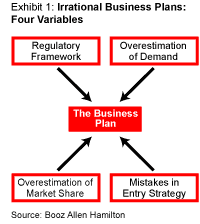 During each step of this process, the combination of conflicting interests, analytical biases, and irrational behavior can become a force that pushes the investment decision in a direction that is inconsistent with rational investor expectations. Herd behavior, premised on the belief that competitors are moving in a direction that might preempt profit maximization or market entry, exacerbates the irrationality, often resulting in a series of mistaken projections of demand and supply for the new service.
Consider the variables that can influence the analytical rigor of the business plan. We have identified four: the regulatory framework, overestimation of demand, overestimation of market share, and mistakes in entry strategy. (See Exhibit 1.) Not all variables appear simultaneously, but at least two of the four tend to emerge when a telecommunications business plan is under development.
Nobel Prize–winning economist Joseph Stiglitz, in his keynote presentation at the 2002 Columbia University conference “The New Telecommunications Industry and Financial Markets: From Utility to Volatility,” established that deregulation has been associated with speculative bubbles through time. And indeed, in the telecommunications industry, the regulatory framework fashioned by governments to promote competition is the dominant variable in driving irrational exuberance, having prompted in many countries a flurry of new participants in search of business opportunities.
Governments face conflicting objectives when authorizing players to compete in a market. A capital-intensive industry such as telecommunications exhibits extremely strong economies of scale, which argues for a limited number of competitors doing business, with strong regulatory oversight. Accordingly, a government hoping to create a vibrant industry should naturally limit entry to a few players.
However, governments, especially in emerging countries, are also motivated by revenue needs. Particularly in the wireless industry, the larger the number of spectrum positions available for licensing, the better it is for the national treasury, regardless of the ultimate sustainability of individual players. Because a multiplicity of players also leads to rapid job creation and an influx of foreign investment, governments will tend to allow operators unlimited entry, whatever the long-term impact. In many cases, governments have rationalized the desirability of this open market by promoting the consumer benefits that result from competition.
In addition to the economic incentive, we have found that governments will adopt policies in direct imitation of other countries’ regulatory frameworks, without regard to their suitability in a different environment. Geographical propinquity — “copying your neighbor” — and common membership in international organizations contribute to such reckless policy diffusion. Developing countries also commonly copy deregulation models adopted by industrialized nations before the effectiveness of those models can be properly assessed.
Whereas governments’ short-term economic and political needs bias them in favor of unlimited entry, one might expect corporate investors to operate more circumspectly. Yet, typically, companies systematically follow the lead of governments and pile into newly opened markets, despite limitations that should be obvious. In Chile, for example, 21 investors applied for a long-distance license to operate in a market valued at only $500 million. By not restricting entry on the basis of natural monopoly or minimum efficient market-share assumptions, government serves as a critical enabler of irrational exuberance.
In the case of the hotly debated 2001 U.S. wireless auctions, irrational bidding behavior was probably directly attributable to the regulatory process; regulators, after all, designed the auction. Because the public policy goal was to encourage more entrepreneurial participants, up-front payments were reduced and payment periods extended. New entrants joined traditional players in the auction. With limited capital at risk in the case of loss or default, the increased number of players with varying risk profiles caused bids to rise significantly above previously recorded levels.
Demand Myths
The second variable commonly present in the development of an irrationally exuberant business plan is the overestimation of market potential. As Charles Kindleberger noted, “Investors tend to choose the wrong modeling tool, fail to take account of a critical piece of information, or go so far as to suppress information that does not conform to the business case implicitly adopted.”
In the telecommunications industry, we have found two primary mechanisms by which companies systematically overestimate demand, which we have labeled the “myth of unmet demand” and the “myth of 1 percent technological substitution.”
In the first myth, corporate investors assume that a new service or technology platform will meet important unsatisfied needs. Although that might be the case on rare occasions, those who fell prey to the myth of unmet demand during the wireless mania ignored the difference between primary and secondary demand for telecommunications services. In communications, primary demand is already largely met by existing technologies and services; new services may enable companies to capture a portion of that original demand, and even to stimulate some new demand, but users rarely have a completely unmet need. A classic case of primary and secondary demand can be illustrated by the interrelationship between pay phones, calling cards, and wireless telephony. A portion of the primary demand captured by wireless telephony was originally met by a combination of pay phones and calling cards; initial market projections for mobile telephony overestimated demand for wireless by neglecting the existence of these substitutes.
Demand overestimation also results from ignoring basic sociodemographic information — particularly regarding disposable income — to justify a telecommunications investment. For example, over the past 10 years, conventional wisdom established that telecommunications investment in emerging markets was naturally attractive because of the limited capability of monopolies to meet the demand gap. Although this was partly true, the fact was that the privatization of state monopolies, which generally occurred before deregulation (Colombia and South Korea are the exceptions), allowed those carriers to close the demand gap very effectively in their markets. New entrants anticipating a frenzy of unmet demand were left to compete for existing users.
New entrants also became excited about serving low-income segments of the population. But the barriers to this strategy are far steeper than many players realized. In Latin America, 70 percent of the population does not have access to telephone service; although this is a business opportunity, meeting it is a hard climb. Those who make up this population do not have the disposable income to purchase the service, and they will probably never become users unless they benefit from universal service policies.
The myth of 1 percent technological substitution, the other common cause of demand overestimation, refers to a statement that showed up in many business plans during the past several years, to the effect that a “mere 1 percent share” of the total telecom market would yield an adequate return on the investment. Such unexamined assertions trivialized the target and vastly understated the risks of telecom ventures. Worse, by defining the market as the aggregate demand for all telecommunications services, this rationale inaccurately assessed primary demand for a newly planned service.
Why did these myths — and other examples of investors’ demand overestimation — persist? One reason is the misuse of market-sizing indicators. For example, to justify entry into the data communications segment, business plan after business plan accepted without critical evaluation the projection that Internet traffic would double every month or two over an extended time horizon. Hindsight has shown that few investors extrapolated traffic correctly. They looked, for example, at traffic growth in the context of initial adoption stages, when the increase is naturally explosive, but routinely failed to take into account mitigating data, such as computer usage growth patterns. Had corporate investors done that, they would have concluded that achieving projections based on the extrapolation of growth rates characteristic of incubation periods was impossible.
Another reason for demand overestimation is the use of forecasting techniques that are just plain poor, such as historical or geographical extrapolation. A classic example is that of a company planning to invest in cellular services in the interior of an emerging country. Many companies in this situation assumed that the average revenue per subscriber in the provinces would be the same as that of users in the nation’s capital. Yet cell phone usage in the interior of the country is almost always significantly lower than that in the main urban center: The size of cities — one of the variables that drive cell phone usage — is considerably smaller outside the capital, and smaller cities result in less time “on the move,” and therefore less cell phone usage. This analytical fallacy, in which individuals tend to make judgments by looking for similarities with previously known observations without expanding their frame of reference, is known in psychology as the representativeness heuristic.
Anchor Metrics
“Anchoring heuristics” also influence estimations of market size and company valuation. During the telecom bubble, we saw clearly that investors anchor and adjust the value of a company in a transaction on the basis of their past experience, notably the initial transactions in the market, even if those transactions had little bearing on what followed. For example, when WorldCom Inc. acquired MFS Communications Company Inc., it established for future transactions a valuation metric of six times assets. By using this as an anchor metric, however, later investors failed to take into account the revenue streams of individual companies or market structures at the time of the transaction. A competitive local exchange carrier (CLEC) in a duopoly — the situation when WorldCom bought MFS — is worth more than a CLEC in a fully competitive market. Often, market dynamics will shift, while the anchoring metric remains stable. New companies will enter the market and acquire funding based on the principle that if they can install the assets in the ground, they can achieve the anchor multiple. At the same time, competition increases, prices decline, and demand saturation leads to overcapacity and overvaluations.
The third variable contributing to a flawed business plan is the company’s misestimation of potential market share. This estimation falls victim to what economists label the “fallacy of composition.” According to this effect, the action of each individual agent is rational — or would be, were it not for the fact that others, also behaving rationally, collectively arrive at inaccurate conclusions. Investors may, for example, each estimate total demand accurately; but their market share projections do not incorporate the existence of many players going after the same market, leading them to vastly overestimate primary demand by effectively aggregating the market shares that all competitors intend to capture. A classic example of how convergent strategies lead to market-share misestimation can be found in the U.S. market, where the sum of CLECs’ projected market share was 20 times the actual aggregate demand in the local exchange market.
The fourth common investment mistake relates to errors committed at the time an entry strategy is developed. Even if demand and, consequently, potential revenues have been correctly assessed, investors can fall into what we call the critical mass trap. Akin to the myth of 1 percent technological substitution, the critical mass trap describes a firm’s overextension of its targeted area of service to reduce the burden of capturing a large share of a smaller market. This results in a “land grab,” which ratchets up the level of capital expenditures — an error that helps explain the plethora of bankrupt CLECs in the U.S. market.
The business planning mistakes we saw during a decade of irrational exuberance in the telecommunications industry show that Professor Shiller may have underplayed the illogic in corporate investment decision making. Professor Shiller attributes stock market investors’ exuberance in part to “the psychological principle that much of the human thinking that results in action is not quantitative, but instead takes the form of storytelling and justification … with no quantitative dimension.” Yet the decision making in telecommunications investment is full of quantitative analysis — analysis plagued with analytical fallacies.
The Financing Trap
In his analysis of investment manias, Professor Kindleberger established that booms are typically fed by an expansion of bank credit that enlarges the total money supply. Thus, the sources of financing often act as a stimulus for, rather than as a check against, investors’ irrationality. The telecommunications industry’s recent history supports Professor Kindleberger’s thesis. We have observed two occasionally overlapping financing effects, depending on whether funding comes from financial institutions or equipment providers. (See Exhibit 2.)
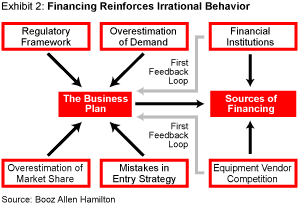
First, financial institutions, driven to secure a position with new companies and (as we’ve seen in recent revelations about the porous walls between financial institutions’ research and investment banking divisions) unburdened by analytical rigor, routinely extended credit without regard to the quality of a business plan. Herd behavior, in which private equity investors often ended up trusting and following another investor’s due diligence instead of their own, was also common. Another variant in this syndrome could be an adaptation of the well-known “IBM effect”: Nobody was going to get fired for investing in telecoms from 1996 to 2000.
Telecommunications equipment providers similarly fed the investment mania. Driven by the competitive imperative to build leading positions in the industry and pushed by sales forces eager to close deals, manufacturers overextended themselves, providing credit to finance equipment purchases by startup service providers and shortcutting the due diligence required by the treasury function to authorize the extension of credit. (Similar behavior by banks underlay the Latin American debt crisis in the 1980s.)
The tension between treasury and sales at equipment manufacturers during the recent telecom bubble was profound. In typical situations, competing equipment providers aimed at capturing business from a startup operator. In addition to selecting equipment based on functional requirements, new operators were particularly keen to reduce their capital expenditures, so the equipment providers competed not only to provide more elaborate equipment features and value-added services, but also to provide more appealing financing conditions. If the equipment manufacturer, on its own or with a financial institution as partner, assumes the lending responsibility, the financing application is examined in light of the startup’s business plan and the new company’s ability to generate free cash flows to service its debt.
Under these conditions, a conflict typically emerges between the manufacturer’s sales function and the treasury function. Treasury and credit need to perform the due diligence on the business plan to certify that lending conditions are in compliance with prudent credit risk management principles. The sales division, though, has an incentive to close the sale, and therefore sees the examination of the startup business plan as a perfunctory step “to keep treasury satisfied.” In periods of expansion, the sales function tends to hold the upper hand and in many cases is successful in selling to a startup despite the credit risk. This situation is reinforced by short-term pressure on quarterly earnings, when revenues become more important than customer profitability. In other words, the due diligence process fails to act as a check against irrational exuberance.
Indeed, the bubble has shown that due diligence, instead of serving as a rational, analytical, and objective restraint on the natural tendencies of internal competitors to fall prey to exuberance, actually serves in some cases to amplify, or at least validate, the irrational behavior. Interaction between decision makers (e.g., founders or managers leading the entry into the new business) and lenders becomes fraught with peer pressure, group thinking, and moral superiority (derived from presumed “visionary thinking”), deployed in the context of what Professor Shiller calls “a complex social and psychological environment.”
Irrationality in Public Markets
Having completed the business plan and a first round of financing, entrants into a new segment of the telecom market typically sought a public offering. At this point, the third reinforcement of irrational exuberance emerged: the equity markets. (See Exhibit 3.)
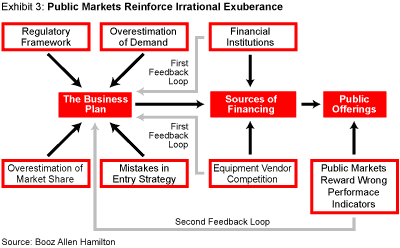
An interesting example of this behavior can be found in the U.S. CLEC industry. In the middle of the telecommunications bubble, the conventional wisdom of operators, reinforced by equity research analysts, was that a new carrier’s market capitalization was driven directly by the number of markets in which the service was launched. Similarly, stock value was related primarily to capital expenditures on plant, property, and equipment. This premise put pressure on companies to “land grab” across multiple markets, without regard to customer acquisition, revenues, and profits.
Another irrationally exuberant mechanism reinforced by the stock market is what we label the “consistency of strategy” story. During the telecom frenzy, operators tended to allocate resources beyond the optimal level in a new business in order to send a “signal” to the stock market regarding their consistency in executing a given strategy. If the market perceives the new investment as consistent with the original strategic intent, it will reward the operator with a higher market valuation, even if the investment does not necessarily yield a positive return to shareholders.
In this process, sell-side research acts as a primary reinforcement vehicle, since equity analysts in investment houses are generally those who interpret the signals sent by public companies in terms of their strategy and implementation. This effect also supports Professor Shiller’s notion that, in many cases, a narrative (also referred to as “the investment story”) trumps analysis.
We have observed these kinds of investments particularly in cross-border market expansions, in bidding for the acquisition of controlling interests in privatized telecommunications companies, and in spectrum auctions. For example, in 1991, now-defunct GTE purchased a controlling share of the privatized Venezuelan monopoly CANTV. GTE’s bidding price of $1.89 billion represented a 29 percent premium over the $1.47 billion Bell Atlantic/Bell Canada bid.
If information about the carrier’s performance is publicly available to all bidders, what explains the spread between the first and second bids? The privatization sale occurred at a time when GTE was aggressively trying to expand overseas. Having lost several privatization bids to competing foreign entrants, GTE management considered it necessary to send a signal to the markets that it had decided to invest overseas and that it was delivering against that strategy. This last factor was entirely external to any rigorous analysis of the return on investment and the rational bid that would result from it. The opportunity to signal to financial markets, which were rewarding consistency, appeared to be the primary driver.
The fact is that in the telecommunications industry, the markets tended, at least throughout the bubble period, to rely on stories spun on specific investments rather than information about demand, supply, and the returns on a specific investment. Although the basic information existed, the analytics that were needed to pull together the required conclusions were not carried out. In this context, the markets reacted positively to the investment story, feeding back a reinforcement of irrational behavior. Public markets also fed back irrational exuberance to private sources of funding. The astronomical market valuations drove the private equity funds and lenders to support untenable telecom business plans.
Is Exuberance Schumpeterian?
An exploration of the factors that drove irrational exuberance in telecom leads to an important question: Can the behavior of investors be avoided, or is it, in fact, intrinsic to the process of creative destruction identified by Joseph Schumpeter? In other words, should we look at irrational exuberance as a situation to be avoided — or might it be a fundamental component of economic development and growth?
The answer is probably that irrational exuberance has a temporarily disruptive but ultimately neutral impact on development. Deregulation did produce the widest benefits to consumers seen in decades — in the form of product availability and declining prices — allowing one to argue that irrational exuberance is an important development factor, the dramatic disruptions in labor and loss of shareholder value notwithstanding. Yet the current industry downturn and impending consolidation have considerably dampened enthusiasm in — and for — the industry. Regulators are endorsing consolidation and favoring balanced oligopolies. Investors are shying away from new ventures. Most financial transactions are focused on restructuring and asset sales. They soon will turn to acquisitions. This will likely retard growth, and certainly will hinder entrepreneurial development.
If cyclicality is one of the intrinsic features of the telecommunications industry, we can envision a medium-term scenario wherein some of the forces and variables mentioned in this article will reoccur. Consolidation and a return to price rationalization, combined with a Schumpeter-style technological shock (might it be broadband?) will result in higher prices and, consequently, intrinsically attractive opportunities, which will foster a renewed cycle of market entry.
Under this scenario, lessons from the past bubble and practices to be avoided will help temper volatility swings. Policy development processes that are subject to endless interest-group lobbying, filings, and compromise tend to blur objectives. It is critical for government policymakers to conduct a comprehensive assessment of regulatory frameworks under consideration, by first explicitly considering the objectives the new policy is supposed to meet, and then examining the tools and mechanisms to be relied upon. Similarly, policymakers in emerging countries will have to develop the capability to design regulatory frameworks that are based on their specific market and social realities, as opposed to recklessly imitating models put forward in industrialized or neighboring countries.
On the corporate side, it is imperative that decision makers introduce governance mechanisms that provide a safety net to irrationally exuberant behaviors. Best practices today argue for smaller executive boards, made up of the CEO, the CFO, and a couple of executives, that can provide the central point for both decision making and accountability. Another best practice is the use of “red teams,” reporting to the CEO and the board of directors, whose function is to conduct the due diligence on key investment decisions. Executives should also put renewed emphasis on independent risk analysis as the primary vehicle to understand what can go wrong, and how to manage it.
Some of these practices are not new. Learning from past experience should push both industry executives and policymakers to become more rigorous in their implementation. 
Reprint No. 03206
| Authors
Raul L. Katz, katz_raul@bah.com Raul L. Katz is a vice president with Booz Allen Hamilton's New York office. He had 18 years of experience specializing in business strategy, consumer and industrial marketing, and the management of international telecommunications companies. |
