
Strategy: An Executive’s Definition
What is a business strategy? It is the result of choices made to maximize long-term value.
This article was written with Kasturi Rangan and Evan Hirsh.
The question “What is strategy?” has spurred numerous doctoral dissertations, countless hours of research, and hearty disagreement among serious management thinkers. Perhaps this is why many executives also struggle with it. Nonetheless, decision makers seeking to steer a business to sustained success need a succinct and pragmatic response. After all, it can only help executives to have a shared definition when they are creating, communicating, and implementing a strategy for their business.

Illustration by Otto Steininger
So, what is a business strategy? Strategy is different from vision, mission, goals, priorities, and plans. It is the result of choices executives make, on where to play and how to win, to maximize long-term value.
“Where to play” specifies the target market in terms of the customers and the needs to be served. The best way to define a target market is highly situational. It can be defined in any number of ways, such as by where the target customers are (for example, in certain parts of the world or in particular parts of town), how they buy (perhaps through specific channels), who they are (their particular demographics and other innate characteristics), when they buy (for example, on particular occasions), what they buy (for instance, are they price buyers or service hounds?), and for whom they buy (themselves, friends, family, their company, or their customers?).
THE STRATEGY+BUSINESS COLLECTION: THE EXECUTIVE GUIDE TO STRATEGY
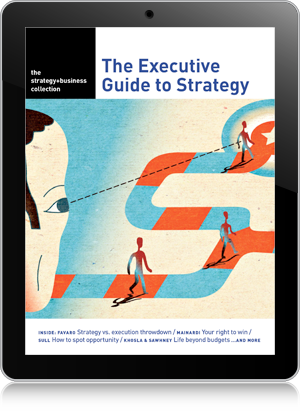 This article is featured in the strategy+business compendium “The Executive Guide to Strategy,” designed exclusively for smartphones and tablets. The collection features our best thinking on creating and implementing the right strategy for your organization—with insights from top leaders including Capable Strategist author Ken Favaro, HBS Professor Cynthia Montgomery, strategy expert Ram Charan, and Kellogg School’s Mohanbir Sawhney.
To download, select your device:





Having a differentiated approach to a target market can be a source of great advantage. Southwest Airlines Company is a case in point. Early in its development, Southwest defined its target market to include regular bus travelers — people who wanted to get from point A to point B in the lowest-cost, most convenient way. In contrast to the industry’s hub-and-spoke standard, Southwest’s point-to-point operations and hassle-free service model offered a compelling value proposition for people who would otherwise choose bus travel. This gave the company a unique growth path compared to the traditional airlines.
Or consider Sir Brian Pitman, the former CEO of Lloyds TSB: He had a policy of defining the company’s target markets at one level of segmentation lower than the competition did. For example, Lloyds was the first “high street” (retail) bank in the U.K. to carve out “high net worth” as a separate business with its own unique target customer, value proposition, and system of essential capabilities. Similarly, it was the first British commercial bank to drop large companies as a target customer (with a few “flagship” client companies as exceptions). Sir Brian’s insight — that you could win by being sharper than the competition in choosing your target market — turned Lloyds from the United Kingdom’s banking laggard to its leading bank.
In both the Southwest and Lloyds cases, “where to play” was an essential part of what made the company’s strategy so successful for such a long time.
“How to win” spells out the value proposition that will distinguish a business in the eyes of its target customers, along with the capabilities that will give it an essential advantage in delivering that value proposition. Choices must be made because there is at least one way to win in every market, but not everyone can win in any given market. With good choices, a business gains the right to win in its target markets. The target market, value proposition, and capabilities must hang together in a coherent way. And good strategies call for the right amount of “capabilities stretch”: not too much or too little change from the capabilities a business already has.
Every company faces innumerable options for where to play and how to win. Often it has to sort out seemingly conflicting objectives, such as the need for both long-term growth and short-term profitability, to choose which options to pursue. To “maximize long-term value” means — when there are mutually exclusive options — to select those that will give the greatest sustained increase to the company’s economic value. We once heard a corporate leader ask, “But how can you ever know when you have maximized value?” The fact is, you can’t, because you can never know with certainty if there’s a better option than those you’ve considered so far. To “maximize long-term value” is to never stop looking for those higher-value options.
It’s worth emphasizing that “maximizing long-term value” is not the same thing as “maximizing share price” or “maximizing shareholder value.” Those objectives typically represent the more short-term demands of current shareholders or their advisors, and they do not always align with what is best for all shareholders, particularly long-term owners. On the other hand, “maximizing long-term value” does not mean forgetting about the short term. Economic value takes into account growth and profitability, the short term and long term, and risk as well as reward.
To define the fundamentals of your business strategy, you need only to answer three questions:
1. Who is the target customer?
2. What is the value proposition to that customer?
3. What are the essential capabilities needed to deliver that value proposition?
Without clear and coherent answers to these three questions, you may have an exciting vision, a compelling mission, clear goals, and an ambitious strategic plan with many actions under way, but you won’t have a strategy. 
Reprint No. cs00002
Author profiles:
- Ken Favaro is a senior partner with Booz & Company’s enterprise strategy practice, and is based in New York.
- Evan Hirsh is a partner with Booz & Company’s engineered products and services practice, and is based in Cleveland.
- Kasturi Rangan is a principal with Booz & Company’s engineered products and services practice, and is based in Cleveland.