
Is State Control Making a Comeback?
In considering the relationship between the public and private sectors, it’s time to distinguish the plausible visions of the future — such as a new regulatory environment — from those, like permanent government ownership of banks and industry, that are not plausible.
(originally published by Booz & Company)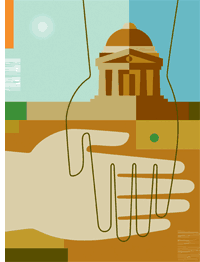 |
|
Illustration by Paul Wearing
|
Fashions go in cycles: Tapered trousers and flares may alternate, along with wide and narrow ties, or long and short hemlines. But it is rarely the case that the old comes back in exactly the form it held previously. And so it is now with the global financial system. Although massive state investments in private enterprise have definitely made a comeback, the realities don’t necessarily mean what the rhetoric might suggest — at least to those who look for precedents from an earlier time.
I saw this cycle firsthand as a civil servant in the United Kingdom. For 35 years after World War II, the “commanding heights of the economy,” such as coal, steel, electricity and gas, telecommunications, and aviation were state owned. Then, in the 1980s and 1990s, we rolled back the boundaries of the country’s public sector through an extensive privatization program. In the end, out of a dozen public enterprises, only the Royal Mail remained in state hands — and the government is still trying to sell that.
From the 1980s onward, the prevailing philosophy around the world was that regulation was a disagreeable necessity. It needed to be trimmed back, lightened up, and based more on principles than on rules. Particular regulations were often justified as corrections for market failure, but the overall body of regulation was itself seen as a market failure: The costs were not borne by those who imposed them. So left to itself, regulation would tend to expand beyond the optimum and needed to be cut back constantly.
Although each country had chosen its own point on the continuum between free markets and state control, almost universally the direction of travel was toward the free market end of the spectrum. The Chinese, the Russians, and even the French all kept moving in that direction.
Then came 2008. The events of last year have profoundly shaken many people’s faith in free markets. There has been extensive state intervention in many countries, including the U.S., the U.K., Germany, the Netherlands, and Ireland. Governments have acquired full or extensive ownership of banks and shadow banks, providing them with huge sums of state assistance. Other sectors, such as housing construction and motor vehicles, have been given support. There has been revulsion among the public at some of the remuneration packages that have been exposed, leading to a desire for heavier regulation of many financial industry practices.
It is natural to wonder: Does this new era of greater state control and regulation mean that capitalism as we know it is finished? Will it reemerge in some very different form? When the dust of the economic crisis settles, could a new order genuinely come to pass in which governments, either by choice or by accident, become major stakeholders (or “state-holders,” as financier Robert Gogel has called them) in business?
Some observers are salivating over this possibility; others are already protesting against it. And there is talk of more countries adopting the Scandinavian model of an expanded welfare state.
There are good reasons, however, to be skeptical that any of this will happen. Although there will be new regulatory regimes throughout the world, there is little or no chance that the government will end up permanently owning and running the banks, and still less of its owning industry at large.
The Limits on State Ownership
To understand why, let us look at the financial system as it is emerging today. All the rhetoric from political leaders, those who are putting bailouts into practice, refers to those interventions as “temporary public ownership.” The recent U.K. Banking Act uses that phrase explicitly. The U.S. Treasury Department has regularly referred to the objective of selling back the assets it is acquiring. At American International Group (AIG), this process has already begun.
In the meantime, the model being developed is arm’s-length management. One senior banker in the U.K. said that the state is “just another name on the share register.” The United Kingdom has set up a double-distancing mechanism, in which an intermediary body (United Kingdom Financial Investments Ltd., or UKFI) has taken the holdings from the Treasury, and it is managing them at a distance. Bank directors are described as “government approved,” not “government appointed,” and each bank’s board is explicitly mandated to serve the interests of the company, rather than any constituency that voted for the directors. The Netherlands government has instituted a similar approach. In the U.K., in sectors other than banking, such as housing or automobiles, state aid and loan guarantees are approved only as temporary or “time-limited.”
Certainly, it is possible that the world’s policymakers and business leaders are deluding themselves and their constituents, adjusting their horizons only partially and with a lag as the world around them changes. But it is unlikely that they would want, or be allowed to return to, state control of private enterprise. Although there have been major failings in the financial sector, and much of the crisis can be attributed to the collective actions of banks and investment firms, governments have “had a bad war” too.
Governments collectively allowed huge imbalances to build up in the world economy. The adoption of inflation targeting based solely on prices of consumer goods allowed asset inflation to develop. The U.S. government actively encouraged subprime lending; the U.S. and other governments, because of their vested interest in growth and tax revenues, bought into the housing and consumer booms. They created a flawed regulation system and acquiesced in allowing banks to cheat by creating off–balance sheet financial vehicles. Governments were slow to spot signs of trouble and then fumbled their responses, clinging to fears about moral hazard or inflation long after they ceased to be relevant threats.
In short, governments’ credibility and moral stature are, at best, tarnished. The public is unlikely to endorse a role for government in managing industry, no matter how angry people are at the financial system. Many people still remember the old state enterprises, such as British Rail and the early Amtrak system, and not always with affection.
Governments will also be constrained by a variety of other factors. Their finances are under strain, with debt levels far beyond old, established limits. They are struggling to fund even their existing responsibilities and will not want to assume responsibility for funding the capital requirements of state enterprises. Governments and their agencies tend to lack people with the capability for direct financial management in a commercial setting. They will rightfully be uncomfortable taking direct responsibility for banks’ lending and foreclosure policies, remuneration systems, and commercial sponsorships.
And governments face constitutional limitations. In Europe, for example, the doctrine of state aid controls — forbidding any government intervention from distorting competition or intra-community trade — is hard-wired into the founding treaties of the European Union. If governments get too involved in underwriting or managing the borrowing of some banks, and thus compete with others that have to raise their capital in the open market, this principle would be jeopardized.
For all these reasons, few policymakers will want to take on responsibility for managing financial services. They will give priority instead to selling the assets they have acquired in order to improve their own damaged balance sheets.
Post-downturn Regulation
But if a permanent expansion of state ownership is unlikely, what about a revival of regulation? In banking and finance, there will undoubtedly be a tightening of regulation and a retreat from the idea that risk is best dealt with by encouraging each enterprise to make its own judgments. The governor of the Bank of England, Mervyn King, has observed that international banking is “global in life, but national in death.” From this has arisen renewed interest in supranational regulation whether in the form of a genuine E.U. regulator or closer cooperation among national regulators.
A huge list of possible changes is emerging from a series of reports by regulators and government working groups. (See Resources.) Whichever menu items are enacted, this new agenda will include more attention to systemic risk, revision of the Basel Accord to build in rising capital requirements as leverage increases, greater transparency, reform of rating agencies, a revision of mark-to-market accounting, and changes to the basis of remuneration.
The structure of banking will also change. In the U.S., this is unlikely to take the form of a statutory return to the Glass-Steagall Act (the 1930s law, repealed in 1999) that prohibited a bank holding company from owning other financial companies. But riskier forms of banking will require more capital to be posted, and the increased expense will constrain banks’ expansion. (It will be like Glass-Steagall without the Act.)
Trust and simplicity will become major selling points. Enterprises that offer closer connection with their customers will see major opportunities. There could be a global renaissance of financial-services institutions that have a mutual or cooperative tradition, of which there are many in Europe. The over-zealous promotion of debt-financed home ownership will be scaled back. Governments will give greater priority to ensuring that people provide for their ever-longer retirements.
The pace of global integration of financial-services institutions could also slow down, or perhaps even partially reverse. For a while, bankers will have to concentrate on getting things right at home. And political leaders will continue to question the economic purpose and social justice of income differentials that have widened dramatically in the last five or six years. The morality of paying the person at the top 500 or 1,000 times the pay of those on the shop floor or in the banking hall will come under challenge. The solution may be a combination of governance changes and heavier taxation of higher incomes.
Many people today think that finance has become too disconnected from the real-world activities it is meant to support. That point of view will become more common, and will influence both rules and practices. There will be calls for greater transparency and simplicity in business finance. Those who lend money will have to have a better sense of the value of underlying assets. Simplicity is not good news for the private equity world, which puts a lot of financial engineering and debt between the underlying production and the financial results.
If I am right that there will not be a massive expansion of public ownership, we may well see a resurgence of publicly supported bodies that provide financing to small and medium-sized enterprises and to the housing sector. They will need to be structured to avoid repeating the disasters of Fannie Mae and Freddie Mac. There could be a revival of the European Investment Bank and national equivalents. Interest in domestic sovereign wealth funds will grow.
Please note what all of these possibilities, even at their most draconian, do not include: a movement toward stricter regulation in the nonfinancial world. Nonfinancial businesses already had their moment earlier this decade when excesses came to light in companies such as Enron, WorldCom, Tyco, and Parmalat. Those scandals gave rise to the United States’ Sarbanes-Oxley legislation and the tightening of auditing and corporate governance worldwide. But since 2008, at least so far, there has been an absence of major scandals in the industrial sector, which sees itself as victim rather than villain. It would take a cause célèbre in the nonfinancial sphere to raise public pressure for greater regulation of business as a whole. In difficult trading conditions, governments will be reluctant to impose further regulatory burdens.
Capitalists Still
When this tornado has blown over, the world will not land where it was in 2007. But it will still be recognizably a capitalist world, albeit with the pendulum having swung back a bit along the state/market arc. The harsh rhetoric about getting the state off our backs will be tempered, and some of the widening in the disparity of incomes will be reversed. The change will be much more profound in the world of banking and finance than in the rest of commerce. But the commitment to the liberal trading regime on which the whole E.U. has been founded will survive. Although the hopes of those who wish to expand the liberal trading regime of the World Trade Organization in the Doha Round may be disappointed, what is there already will largely survive.
When people claim that faith has been lost in the free market system, they fail to distinguish what is genuinely flawed and needs to be fixed from what is still valued. The imbalances in the global economy certainly need to be addressed, though regrettably the Group of 20 (G-20) has offered little or no guidance. In addition, risk management, regulation, and remuneration policies in the banking system need massive change. But have we lost faith in the value of competition? Or in the benefits of open trading markets policed by the WTO? Or in the importance of properly functioning labor markets? Or in the corporate governance of the broad mass of companies? No, we have not.
Nevertheless, it will be a chastened capitalist world, shorn of much of its swagger, in which both politicians and business leaders will have a mountain to climb to rebuild their credibility and authority.
Lord Andrew Turnbull is a senior advisor to Booz & Company in London, and the U.K.’s former secretary of the cabinet and head of the Home Civil Service. He is chairman of BH Global Ltd. and a nonexecutive director of Prudential PLC, the British Land Company PLC, and Frontier Economics.