

Strategies for Global Connectedness
National efforts to expand international flows—of trade, capital, information, and people—can be a major leverage point for raising prosperity.

Illustration by Lars Leetaru
Not that long ago, the world was supposed to be flat. Hardly a day passed without references to globalization and “borderless markets.” Many policymakers and business leaders jumped on the bandwagon, treating all interconnection among countries as equally beneficial.
But this perception that “the world is flat” was so exaggerated that it is fair to call it “globaloney.” The last few years—of financial crises, weak growth, and mounting protectionist pressures—have demonstrated that the world is far less connected than it appeared to be. The real world is roughly only 10 to 25 percent globalized. Most activities that could take place either across or within national borders are still domestic. Moreover, the trend is toward further localization. The same policymakers and business leaders who once sought universal openness are focusing their investment, attention, and effort within their own home countries. Few leaders, however, have actually measured the level of globalization that exists in their country; fewer still have quantified the untapped potential for growth in their countries. If they had, they would recognize that they need increased global connection, even more than before—but in a smarter, more conscious, more considered form.
In plotting a course toward smarter integration, the differences among countries matter a great deal. Two attributes merit special consideration. The first is global depth. When used to describe a country’s interactions, it refers to the magnitude of international flows—of trade, capital, information, and people—relative to the size of its domestic economy. In other words, an economy’s depth represents how much of it is devoted to exports or imports. Because international trade and investment are generally beneficial, the practical prescription for most countries is to work toward increasing their depth.
The other important dimension of global connectedness is breadth, which is the extent to which a country’s international trade flows are spread out globally versus confined to a particular set of partner nations. Breadth can be too great or too small: Some countries would benefit from more diversification whereas others could gain more from greater focus. But although the particulars may vary, the general rule holds true around the globe: By strategically increasing international connectedness, political leaders have the potential to unleash tremendous economic and social gains.
Connectedness and Growth
An accurate read of the potential value of globalization for your particular country is the first step. Because public policies and business plans have to be enacted in specific countries and regions, breadth and depth must be analyzed on a country-by-country basis. The DHL Global Connectedness Index, which we compiled for the first time in 2011—and released in an updated and expanded edition in November 2012—was created with this purpose in mind. The index is based exclusively on hard data instead of surveys, to counteract the effects of globaloney. It measures connectedness according to countries’ participation in 10 types of generally beneficial international flows: merchandise trade, services trade, foreign direct investment (FDI), portfolio equity investment, international telephone calls, international Internet traffic (as indicated by the proxy of bandwidth statistics), international trade in printed publications, international tourism, international education, and international migration. (A few types of flows are excluded because the risks seem to outweigh the benefits. For example, the flow of “hot money,” in the form of short-term debt, can be risky; it can rapidly reverse itself, robbing economies of financial capital just when they need it most.) The depth and the breadth of each flow are measured, and the results are aggregated to score and rank each country’s global connectedness.
The 2012 DHL Global Connectedness Index covered data through 2011 for 140 countries, accounting for 99 percent of the world’s GDP and 95 percent of its population. The top 10 overall spots went to, in descending order, the Netherlands, Singapore, Luxembourg, Ireland, Switzerland, the United Kingdom, Belgium, Sweden, Denmark, and Germany. For depth alone, the leaders were small countries: Hong Kong (China), Singapore, and Luxembourg topped the list. Large countries had greater breadth: the United Kingdom, the United States, and the Netherlands led that list.
Depth, in particular, seems to spur economic growth. There is a strong positive correlation across countries between the depth of a country’s global connectedness and measures of its prosperity, such as its GDP per capita and its ranking on the U.N.’s Human Development Index. To be sure, correlation is not the same as causation, but statistical regressions show that after controlling for initial income levels, countries with deeper global connectedness have tended to grow faster than less-connected countries.
Traditional economic models capture only a fraction of the benefits of global connectedness. Six ways to increase value through breadth and depth are feasible: adding volume, decreasing costs (for example, by expanding scale), differentiating or specializing, intensifying competition, normalizing risk, and generating knowledge. Traditional models assume full employment (especially problematic during times like these) and leave out economies of scale, so they capture only part of the gains from adding volume or decreasing costs. Because they leave out the last four activities entirely, they miss such benefits as those that accrued to some U.S. automobile companies in recent years as they increased the quality of their vehicles. Today, General Motors sells more cars in China than in the U.S., diversifying its risks and helping it recover from its economic problems. And cars are becoming “greener” faster because of international knowledge flows.
Taking this full set of factors into account, the gains from expanding merchandise trade alone represent an increase of 2 to 3 percent of global GDP. Although some services (like haircuts) will always be delivered locally, liberalizing trade in services can increase gains from trade to 4 percent of GDP or more. Reducing restrictions on the flow of capital, information, and people could reasonably expand GDP another 4 percent, bringing the total economic gains to 8 percent or more—trillions of dollars in increased income every year. Complementarities among the different types of flows push this estimate up even farther. Cultural, political, and national security benefits often accrue from deeper and broader globalization: Prosperity typically tempers xenophobia, and military conflicts tend to decrease.
How can countries reach this level of globalization? The diversity that is fundamental to our world precludes issuing one-size-fits-all recommendations for policies and practice. Three countries—the Netherlands, India, and Mexico—demonstrate the range of choices available to decision makers.
The Netherlands: Room to Gain
In 2011, the Netherlands was a leader in global connectedness, ranking fifth in depth and third in breadth. It had hundreds of times the depth of the least connected country, Burundi. The Netherlands’ ranking is unsurprising; it was one of the pioneers of global trade centuries ago, remains a key trading hub, and is at the center of Europe, the world’s most interconnected continent.
But even the Netherlands has significant headroom for gains from increasing globalization. Although its merchandise exports represented 79 percent of its GDP in 2011, more than half of its manufacturing exports flowed through the country rather than originating within it. From the standpoint of a Dutch manufacturer (as opposed to a Dutch importer), there is still a great deal of export growth potential. The depth of the Netherlands’ home-produced merchandise exports is closer to 30 or 40 percent.
The breadth of the Netherlands’ merchandise exports also indicates significant growth potential. In 2011, 80 percent of the Netherlands’ merchandise exports went to destinations within Europe, even though Europe makes up only about 30 percent of the world economy. There are similar proportions for its capital flows (68 percent of the Netherlands’ incoming foreign direct investment came from Europe), its information flows (76 percent of its international calls occurred within Europe), and its migration of people (46 percent of Dutch emigrants stayed in Europe).
There are signs that the Dutch are interested in more connectedness. In the September 2012 national parliament elections, the two winning parties (Liberal and Labour) were pro–European Union. Nonetheless, there is still some major opposition to connectedness in the Netherlands. This is represented by the Socialist party on the left, and on the right by Geert Wilders’s nationalist Party for Freedom, which tied for third place.
India: Distant Markets
India is much less connected than the Netherlands, ranking 62nd overall and 119th in depth. But it ranks 20th in breadth. The low depth score is not as alarming as it might seem; large countries, with vast internal markets, tend to have lower depth scores, and countries with lower per capita income score lower in both depth and breadth.
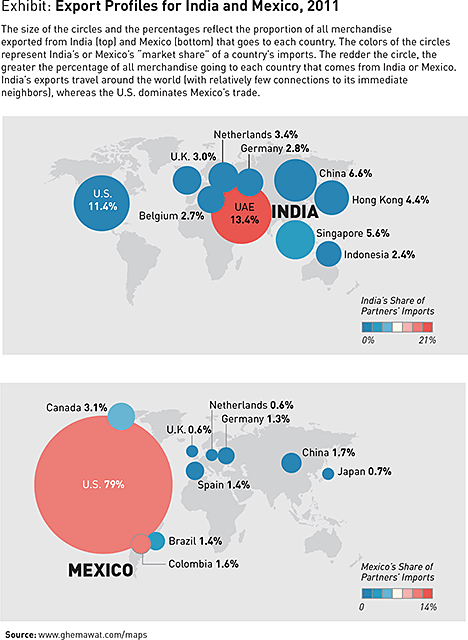
India’s high breadth score, on the other hand, is cause for concern. It derives, in part, from the country’s troubled relationships with its closest geographical neighbors. For example, Indian trade with Pakistan, according to one study, is only 2 to 4 percent of what it might be under friendlier circumstances. The rest of India’s neighbors are relatively small and poor, presenting limited opportunities compared with, for example, the benefits China realized by tying into Japanese and Korean production networks. It is neither exaggerated nor xenophobic to say that one of India’s key structural problems is that it is located in a difficult neighborhood. Therefore, although India should lead regional integration with the long-term aim of reducing its breadth, it will be forced to focus on more distant markets than would normally be optimal.
China is the one large close neighbor with which India can trade; indeed, China recently overtook the U.S. as India’s top trading partner. But caution is in order. India runs a huge trade deficit with China and exports mainly primary products there: Copper and iron ore account for nearly one-half of the total. Given the limited progress the U.S. has made in rebalancing its trade with China, it’s hard to see what India might accomplish in the near to medium term. And concerns about India’s trade with China are reinforced by historical tensions and the inevitable competition between rising powers.
India has a lot to gain, however, from increasing trade within its own borders. Trade among Indian states represents an underexploited opportunity; sales taxes favoring in-state producers are just one example of the internal trade barriers that could profitably be reduced. Another point of high leverage would be to invest in improving India’s notoriously bad domestic infrastructure. Tackling corruption must also be a priority. There is striking evidence in the 2012 DHL Global Connectedness Index that improving the domestic business environment not only helps domestic businesses, but boosts international connectedness as well, because foreigners tend to be sensitive to such domestic problems.
Finally, Indian policymakers and business executives should take advantage of the country’s historical bridges to the rest of the world, particularly its people’s English-language proficiency. More than 80 percent of India’s IT services exports, for instance, are to English-speaking countries. The Indian diaspora and the Commonwealth can also be tapped, along with “South–South” connections that leverage common interests between Indian enterprises and their counterparts in Southeast Asia, Central Asia, and Africa.
Mexico: Beyond the U.S.
Mexico ranks even lower than India (84th overall, 93rd in depth, and 68th in breadth), but unlike India, Mexico has too little breadth. Between 2007 and 2011 (a time span chosen to smooth out the impact of the financial crisis), 81 percent of Mexico’s merchandise exports went to the United States. It’s natural that the U.S. should be Mexico’s top export partner, but models indicate that its share ought to be lower. That doesn’t mean that Mexico should decrease its exports to the U.S.; instead, the country needs to increase its exports to the rest of the world.
Mexico’s main underexploited opportunities lie in Europe and Asia. Its limited exports to those continents (about 9 percent of its total) are especially surprising because Mexico has signed more free trade agreements than any other country, including accords with the E.U. and Japan. But much of what gets assembled in Mexico contains so much foreign (particularly U.S.) content that it fails to count as Mexican, according to the E.U.’s rules of entry. In general, as a result of its role as an assembler of U.S. products, Mexico enjoys less benefit from its depth than a typical country with its metrics would. According to an analysis by Jaime Serra, who was Mexico’s lead negotiator on the North American Free Trade Agreement (NAFTA), each U.S. dollar of Mexican exports generates only US$1.80 of economic activity in Mexico, versus comparable figures of $2.30 for Brazilian exports and $3.30 for U.S. exports.
Mexico needs to develop more domestic suppliers. That means its policymakers, like those in India, need to improve the country’s domestic business environment. Reducing corruption and improving physical security should be a prominent part of that agenda. Cracking down on monopolies would also help the Mexican economy, and one way to do so is opening the country to more foreign competition.
For Mexican business, too, the agenda is clear. Mexican exporters should invest to capture Asian and European opportunities, raising their game to bridge the greater distances and differences involved. They should not try to take on the world, just focus on winning in a few key markets. And rather than try to sell only on the basis of low costs, they should emphasize upgrading to differentiate their companies from global competitors.
Capitalizing on Connectedness
The examples of the Netherlands, India, and Mexico point the way toward a group of general prescriptions for prosperous engagement.
1. Picture the world to reveal potential gains. Visual images can depict the current flows of trade, capital, information, and people, into and out of each country. They can also show the potential gains from better global connectedness. More than 500 maps depicting how the world looks from the perspectives of nearly 200 countries are available at www.ghemawat.com/maps.
2. Understand what is unique about your country’s situation. Global connections are conditioned heavily by each country’s distinctive cultural, political, geographic, and economic profile. Connectedness strategies must be tailored for each country.
3. Increase depth through domestic and international policies. Every country, even the Netherlands, has much to gain by increasing the depth of its connections. Implement policies that directly support international flows, such as trade facilitation, as well as measures that improve your country’s domestic business environment, such as reducing legal obstacles to starting and running businesses.
4. Analyze breadth to find untapped markets. Some countries focus too much on only a few trading partners, whereas others miss out on nearby opportunities. Don’t treat global connectedness as a zero-sum game; expand your trade rather than just shifting shares from one country to another.
5. Remember the importance of distance. Most countries’ deepest connections will be to other countries within their own regions. In fact, roughly 50 percent of trade, foreign direct investment, and migration take place within regions, and regions with more ties tend to be much more prosperous. This is natural given the extent of cultural, administrative, geographic, and economic commonalities that typically bind regions together.
6. Don’t forget internal connectedness. Large and diverse countries, such as India and Nigeria, can reap substantial gains by weaving their regions together. Even some small, rich countries like Belgium, with its divide between Flanders and Wallonia, have opportunities for greater internal integration.
7. Seek strong flows in both directions: inward and outward. Mexico’s problem of insufficient merchandise export breadth does not carry over to its merchandise imports, nearly half of which come from outside North America. India’s recent rise in the connectedness rankings was powered by outward FDI, masking the fact that it still ranks in the bottom 20 percent of countries in the depth of its inward foreign direct investment.
8. Recognize the importance of imports. Don’t mistake an export-only development strategy for a true global connectedness strategy. Imports of capital goods—machinery, equipment, and infrastructure-related products—boost productivity by facilitating the adoption of new technologies. New evidence suggests that imports might accelerate productivity growth faster than exports. Importing is also usually the first step in the internationalization of small and medium-sized businesses that later go on to export.
9. Recognize the long-term shift in world demand. It can take years, if not generations, to build robust international connections; they are often based on indigenous factors like the proportion of a country’s population that speaks a particular foreign language. For this reason, the shift in the world’s economic center of gravity is vitally important to every country. It has already shifted quite a bit—from the mid-Atlantic in 1980 to around Izmir, Turkey, by 2008; forecasts suggest that it will move to the China–India border by 2050. To participate in the world’s fastest-growing markets, most Western countries will need to increase their breadth by dealing more effectively with cross-country differences and distances.
10. Resist protectionism. Finally, the case for global connectedness needs to be articulated much more clearly—and loudly. Too often, business and political leaders, even those who know better, find it more comfortable to follow public opinion, which is increasingly protectionist in many countries, than to argue forcefully for more integration. To provide just one illustration of why it is so important to correct globaloney, respondents to a recent public survey in France estimated that immigrants make up 24 percent of the country’s population. The correct figure is only 10 percent. Would anti-immigrant rhetoric have been so prominent in the 2012 French elections if the public had a more accurate read on the present extent of globalization?
As the U.S. journalist Walter Lippmann wrote in 1922, “The world that we have to deal with politically is out of reach, out of sight, out of mind. It has to be explored, reported, and imagined.” The opportunities for gains from more global connectedness are not obvious. Most of us need to adjust our world view to see the headroom for gains, and we need to reach out first to form new connections before specific opportunities come into view. We can still benefit enormously from further expansion of the circles of human cooperation, especially when it is done in a deliberate way, capturing tangible gains while avoiding potential pitfalls. 
Reprint No. 00139
Author profileS:
- Pankaj Ghemawat is the Rubiralta Professor of Global Strategy at IESE Business School in Barcelona. His books include World 3.0: Global Prosperity and How to Achieve It (Harvard Business Review Press, 2011) and Redefining Global Strategy: Crossing Borders in a World Where Differences Still Matter (Harvard Business School Press, 2007).
- Steven A. Altman is a senior research associate and lecturer at IESE Business School and a former senior associate at Booz & Company.
