
A Master Model for Mobile Multimedia
Because the customer experience is king, wireless carriers must learn the art of partnering across the value chain.
(originally published by Booz & Company)
 |
|
Photograph by Holly Lindem |
Through third-generation (3G) high-speed networks, and even narrower-band networks, portable multifunction phones will soon reach data transmission power similar to that of personal computers. With wireless technology advancing and average consumers becoming more adventurous, mobile telecom carriers and makers of handheld phones are poised to take the great leap beyond the voice market “invented” by Alexander Graham Bell in 1876, and fully develop the market in mobile data communication.
Certainly, all signs indicate that mobile data — the sounds, pictures, video, and text transmitted through wireless networks — constitutes the biggest new business opportunity for the wireless telecom industry since its inception. When NTT DoCoMo introduced i-mode, the world’s first multimedia mobile data service, three years ago in Japan, it caught on quickly with teens, who were captivated by playing games, e-mailing text messages, and downloading ring tones from the Internet. Today, a burgeoning population of consumers of all ages around the world fancies possessing a single mobile device for communication, organization, and entertainment.
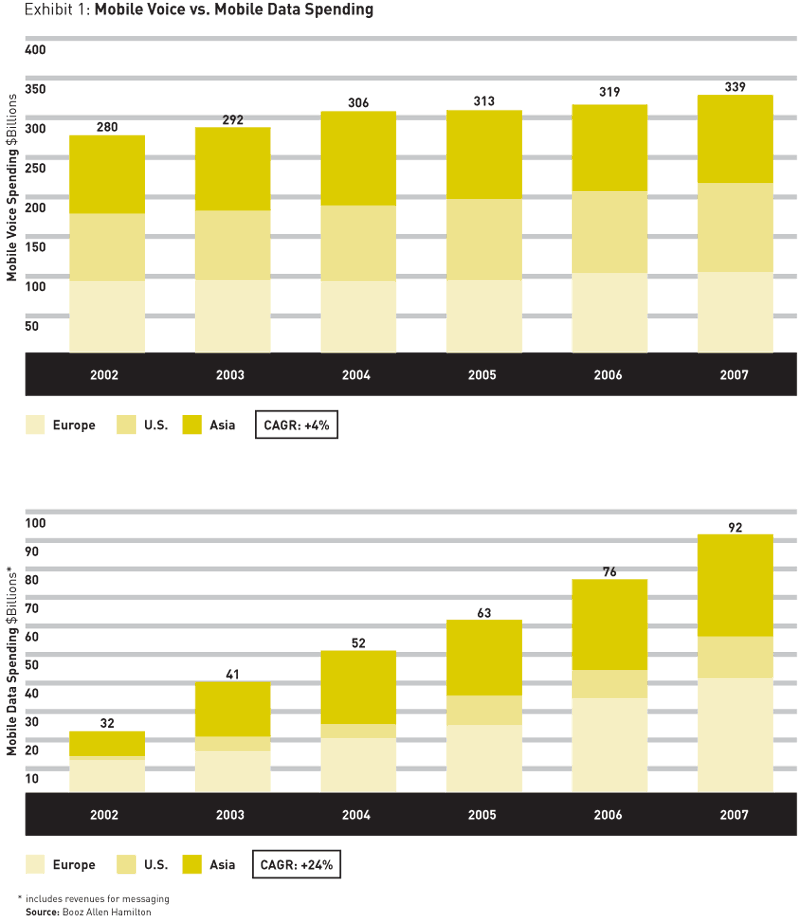
For many wireless telecom operators worldwide, mobile data service isn’t just a new market opportunity, it’s a survival kit. Operators are in a difficult spot: The network connection they control is rapidly becoming a commodity, and revenue growth from traditional voice and text services is slowing; compound annual growth in spending on voice services from 2002 to 2007 will be just 4 percent. (See Exhibit 1.) Thus, the mobile operators that spent billions of dollars to build 3G networks are under great pressure to introduce multimedia data services to generate revenues fast, so they can pay off and capitalize on their broadband investments.
But the shift from voice to data services won’t be an easy one. Indeed, mobile operators won’t succeed without making substantial changes to their business models. Currently, their revenues come mostly from time- and volume-based fees charged to customers for connecting to their networks. This connectivity strategem is not well suited to the world of data services, in which the network is a less valuable asset than the content that is transmitted through it. The focus on connectivity also has isolated mobile operators within the wireless value chain. Because they were able to grow and profit in the past simply by owning the network, mobile operators had little reason to seek value from other sources.
We believe a new “integrated services” business model — one that encourages productive partnering and more varied approaches to value creation — is the most promising option for the wireless industry. Operators won’t simply provide a connection to the network; rather, they will position themselves to directly influence and profit from every aspect of the wireless experience: reliable connections, clear reception, attractive and easy-to-use phones, useful and fun applications, good customer service, and more. As The Register, a U.K.-based Web publication for the wireless industry, put it, carriers that “cash in through integration” can create value from their networks, the handset, and content.
To do this effectively, mobile operators will need to interact more closely with handset manufacturers, content owners, software vendors, and application developers. They will also face aggressive new competitors among these companies and others in the digital value chain that are intent on getting their piece of the wireless action.
Growing “co-opetition” in the wireless industry, as well as changes in the power structure of a value chain, are common phenomena for many industries. How mobile operators respond and adapt to their new market dynamics, therefore, offers lessons, not just for wireless players, but for companies across industries facing today’s familiar mix of business uncertainty and compelling opportunity.
Beyond Connectivity
The worldwide growth of the mobile data marketplace has been little short of breathtaking. As of October 2003, NTT DoCoMo, one of the industry’s earliest leaders, had moved roughly 40 million of its 46 million mobile service subscribers in Japan to the i-mode data services platform, according to the Financial Times. The company is reaping impressive rewards: Monthly revenue from i-mode users is typically 20 percent more than from its voice-only services.
Major European and American mobile telephone operators are racing to attract new customers with their own multimedia data services, which include AT&T’s mMode, Vodafone live, and France Télécom’s Orange Sans Limite (Orange without Limits). Handset manufacturers, including Nokia, Motorola, Siemens, Sanyo, and Sony Ericsson, have in the past year introduced dozens of new models of so-called smart phones, which serve as PDAs, cameras, and e-mail and messaging devices. More multifunctional phones are on the way.
In 2002, spending on mobile data services in Europe, the United States, and Asia reached $32 billion. From 2002 to 2007, mobile data service spending will grow at a compound annual rate of 24 percent, reaching $92 billion in 2007, according to Booz Allen Hamilton projections. Even though voice transmission remains by far the largest part of the wireless business, we anticipate that in Europe, sending messages, getting news, playing games and lotteries, watching sports, and sharing photos and video clips will be the top revenue growth generators in mobile products and services for the mass market within three years, with the United States following a similar trajectory.
Yet, to date, mobile telecom operators have applied the same connectivity-only model that the first generation of U.S. and European cable and Internet service providers did in the 1980s and 1990s. These companies charge consumers to access their network, and then forge agreements with third-party content providers, such as game developers or Internet service providers that want to use the network as a distribution channel for their content. Third parties also develop their own paid relationships with consumers.
Because their revenues have derived from charging rent for use of their networks, mobile carriers have historically focused on a network’s speed and coverage. It has been up to the third parties (the renters) to make the large investments in the complex IT systems that deliver multimedia content, and to shoulder the marketing and distribution risks and responsibilities for growing mobile data service offerings. Mobile operators’ preoccupation with network efficiency has also meant they have played a limited role in influencing the look, feel, and usability of handsets.
Mobile operators could continue to capture only the basic value from the network connection as they add multimedia services, but their ability to grow revenues and profits will be highly constrained. The connectivity-only value proposition keeps them embroiled in brutal competition on pricing and network quality. Additionally, with this model, operators will always remain one step removed from the customer experience.
On the basis of our research and discussions with scores of executives at leading companies, we see two primary ways mobile operators can change their business models. One alternative is to adopt a low-cost, low-risk, lower-growth connectivity model with the objective of increasing user traffic and the volume of data transmitted over the company’s wireless network. The other is to use the higher-cost, higher-risk, but higher-value-added integrated service model, which aims to capture more value from the different types of content carried over the network.
The connectivity model may be viable for some small mobile service companies with limited financial resources and high-speed network capacity that can compete on price, rather than on the breadth and quality of their services. An operator choosing such an approach would have to limit capital expenditures on the network and service platforms, which would compel it to eliminate most marketing and customer care costs, reducing these functions to the bare minimum.
Refocusing Relationships
But this approach won’t work for the major carriers, especially those that have already made significant 3G investments. To earn the required return on their investments in high-speed networks, these operators can’t afford to cede to other players any of the potential revenue streams they can earn from content transmitted through their networks. For the majors, the integrated service model makes more sense.
Under it, mobile operators will get involved in — and extract revenue and profit from — all the critical points in the value chain that affect the user experience. Mobile operators may play multiple roles in packaging, promoting, and selling content, subscriptions, and services offered by third-party content companies. These partnerships are crucial to the mobile operator’s ability to expand revenue streams, grow market share, and capture more value from the customer relationship.
Perhaps the most important value-generating step is enhancing the relationship between the handset maker and the mobile operator. In the past, mobile operators had little involvement in handset design and configuration, except in Japan. Operators typically set prices and managed customer access to their service. Handset manufacturers drove improvements in the devices, such as decreased size and weight, longer battery life, and different ring tones. Mobile operators were content to buy and sell largely undifferentiated handsets.
With the growth of mobile data services, the arm’s-length relationship between mobile operators and their device suppliers needs to end. Applying the integrated strategy, carriers will concentrate on enhancing the handset’s “service environment” — the device’s interface and its underlying software platforms, which are critical to creating devices and applications that are easy to use, reliable, and secure.
Simple cobranding of the handset case (e.g., the Sprint name and logo printed on Sanyo’s 8100 picture phone) has been common for years. Now leading mobile operators are getting involved in more creative tactics that enhance their brand, such as selecting the device’s operating system and preloaded software applications. Some mobile carriers have set up exclusive distribution agreements with manufacturers to sell a specific handset model, with features designed to support the carrier’s multimedia service. Such design collaboration and marketing partnerships with mobile operators are especially attractive to device manufacturers because they help the manufacturers sell a larger number of tailored, higher-priced, higher-margin multifunction handsets. (See “How Mobile Operators Are Disrupting the Handset Industry,” at the end of this article.)
We expect more network operators will look to device manufacturers to tailor handsets for their services, based on specific hardware, software, and product features. Manufacturers could even design entire service environments for specific mobile operators and offer them as preconfigured integrated solutions.
Through increased cooperation with mobile operators, handset manufacturers and component suppliers should be better able to focus their research and development on innovations that can be brought to market rapidly and successfully. Manufacturers can also work with mobile operators to keep costs down and responsiveness up. For example, inventory levels for components and finished products can be managed jointly through demand forecasting. Moreover, component costs can be reduced when operators select in advance components that can be standardized. For instance, there could be two or three screen types for all handsets, which would help manufacturers customize their products for specific customer segments while still maintaining economies of scale and margins.
Collaboration with content partners is another critical strategy in the integrated model. Mobile operators can reward content providers through revenue sharing that gives each partner a portion of the price charged for each download of content. The Dutch mobile carrier KPN, which offers data services using the i-mode platform, has revenue-sharing contracts with several hundred i-mode–compliant content providers, and works with them to ensure that its customers experience the best service the i-mode platform can offer.
Digital Rights
Mobile operators can make themselves more attractive to content partners by embedding digital rights-management systems in their service environments. Strong copyright protection is especially appealing to music companies, which are seeking to reduce the erosion of content value by peer-to-peer file-sharing services. Our interviews in Europe and the United States indicate most music publishers won’t provide their content to mobile operators unless they explicitly offer digital rights protection. Mobile operators’ control over the device software and hardware is essential for them to be able to provide this protection.
Only a few of the nontraditional competitors of mobile operators, notably Nokia, Microsoft, and Qualcomm, have the technology and financial resources to seriously challenge operators on the quality of their integrated services. Still, mobile operators can find ways to work constructively with these companies through mutually beneficial arrangements, such as service-level agreements and brand tie-ins. But to benefit from their partners’ expertise without sacrificing returns, mobile operators must build capabilities in all the areas that go beyond connectivity. They may not need to manufacture devices or generate content themselves, but mobile operators must increase their economic and technological sphere of influence in the wireless market so they have more control over their revenues and profits.
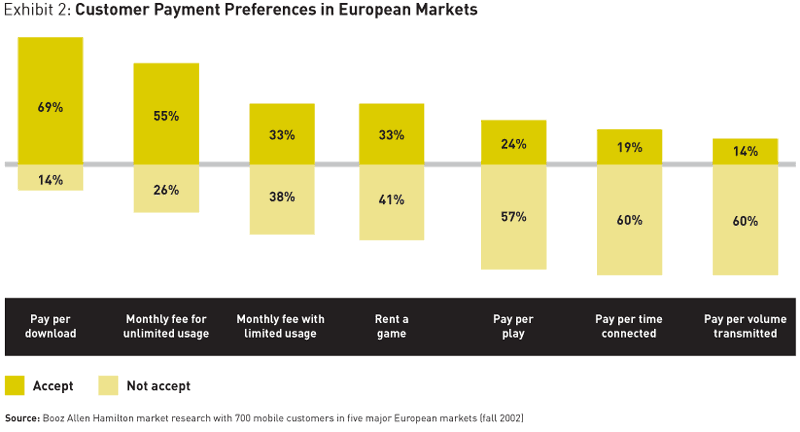
The integrated services approach changes the pricing model, too. Charging for services on the basis of the volume of data transmitted is a strategy that mobile operators copied from early Internet services companies. But our research shows there is no correlation between volume usage and a customer’s perception of value. When we asked 700 users of consumer mobile telephone services in five major European markets in the fall of 2002 what payment methods would be most acceptable to them, 69 percent said they preferred the value-based pricing model, wherein they pay a price per download of content (1 euro per song, for example). Only 14 percent said they preferred to pay according to the volume (megabytes) of data transmitted. (See Exhibit 2.)
Not only is value-based pricing more acceptable to users, it is better for the business. Our analysis shows that volume-based pricing would actually decrease revenue for the popular photo, short-text, and instant message services, and would inhibit usage of music downloads, games, Internet browsing, and video telephony. (See Exhibit 3.)
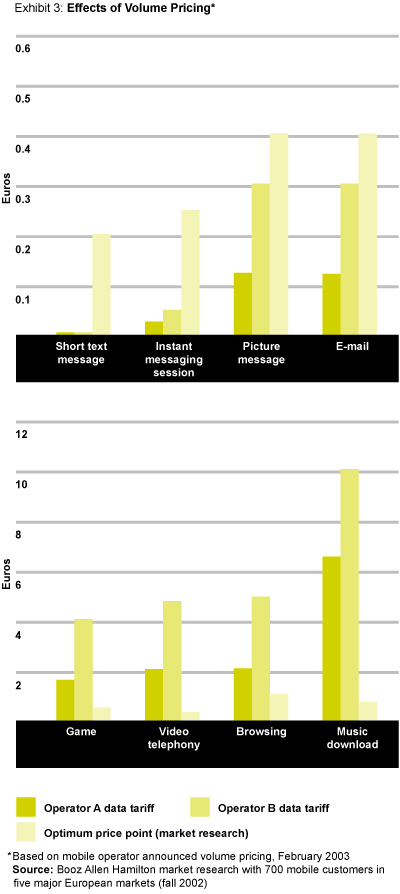
Furthermore, at the prevailing volume-based rate charged by European mobile operators in February 2003, downloading a one-megabyte music track would have cost 10 euros, but a standard text message would have cost only 0.0001 euro. According to our research, the optimal price would have been closer to 1.0 euro per download for a song and 0.2 euro for a short text message.
Emerging Lessons
The year 2003 was a watershed for the mobile data market. Consumer demand for and the supply of mobile data products and services increased noticeably, especially in Europe and the U.S. In January 2003, Nokia, the world’s largest mobile device manufacturer, created a separate business division dedicated to selling multimedia handsets. Rising demand for more sophisticated mobile phones gave several European mobile operators’ multimedia services a substantial lift last year, and the momentum continues.
Nevertheless, plain old-fashioned voice service remains the mainstay of the wireless business, and it will continue to be for the next several years. Indeed, in 2003, spending on voice services was $292 billion in Europe, Asia, and the United States — more than seven times as much as the $41 billion spent on mobile data service. By 2007, annual spending on data services in these regions will reach $92 billion, which is still not close to the nearly $339 billion projected to be spent on voice service.
In this transitional time in the wireless industry, all companies involved will need to work hard to win the confidence and loyalty of new users of these services, and be smart about setting expectations. To be sure, many services introduced in 2003 will not be around in 2007. And such practical constraints as a lack of battery power to support hours of multimedia use will have to be overcome. But the hurdles are temporary; in the long run we believe the industry as a whole, and players individually, will ultimately be healthier and more profitable, in no small part because of the partnership model we have described.
In the past, the wireless industry has been hurt because many players were not winners in their relationships with others in the value chain. This is changing as demand for wireless products and services grows, and companies discover that collaboration is the best way to accelerate innovation, increase profits for individual companies, and enrich the overall market.
If you’re successful and growing, you can manage any way you want to,” Harvard Business School professor Clayton Christensen has observed. “Growth makes so many dimensions of management easier. It’s when growth stops that things get tough.” Clearly, today’s mobile operators have reached this crossroads. In the wireless industry, or in any industry where the case for change is clear but the path is less so, companies need to understand the interests of other market participants and anticipate their potential plays, as well as possible diversification moves they themselves could make.
Companies that become “masters” of the industry when the going gets toughest are those that actively and creatively build portfolios of business options — options that enable them to maintain strength in their traditional businesses while they build an alternative, and better, future. For the wireless industry, that future is multimedia data services.
|
How Mobile Operators Are Disrupting the Handset Industry |
|
For the past decade, five manufacturers — Nokia, Motorola, Samsung, Siemens, and Sony Ericsson — have accounted for 70 percent of the handset shipments worldwide. Such stability has enabled several handset makers to develop leading consumer brands, recognizable user interfaces, and strong service innovation teams, thereby positioning themselves as user-friendly companies. Focusing on network quality and offering the right service plan to attract new subscribers, mobile service providers traditionally bought indistinguishable handsets at a premium on the assumption that the manufacturers would drive innovation and new services to market. With the growth in data services, mobile operators are now working with handset makers to develop distinctive features (such as embedded ring tones and other elements of the user interface), create loyalty clubs, and tap into many other elements that create value. Japanese operators have worked with handset manufacturers from the start. NTT DoCoMo, for example, includes handset manufacturers in its own R&D centers in order to specify device requirements and retain greater control over the wireless value chain. The fragmented nature of the wireless services market in the United States and Europe prevented any single operator from achieving the scale necessary to influence handset manufacturers as NTT DoCoMo has done. However, U.S. and European mobile operators’ activity in the handset industry today shows how the wireless market environment is changing, and how mobile operators are repositioning themselves to capture more value. Flagship cobranded handsets being introduced to support mobile operators’ new data services, such as polyphonic ring tones and downloadable games, reflect this new market reality. And it is becoming more common for mobile carriers to set up exclusive distribution agreements with suppliers for specific handset models. In October 2003, for instance, France Télécom’s Orange introduced the Motorola MPx200, which uses the Microsoft Windows operating system, marketing it with special services “exclusive to Orange.” Mobile operators are also benefiting from the end of a completely vertically integrated production system controlled by handset makers. A multitude of specialized component suppliers have emerged:
The rise of component specialists has given mobile operators greater latitude to influence handset design and production costs. From a cost perspective, by disintermediating the vertically integrated handset supplier and cutting their margins, mobile telecom operators can save as much as 15 percent on the wholesale handset price. Through their involvement in product specifications and customization, mobile operators earn more revenues from the services they provide. According to our interviews with mobile operators in 2003, consumers using customized handsets had a 50 to 60 percent higher monthly average data volume and usage rate than consumers using noncustomized handsets. Overall, more mobile operators are seeing collaboration with handset makers as necessary to developing a new business model that goes beyond connectivity. — Alexandre Froment-Curtil and Frederick Knops |
Reprint No. 04108
Helmut Meier (meier_helmut@bah.com) is a senior vice president of Booz Allen Hamilton based in Düsseldorf, Germany, and Vienna, Austria. He has served major communications and technology companies for more than 20 years. He is a member of the firm’s European Board and chairs its European Board for Innovation, Marketing, and Communications.
Roman Friedrich (friedrich_roman@bah.com) is a vice president with Booz Allen Hamilton based in Düsseldorf, Germany, and Stockholm, Sweden. He has assisted a broad range of telecommunications companies, including fixed-line carriers, equipment resellers, Internet service providers, infrastructure providers, and mobile service operators.
Hanno Blankenstein (blankenstein_hanno@bah.com) is a senior associate with Booz Allen Hamilton based in Munich, Germany. He supports telecommunication, technology, and media groups on strategy transformation, with emphasis on innovation, product pricing, and business development.
Also contributing to this article were Booz Allen Hamilton vice president Frederick Knops, associate Alexandre Froment-Curtil, and associate Jonathan Corp.