

CEO Succession 2003: The Perils of "Good" Governance
Pressured by shareholders, boards are humbling once-imperial CEOs — in ways that may contribute to lower returns, Booz Allen Hamilton’s annual study finds.
 |
|
Photograph by John Paul Endress |
But the sun is not yet shining on executive suites and boardrooms. For the first time in our research — the most comprehensive ongoing survey of the demographics and performance characteristics underlying chief executive succession worldwide — we are seeing evidence that the contemporary governance movement is presenting CEOs and boards with a leadership dilemma of “lady-or-the-tiger” dimensions. Despite the one-year respite, companies remain focused on firing overcompensated, underperforming chiefs — the rate of CEO dismissals increased by 170 percent from 1995 to 2003. Yet that singular obsession appears to be contributing to lower average shareholder returns.
Why? Among other reasons, companies are dumping CEOs faster than they can replace them with qualified internal candidates, and thus are turning increasingly to outsiders. But our data shows that outsiders deliver significantly lower shareholder returns than insiders do over the course of their tenure.
Our findings indicate an evolving management picture shot through with such paradoxes. For example, boards, regulators, and shareholder activists are increasingly agitating for the separation of the roles of CEO and chairman. Yet in reviewing the career performance of all the CEOs who left office in the years we have studied, we find this division of responsibility also results in lower returns for shareholders. Company leaders, directors, and shareholders, we believe, would do well to reexamine today’s “good governance” campaign in light of our research.
Among our specific findings:
-
In North America, the heat on CEOs has been reduced from boil to simmer. In the U.S. and Canada, involuntary successions accounted for 31 percent of all turnovers in 2003, down from 2002’s peak of 39 percent, although higher than in any other year studied.
-
Europe has become the pacesetter in forcing out underperforming chief executives. Top European companies experienced the highest-ever rate of forced succession events: Nearly half of all CEO turnovers in Europe in 2003 were performance related. Forced turnover of CEOs of Germany’s largest companies reached an extraordinary 8.1 percent in 2003, more than double the global average and the highest level in any region in any year we’ve studied.
-
Globally, the “imperial CEO” isn’t. More than half the departing CEOs — 55 percent — in the six years we have studied did not hold the title of chairman. Just 28 percent carried both titles through their entire tenure.
-
Splitting the roles of chief executive and chairman does not result in higher returns for shareholders. The norm in Europe for at least a decade, dividing the positions of CEO and chairman has become the governance movement’s cause célèbre in the U.S. But returns to investors are lower — 4.7 percentage points per year lower in Europe, and 4.1 percentage points lower in North America — when the roles are split.
-
The outsider who comes in to whip a company into shape is more likely to get a thrashing. Forced turnover of CEOs who were hired from outside the company reached striking levels in 2003: In North America, 55 percent of outsiders were forced to resign; in Europe, 70 percent left involuntarily.
-
The best-performing leaders already have experience at the company they are leading. Prior service as a chief executive does not correlate with superior performance. To the contrary, over the six years of our study, CEOs who had previously led other companies delivered returns for investors 3.7 percentage points per year lower than first-time insiders.
-
A tough job is taking its toll on CEO tenure. Average tenure for chief executives who left office last year was only 7.6 years, among the lowest we’ve seen since 1995.
-
The younger the CEO when hired, the higher the likelihood of being fired. Chief executives forced from office last year were, on average, 49 years old when they were hired; CEOs who retired voluntarily were five years older when they started.
These and our other findings about CEO succession in 2003 depict a corporate marketplace rocked by disequilibrium. In its singular emphasis on the removal of underperforming CEOs, the governance movement risks overlooking the vital roles played by boards and management in developing viable successors and fostering superior returns. The return of growth to the top of the corporate agenda makes resolution of the governance paradox more critical than ever. Consistent, unified leadership — from both managers and directors, and cascaded through the entire organization — is required to execute the myriad elements of a growth program: productively integrating major acquisitions, improving the time-to-market and quality of new products and services, placing large bets on new strategic directions, and more. That’s hard for companies to do when CEOs are consumed with compliance and the prospect of imminent dismissal.
The Top 2,500
Booz Allen Hamilton’s annual study of CEO succession aims to identify patterns in the relationship between chief executive officer tenure and corporate performance that can provide insights for managers, board members, and their advisors. Following the methodology used in previous years, we identified chief executives at the 2,500 largest publicly traded companies in the world (based on market capitalization as of January 1, 2003) who left their positions during 2003. Using the companies’ public statements, as well as our review of press coverage, we determined whether a succession was voluntary or induced.
We used public data sources to help analyze these executives’ entire tenure as CEOs, including personal demographic data (such as age at ascension and departure) and the financial performance of the companies.
In assessing performance, we measure total shareholder returns (TSR), including dividend reinvestments, and compare individual company performance with regional industry performance for the period of a CEO’s tenure. A shareholder return of 1 percent therefore means that the CEO class in question — retiring outsiders, for example — delivered TSR 1 percentage point greater than the entire relevant market. (See “Methodology,” at the end of this article.)
Thus, our study reviews the entire careers of CEOs at the point of their departure. In effect, we look back on the professional lives of each year’s “graduating class” of CEOs, and, in the aggregate, try to determine factors that contribute to the success of some and the failure of others. To tease out information that might illuminate the relationship among boards, management, and corporate performance, this year, for the first time, we included data about whether CEOs held the title of chairman of the board throughout their tenure; whether they were named chairman during the course of their service; or whether they never held the title.
That vein of research is important because of the continuing, unrelenting scrutiny of corporate governance practices around the world. Criminal trials of former CEOs and board members accused of fraud, larceny, and other crimes at Enron, Tyco, WorldCom, and Martha Stewart Living Omnimedia dominated business-news coverage for much of the year. New scandals were uncovered — notably in Europe, where malfeasance was found at the Italian food company Parmalat. The implementation of the Sarbanes-Oxley Act in the U.S. in 2003 resulted in significant changes in the composition and charters of boards. New regulatory initiatives were unveiled, including a proposed epoch-making change in Securities and Exchange Commission rules that could allow shareholders to directly nominate candidates for boards of directors.
The long-term trend in CEO turnover reinforces the main conclusion reached in our previous succession studies: Aggressive shareholder capitalism has become the defining characteristic of 21st-century capitalism. The days when investors “hired” professional managers to run the firm and left it to the board of directors to oversee them — the de facto corporate governance model for much of the 20th century — now seem to be gone for good. As the era of managerial capitalism wanes, we are entering a new, unfamiliar period, in which CEOs and boards are scrutinized intensely not only by shareholders, but by regulators, politicians, and the legal system as well. Moreover, they are being held to account for more than financial performance; increasingly, the specific decisions they make on the job are being second-guessed. The Walt Disney Company’s choice not to renew its distribution relationship with another film company provided support for a shareholder revolt that stripped Disney’s chief executive, Michael Eisner, of the chairmanship; in Germany, Josef Ackermann, the CEO of Deutsche Bank AG, was tried on charges that, as head of Mannesmann’s supervisory board, he approved overly generous separation payments for top executives.
Below 10 Percent
That changing dynamic is, at first glance, not apparent in our biggest aggregate statistic — the percentage of the world’s largest companies that changed their chief executive. Among the world’s top 2,500 companies in 2003, the CEO turnover rate was 9.5 percent — below 10 percent for the first time since 1998. The peak year for the global turnover rate was 2000, when it reached nearly 13 percent.
The easy interpretation of the 2003 rate is that global succession is reverting to the mean. But the downtick obscures striking differences in the incidence of CEO successions in different regions of the world, and the continuing shift toward greater forced turnover.
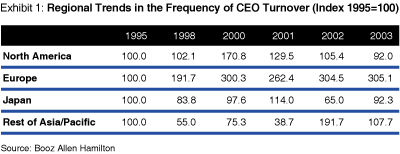
Regionally, the succession rate was highest in Japan, where 13.8 percent of the largest companies changed their CEOs — a 42 percent increase over 2002. (Improved local-language data collection in Japan has found a much higher incidence of succession events over the six years we studied than previously reported, so this year’s study supersedes all others.) To a large extent, this reflects the cyclical nature of planned successions in Japan. The turnover rate in the rest of Asia declined to 5.3 percent from the high of 9.4 percent in 2002. The rate of CEO succession in Europe remained at 9.7 percent, but for the first time was higher than in North America, which had its lowest succession rate since we began tracking the data. The regional trends in overall succession events can be seen more clearly when indexed to the rate of succession in 1995, our study’s benchmark year. (See Exhibit 1.)
The overall decrease in turnover at the top is due primarily to the decline in what we classify as performance-related successions, which include any departure initiated by the board, attributed by the media to poor financial or managerial performance, or ascribed to “personal reasons” that accelerated a previously planned retirement. Globally, performance-related successions occurred at 3 percent of the top 2,500 companies in 2003 — a 29 percent drop in forced turnover from 2002, but close to the forced-turnover rate in 2000. (See Exhibit 2.)
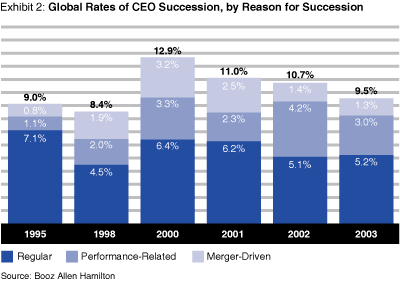
Our other two classifications are merger-driven, in which a CEO’s job is eliminated after an acquisition, and regular, which includes planned retirements, a CEO’s acceptance of a better position elsewhere, health-related departures, or death in office. Regular and merger-driven successions were about even with 2002’s low rates, at 5.2 percent and 1.3 percent, respectively.
This was the second year in a row that merger-driven successions were low. As we noted last year, merger and acquisition (M&A) activity should rebound in a rising stock market, particularly against the backdrop of performance pressures. After all, many M&A deals mask forced transitions: If the target company was doing well, it likely wouldn’t have been prey. Although merger-induced succession did not climb in 2003, M&A action certainly appears to be rising in 2004, with the proposed takeover of France’s Aventis by Sanofi-Synthelabo and J.P. Morgan’s announced acquisition of Bank One, among several large transactions awaiting closure. Thus, we expect merger-driven successions to rise in 2004 and 2005, as deals conclude and management changes take place.
Last year, we hypothesized that the overall rate of CEO turnover in North America would average about 11 percent per year, higher in years with extensive merger activity and lower when merger activity was minimal. The overall rate of CEO turnover in 2003 is consistent with our hypothesis. Total turnover is lower than 11 percent partly because of the low rate of merger activity. As economic recovery prompts increased merger activity, we expect total annual CEO turnover to rise to 11 percent — and even beyond when merger activity reaches its next cyclical peak.
The linkage between a CEO’s fate and shareholder returns is statistically significant. CEOs who left office as planned in 2003 generated average shareholder returns 4.4 percentage points ahead of their regional stock markets — and a full 6.9 points higher than their colleagues forced from office. This “return gap” is slightly higher than in 2002 but significantly lower than in both 2000 and 2001.
The ways shareholders define underperformance, and the degree to which they accept it, differ markedly by region, however. In North America last year, CEOs forced from office generated median regionally adjusted returns that were only 4.6 points lower than leaders with regular successions; in Europe, it took a 5.5 point shortfall from the median to provoke dismissal. The 2003 difference in median returns in North America is the lowest seen over the six years reviewed, and continues a narrowing trend that began in 2001 in both regions, indications that shareholders continue to be intolerant of performance shortfalls.
 U.S. Firing Squad
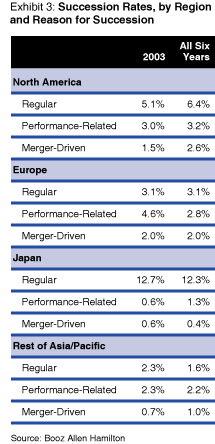
Reviewing the trend in performance-related successions last year, we questioned whether the unabated pressure on corporate directors would continue to ratchet up the high rate of performance-driven succession in North America, and whether the pace of forced succession in Europe would also continue to increase. In 2003, the patterns in North America and Europe diverged: Forced turnover in North America declined to 3 percent, slightly lower than the average level across all six years we studied, while Europe experienced its highest-ever rate of forced succession, 4.6 percent. (See Exhibit 3.)
With the benefit of hindsight, it appears that the 5.2 percent rate of forced succession in North America in 2000 and even the 4.3 percent rate in 2002 were aberrations, much higher than the long-term trend line. Newsmaking financial irregularities at Enron, Tyco International Ltd., Adelphia Communications, and the HealthSouth Corporation, among other companies, weren’t responsible: They were too few in number. No more than 0.3 percent of CEOs lost their jobs in any year studied because of financial scandals or allegations of misconduct. The major factor explaining the extraordinary levels of forced turnover, rather, appears to be the performance of the stock market.
The stock market collapse of 2000 and the subsequent recession triggered peaks in both voluntary and involuntary turnover. The voluntary opt-outs make sense; lower expectations for the value of a CEO’s stock options and the change in skills required to lead companies during a downturn induce more CEOs to step down.
But the character of the forced turnover, in many ways, defies logic. The high rates of involuntary succession were concentrated in industries that had unusually poor performance for investors, like telecommunications and information technology (in 2000, 2001, and 2002), consumer discretionary in 2000, and utilities in 2002. (See “Risky Businesses,” below.) In the U.S., investors apparently want CEOs to share the pain of poor returns.
|
Risky Businesses |
|
|
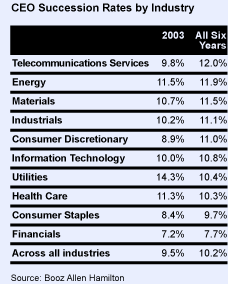 Of the 10 industry sectors we examine, financial services continues to be the “safest” by far for CEOs. The 2003 succession rate of 7.2 percent for financial- services companies was even lower than the sector’s average for the six years surveyed. The most “dangerous” industry was utilities, where 14.3 percent of the largest companies changed CEOs last year — nearly twice the turnover rate in financial services, and half again as high as the overall global succession rate of 9.5 percent. The high rate in utilities is a recent phenomenon: Over the six years Booz Allen has tracked, utilities are close to the global mean rate of 10.2 percent. Another industry in transition was energy, with a succession rate of 11.5 percent, just below its six-year mean of 11.9 percent. Throughout the six years we have studied, telecommunications companies have experienced the highest succession rate, 12 percent.
Although this reaction is not surprising, it is irrational. The returns investors receive from a stock reflect a combination of the overall trend of the stock market, unanticipated events in a particular industry, and the performance (and expectations for future performance) of the company. An individual CEO has almost no influence on the broad stock market, or on industrywide trends. Forced CEO turnover should relate only to the part of the returns unique to the company. But, in the U.S. at least, it doesn’t; CEO firings track the stock market returns of the company’s sector.
This conclusion is one of several this year that raise uncomfortable questions about the relationship between boards and management, for it indicates that directors are highly responsive to shareholder pressure about share prices, even if management is not solely responsible for the performance.
This is one of the reasons we don’t believe the low relative rate of overall CEO turnover in 2003 means boards have grown unresponsive to investor concerns. To the contrary, the data for 2003 shows that the long-term trend toward increasing forced turnover of CEOs in the U.S. is continuing. The rate of performance-related successions in 2003 was 130 percent higher than in 1995, and greater than in 1998 and 2001. Given the increased attention to governance issues, along with the effects of legal and regulatory changes, we expect to continue seeing performance-related successions higher than in the 1990s.
Europe’s Forcing Function
In Europe, forced succession of CEOs doesn’t fluctuate with broad returns on the stock market or with returns in an industry; only the company-specific element of returns matters. The better logic, though, hasn’t made CEOs there safer. Quite the opposite: In 2003, for the first time in our survey, both total CEO turnover and forced CEO turnover were higher in Europe than in North America.
During the past decade, European supervisory boards have become increasingly willing to replace CEOs for poor performance: The rate of forced turnover has more than quadrupled since 1995, when only 1 percent of European companies fired their chief executive or managing director (as the role is commonly titled at many European companies). Among European CEOs who left office during the last three years, only 40 percent achieved a regular retirement; 41 percent were removed forcibly, and 19 percent left after their company was acquired. A new European CEO must expect that he or she won’t enjoy a “normal” career end.
Consistent with the high rate of turnover, for the six years we studied, the average tenure of CEOs is lowest in Europe: only 6.5 years compared with 9.4 years in North America, 7.5 years in Japan, and 7.3 years in the rest of Asia. (See “CEO Demographics: The Sting of Youth,” below.)
|
CEO Demographics: The Sting of Youth |
|
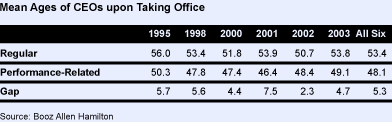
The folly of youth may reveal itself in the executive suite: The younger you are when you become a chief executive, the more likely you are to be fired from the job, according to our research. CEOs who were fired from their jobs in 2003 were, on average, 49.1 when they took office; those who retired on their own terms last year were, on average, 53.8 years old when they became chiefs. This gap has shown up in every year we have studied. CEOs forced from office in 2003 were also younger than voluntary retirees when they left — another finding consistent with our past research. Globally, the mean age of a CEO forced from office in 2003 was only 55, whereas those with regular successions were, on average, 62.1. The "age gap" of 7.1 years is greater than it was in 2002, but still below the 9.5-year average gap for the other five years studied. The mean age of all CEOs who left office last year (59.5) was the highest we’ve seen since 1998 (60.4), but remains close to the mean age for the previous five years examined. Japanese CEOs remain the elder statesmen, with a mean age of 63.8 for departing chief executives last year. Regionally, North American CEOs once again enjoyed the longest tenures in 2003 (8.4 years). The tenure for Japanese CEOs is 7.5 years, the mean for the previous five years studied. European tenures are the shortest, at 6.6 years. The average global tenure for the class of 2003, 7.6 years, is among the lowest we’ve seen since 1995. This suggests that shareholder activism, increased governmental oversight, and improved corporate governance have contributed to making the CEO’s job tougher and shorter in duration.
|
In Europe’s two largest economies, Germany and the United Kingdom, the rates of both total CEO turnover and forced CEO turnover were higher still. In 2003, forced turnover at large public companies in the U.K. reached 6.5 percent, and, in Germany, it reached an extraordinary 8.1 percent — the highest level of forced turnover in a large country in any year that we’ve studied. Contributing to German forced turnover was the dismissal of several long-standing yet underperforming CEOs, such as MG Technologies’ Karl-Josef Neukirchen. Our hypothesis is that, with so much forced turnover in 2003, both Germany — and Europe in total — will experience somewhat lower forced turnover in 2004. That would continue a seesaw pattern we have been seeing in all three of our study’s major regions, with a year of above-average forced turnover rates followed by a year of firings below average levels.
In Europe, at least three trends are focusing shareholders’ and regulators’ attention on corporate governance issues: growing public ownership of stocks, in part because of the privatization of former state-owned enterprises; the need by non-U.S. companies whose shares are traded in the United States to meet Sarbanes-Oxley’s compliance requirements; and the development of new European Union regulations regarding board composition and disclosure. It’s no surprise, then, that the pressure on Europe’s chief executives is rising.
The Asian Exception
In contrast to North America and Europe, Japan experienced only a 0.6 percent rate of forced turnover in 2003, even lower than its historical average. Last year, assessing Japan’s 2002 spike to a forced turnover rate of 3.3 percent, we recognized that many of the forced successions were triggered by scandals, but speculated that the change was more likely “due to the region’s gradual transition to Western-style governance procedures.” Although governance reforms — including important regulatory changes — continue to be enacted in Japan, we did not see those changes reflected in management suites last year.
Much of the persistent difference, though, is probably due to Japan’s unique leadership model for large corporations. Forced turnover is simply a less important management tool, because the Japanese system emphasizes long development periods to train internal CEO candidates, who subsequently serve relatively short terms in office. Japanese CEOs are 58.4 years old on average when they take office, compared with 50 years in Europe and 49.1 in the United States. And Japanese CEOs, most of whom retire voluntarily, serve an average of 7.5 years in office, less than the 7.6 year global average we saw in 2003 and the 8.2 year global average across the six years we have studied. Without forced turnover, underperforming CEOs in North America and Europe might remain in office far too long. But in Japan, normal retirement addresses most instances of poor performance. (The lower rate of forced turnover in Japan doesn’t mean that shareholders’ interests are ignored. Those Japanese CEOs who were forced to resign produced average annual returns 4 percentage points lower than those who achieved a normal retirement.)
In contrast to Japan, other Asia/Pacific countries take a high-risk, high-variance approach to leadership. CEOs take office at the youngest age of any region — 47.4 years. Although CEOs who perform well remain in office for 11.5 years, poor performers are fired after only 4.3 years. Over the six years studied, firing of CEOs is most prevalent in Asia/Pacific: 46 percent of departing CEOs were fired, whereas only 34 percent achieved a normal retirement. The remaining 20 percent lost their jobs following a merger.
Chairman and/or CEO
Separating the roles of CEO and chairman of the board has become a major objective in the U.S. among corporate governance activists, many of whom aver that combining the positions gives one individual too much power and too little accountability for results. The campaign appears to be picking up steam; six companies — Ameren Corporation, Bed Bath & Beyond Inc., the Charles Schwab Corporation, Clorox Company, Freeport-McMoRan Copper & Gold Inc., and Hasbro Inc. — separated the roles for governance reasons in 2003. Observing the growing pressure, we gathered new information this year to determine whether departing CEOs were also chairmen, and at what point in their careers they took on the role. Combining the data for all six years and all regions, we were surprised to find that the “imperial CEO” by and large doesn’t exist: More than half the departing CEOs — about 58 percent — did not hold the title of chairman, and just 21 percent carried both titles throughout their tenure. (The remaining 21 percent picked up the chairman’s role after serving for some period solely as chief executive.)
Both the roles of corporate leaders and the suppositions about them differ markedly by region. Since regulatory constraints on corporate directors and leaders are, increasingly, global in their influence, it’s important that regulators, legislators, and shareholders consider these regional and cultural differences. For example, as Exhibit 4 shows, there are considerable regional differences in the division of the chairman and CEO titles among outgoing chief executives, which reflect the regional variations in corporate governance structures, particularly the differences in the roles played by boards and management. In Japan, 96 percent of departing CEOs were not chairmen; in North America, only 26 percent of departing CEOs did not hold their firm’s chairmanship.
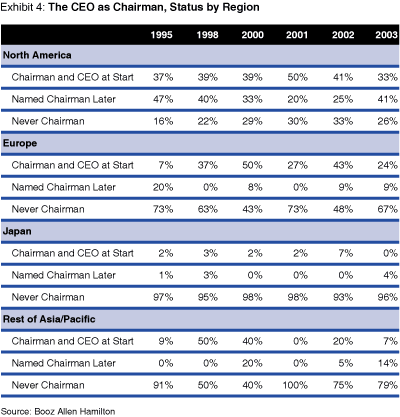
The biggest surprise is the large number of North Americans who initially held only the title of CEO and added the title of chairman three years or more later. North America remains the only region where a single individual routinely takes both titles. But instead of immediately conferring the chairmanship on an incoming CEO, our research indicates that many obtain the position only after a probationary period.
Despite the pressures of the governance movement, separation of the roles does not appear to be increasing, either globally or in any of the major regions. Indeed, in Europe, the proportion of departing CEOs who were not chairmen was lower in 2003 than in 1995. This is counterintuitive. In the U.K., for example, there was a striking change in the composition of corporate leadership after the appearance of the Cadbury Commission report on governance reform in 1992. The commission’s recommendation that public companies separate the roles of chairman and chief executive, along with subsequent reforms, led most U.K. companies to divide the positions. We had expected the split roles to be reflected increasingly in European turnover figures — that is, year on year, we anticipated seeing more departing nonchairman CEOs. Instead, the proportion of nonchairman European CEOs remains below its 1995 peak.
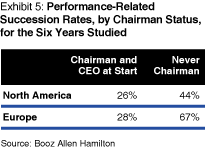 The appearance of “safety” among nonchairman CEOs disappears, though, when we look not at total turnover but at forced turnover. Consistent with the claims of governance activists, boards of directors are far more likely to force the resignation of a CEO when the roles of CEO and chairman are split. Exhibit 5 shows that in both Europe and North America, the proportion of CEOs forced to resign is higher among those who don’t also hold the chairmanship — in Europe, more than twice as high.
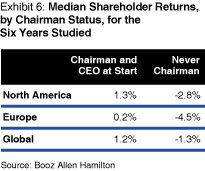 But contrary to the presumptions of governance activists, dividing the roles of CEO and chairman does not result in higher returns to investors. In both Europe and North America, returns to investors are lower when the roles are split. (See Exhibit 6.) The main reason for the difference in total shareholder returns is the extremely poor performance of nonchairman CEOs in the second half of their tenures.
These findings have striking implications for both chief executives and directors. Clearly, a CEO who is not chairman is the board’s hired hand; a chief who is also chairman has far more influence over the other directors. Although that certainly means a chairman–CEO has an advantage in maintaining himself or herself in office, it also means there is something in that increased authority that contributes to superior corporate performance, particularly during the second half of the leader’s tenure.
A number of explanations are possible for this pattern. It may very well be that the chairman–CEOs are better able to withstand pressures for short-term changes that don’t pay off, and have the combination of experience and power that allows them to stay the course when shareholders are agitating for change. Perhaps boards are more careful in the selection of a CEO when they know the additional chairmanship will make his or her removal difficult. Maybe a board, once it’s made the commitment to a chairman and CEO, focuses less on evaluation and more on making the individual successful. Perhaps the greater job security of the combined roles emboldens the CEO to undertake the risky transformation of a com-pany’s culture, which often is critical to a firm’s lasting success. Then again, it may simply be that more qualified leaders have the leverage that weaker leaders lack to bargain with boards for the chairmanship.
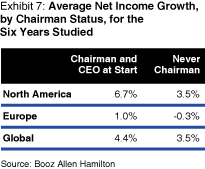 Because our results ran so contrary to the new conventional wisdom, we also analyzed the impact of separating the chairman and CEO roles on net income growth rates. The results are similar: In both Europe and North America, companies’ net income growth is greater when one person has held both roles. (See Exhibit 7.) With net income, the performance differences are less pronounced and consistent than they are with TSR. But we see no evidence to support the presumption of governance activists that splitting the roles will help shareholders.
Our results lead us, however humbly, to offer a bit of guidance for the owners of public companies: Effective governance should concern itself not only with the removal of underperforming managers, but also with improving managers’ performance. While it undoubtedly makes sense in some circumstances, the blanket presumption that the roles should be split confuses the secondary objective of governance — overseeing managers — with the primary goal: enhancing returns to investors. In the U.S., the emerging practice of appointing a “lead director” may, in the future, provide the company the necessary strong leadership while also providing appropriate checks and balances for shareholders.
The Outsider Paradox
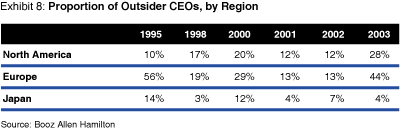
Whether or not CEOs are promoted from within continues to make a big difference in how they perform. Increasingly in recent years, boards have sought outsiders to rescue a fumbling firm. This “search for a corporate savior,” in the memorable words of Harvard Business School Professor Rakesh Khurana, is reflected in our findings. Globally, 28 percent of the CEOs departing in 2003 were “outsiders,” hired into the job from another place. That is the highest proportion in any year that we studied. Outsiders are even more prevalent in Europe than in North America: 44 percent of outgoing CEOs vs. 28 percent, respectively, in 2003. (In Japan and in the rest of Asia/Pacific, where both the proportion of outsiders and the proportion of combined chairman–CEOs is very low among graduating chief executive classes, any comparisons are not reliable statistically.) (See Exhibit 8.)
But our research shows that these corporate saviors do not perform as well as CEOs who are promoted from within. Globally, insiders who departed last year drove shareholder returns 3.5 percentage points per year greater than departing outsiders. In Europe, departing insiders averaged 5.1 percentage points per year greater returns than outsiders. (See Exhibit 9.) Though our experience supports the growing importance of large, strategy-based transformations to improve shareholder returns, it’s not necessarily the case that outsiders are best positioned to “shake up the culture” and get it done.
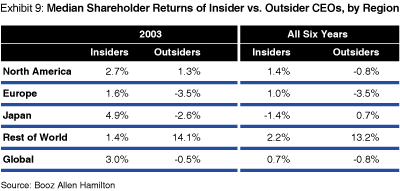
Poor outsider performance is especially pronounced during the second half of outsiders’ tenures, when their returns to investors are 5.1 percentage points per year worse than insiders’ returns in North America and 7.7 percentage points worse in Europe, for the six years studied. There are contrasts, however, in first-half performance. In Europe, insiders and outsiders achieved similar levels of performance during the first half of their tenures. In North America, where social and political reality better accommodate corporate restructuring and cost reductions, outside change agents deliver significantly better first-half performance than insiders. North American outsiders perform worse than insiders over their full tenure because their excellent first-half performance is more than offset by an abysmal second half.
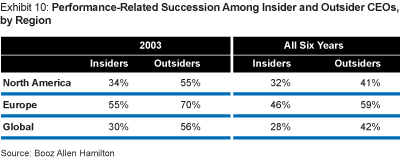
As we reported last year, outsider CEOs were again more likely to be forced from office than insiders were in 2003. Forced turnover of outsiders reached extraordinary levels in 2003: In North America, 55 percent of outsiders who departed were forced to resign; in Europe, it was 70 percent. Globally, more than two-thirds of the insider CEOs who left office last year retired voluntarily versus only 44 percent of outsider CEOs. Across the six years, globally, only 28 percent of insiders who left office were forced out, versus 42 percent of outsiders. (See Exhibit 10.)
There are probably several reasons underlying the differing fortunes of insider and outsider CEOs. Last year, we hypothesized that outsiders have a mandate from the board to oversee a major, needed change, but frequently lack the personal networks, cultural understanding, and deep knowledge of the multiple operating environments — in sum, the “social capital” — to sustain change and high performance at a firm throughout their tenures.
But there’s probably a more subtle reason outsiders fail more frequently than insiders. Outsiders typically are brought in to execute a specific playbook — to solve this problem now in this way. But in our experience, the most successful CEOs are those who can adapt and modify the playbook, their own leadership styles, or both; they create new directions as needed. It’s a rare skill, and it seems to reside primarily, and somewhat ironically, with untested insiders.
Why do boards increasingly hire outsiders despite this spotty track record? Part of the answer may be the incorrect assumption that outsiders are better equipped to drive major change. But we think there’s another, knottier reason: the shortage of attractive internal candidates.
Consistent with our hypothesis that there’s an inadequate pool of attractive CEO candidates, boards are also increasingly turning to executives who have previously been CEO of another publicly traded corporation. In 2003, 11 percent of departing CEOs were completing at least their second turn as a chief executive, more than double the percentage over the previous five years we studied. But, as with outsiders, prior CEO experience does not correlate with superior performance. To the contrary, across the six years studied, CEOs who previously led other companies delivered returns for investors 3.7 percentage points per year lower than those of first-timers globally. (See Exhibit 11.)
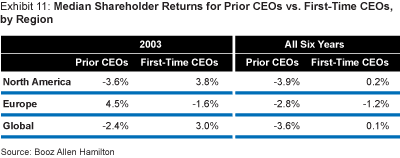
It is interesting to note that prior CEOs underperform during the first half of their tenures. Apparently, experience as CEO of a publicly traded company does not contribute to a strong start as much as does time spent working in a company’s various business units — the usual path for those who haven’t previously been a CEO.
Governance Reconsidered
Boards of directors play four critical governance roles: removing underperforming CEOs, ensuring effective internal control systems, helping the CEO and management team sustain superior performance, and creating viable successors to the CEO. Too often, discussions of governance reform focus on the first two roles. Although that focus is understandable, given the accounting problems surfacing in both Europe and North America and the notorious (but not numerous) examples of long-tenure, underperforming CEOs, we think the debate should be rebalanced, with far more attention paid to helping the current CEO and ensuring a smooth and effective succession process.
At leading companies, the leader doesn’t make the company — the company makes the leader. Well-managed companies have institutionalized the ability to extend and perpetuate a good management system.
The governance debate presumes that easier removal of underperforming CEOs will enhance returns to investors. In 1995, when only 1.1 percent of CEOs were removed for poor performance, that presumption was probably right. In 2002 and 2003, when three to four times as many CEOs were removed for poor performance, we might have reached the point of diminishing returns.
At some juncture, the prospect of forced dismissal will seem so likely that it will hang like a cloud of misery over a chief executive, undermining his or her ability to perform. Concerned about their mortality, CEOs will try to get even more done quickly, emphasizing quick fixes at the expense of company transformation. Revolving-door CEOs will likely face increasing difficulty in driving change — much like the difficulties elected officials face with public sector bureaucracy.
The revolving-door problem appears to be particularly acute in Europe. At first glance, the high rate of forced, performance-based turnover of CEOs among European companies appears to indicate that these firms have internalized good-governance messages and methodologies. But when seemingly disconnected bits of data are put together, the picture is less flattering. Our research shows that European companies have a higher proportion of outsider CEOs than companies in other regions, that these CEOs’ performances are worse than those of insiders, and that they stand a higher likelihood of being fired.
That the governance “conversation” needs to shift is supported further by clear evidence that boards aren’t effectively playing their roles in succession and in helping to ensure long-term success. The increasing reliance on outsiders and prior CEOs, despite data showing that they deliver poor performance for investors, suggests that a more effective process to develop inside CEO candidates could improve returns to investors.
More robust pools of internal candidates might also help slow the rise in CEO compensation. Increasing use of outsiders and the recycling of former CEOs — especially in the United States — suggest that across the economy, demand for viable CEO candidates exceeds supply. Increasing the supply to match or even exceed demand should moderate CEO compensation — and, as our evidence shows, it will probably increase shareholder returns.
But directors’ responsibility extends beyond the succession process itself. One of our most consistent findings, year after year, is that CEOs generate better returns for investors in the first half of their tenures than in the second half. Across the six years we studied, first-half returns are 5.5 percentage points per year better in North America and 7.3 percentage points better in Europe. Evidently, boards do an excellent job selecting a CEO to meet immediate challenges, but they are much less effective in helping the CEO sustain superior long-term performance. Improving second-half performance would yield a big payoff for investors.
The challenge for boards and regulators alike is to ensure balance across the four roles. In our view, governance reform must pay significantly greater attention to the development of viable internal successors and to more effective partnering between the board and management to deliver sustained long-term performance. These roles are the next frontier in improved performance for investors.
|
Methodology |
|
This study required the identification of the world’s 2,500 largest public companies, defined by their market capitalization on January 1, 2003. We use market capitalization rather than revenues because of the different ways financial companies recognize and account for revenues. The Compustat/Global Vantage database of public companies provided a ranking of all publicly traded companies on December 31, 2002. To identify the companies among the top 2,500 that had experienced a chief executive succession event, we used a file of executive changes provided by idEXEC (a global business-to-business contact database of executive decision makers). We also used a variety of printed and electronic sources, including Corporate Yellow Book and Financial Yellow Book (both published by Leadership Directories, N.Y.); Fortune; the Financial Times; the Wall Street Journal, and several Web sites containing information on CEO changes (www.ceogo.com, www.executiveselect.com, and www.hoovers.com). Additionally, we conducted electronic searches using Factiva for any announcements of retirements or new appointments of chief executives, presidents, managing directors, and chairmen; results of this search were compared to the list of top 2,500 companies. For firms that had been acquired or merged in 2003, we used Bloomberg. Finally, we consulted the marketing personnel of Booz Allen Hamilton offices outside the U.S. to add any CEO changes in their regions that had not been identified. Our historical database of past CEO changes has been greatly enhanced this year thanks to improved local-language research, particularly in Japan. Each company that appeared to have experienced a CEO change was then investigated for confirmation that a change had occurred in 2003 and for identification of the outgoing executive: title(s) upon succession, starting and ending dates of tenure as chief executive, age, education, whether he or she was an insider or outsider immediately prior to the start of tenure, whether he or she had served as a CEO of a public company elsewhere prior to this tenure, whether the CEO had been chairman and, if so, for how long, and the true reason for the succession event. Company-provided information was acceptable for each of these data elements except for the reason for the succession; an outside press report was necessary to confirm the true reason for an executive’s departure. We used a variety of online sources to collect this information on each CEO’s tenure, including company Web sites, the Factiva database, www.transnationale.org, and proxy statements available on the U.S. Securities and Exchange Commission’s (SEC’s) EDGAR database (for U.S.-traded securities). In some cases, when the online sources were unproductive, we contacted the individual companies by e-mail and telephone to confirm the tenure information. We also enlisted the assistance of Booz Allen offices worldwide as part of this effort to learn the reasons for specific CEO changes in their regions. We then calculated average growth rates (AGRs for total tenure, first half, and second half) for two types of financial and shareholder information for each executive’s tenure: net income and total shareholder return (TSR, including the reinvestment of dividends, if any). Net income data was provided by S&P (Custom Projects); quarterly data was provided for North American–traded securities, and annual data was provided for other firms. To enable meaningful cross-industry comparisons, we also collected the income data information for the relevant industry and region (e.g., industrials in North America, Europe, Japan, rest of Asia/Pacific, South America, or Middle East/Africa) and subtracted the regional industry income growth from the company’s average growth in the same period. TSR data was provided by Thomson Financial Datastream. We calculated regionally adjusted TSR AGRs by subtracting the Morgan Stanley regional shareholder return indices from the company’s performance during the periods in question. |
Reprint No. 04208
Chuck Lucier (chuck@chucklucier.com) is senior vice president emeritus of Booz Allen Hamilton. He is currently writing a book and consulting on strategy and knowledge issues with selected clients. For Mr. Lucier’s latest publications, see www.chucklucier.com.
Rob Schuyt (schuyt_rob@bah.com) is a vice president with Booz Allen Hamilton in Amsterdam. His expertise is in developing growth, innovation strategies, and performance improvement for clients in the media and communications industries.
Junichi Handa (handa_junichi@bah.com) is a vice president with Booz Allen Hamilton in Tokyo and director of the firm’s Japan office. His consulting experience covers a wide spectrum of management and operations issues, from corporate strategy to supply chain redesign.
Also contributing to this article was Julien Beresford (beresford_julien@bah.com), president of The Beresford Group, a research company based in Westport, Conn.
