
Suits to the Rescue
The most creative member of an R&D team may be its accountant.
(originally published by Booz & Company)
 |
|
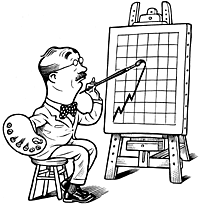
Illustration by Lars Leetaru |
It’s a tidy little dichotomy, but it’s all wrong. It ignores the fact that business innovation is less a matter of invention than of synthesis. The greatest breakthroughs are made by those with the broadest perspectives and the deepest knowledge — the ones who not only can see the potential in a new technology or design but also understand the economics of production and distribution, the dynamics of supply and demand, the motivations of competitors, and the needs and caprices of consumers. And that capacity — what might be called, a little clumsily, analytical creativity — is much more likely to be found among the suits than the turtlenecks.
These thoughts are inspired by the new book They Made America (Little, Brown and Company, 2004), a grand tour of the world-shaping business innovations of the last 250 years, by Harold Evans, the renowned journalist (and former strategy+business columnist). Sir Harold tells, among many other instructive tales, the little-known story of Samuel Insull. A starched English bean counter who became Thomas Edison’s most indispensable partner, Insull took care of all the business details that Edison couldn’t be bothered with — the financing, the operations, the hirings and firings, the mergers. With a deft combination of discipline and daring, he sowed the seeds of what is now one of the world’s very largest companies, General Electric.
But Insull’s greatest achievement came after he left Edison’s employ and, in 1892, journeyed from New York to Chicago to become the president of a tiny electricity producer. The move baffled Insull’s associates. How could he give up the helm of Edison’s empire in order to lead Chicago Edison, an unaffiliated backwater company with three little generators and a paltry 5,000 customers?
But Insull saw something the rest missed — something that would not only lead to the creation of one of the most dominant businesses America has ever seen, but also change the lives of nearly every citizen in the land.
Lighting Many Bulbs
When Insull went to Chicago, electricity was very much a luxury good. Produced in small, coal-fired power plants scattered through big cities, electricity, by virtue of its high cost, was used only by prosperous companies and rich citizens. Even the wealthiest burghers couldn’t afford to turn on the juice for long. They outfitted their chandeliers to run on both electricity and gas. When guests arrived, they switched on the lightbulbs; when guests departed, they cut the current and went back to burning the much cheaper gas flames. No one in the electricity business saw any alternative to this arrangement — or even the need for an alternative.
No one, that is, except Insull. Having studied both the technology and the economics of electricity generation, he was the first to realize that electricity could be a cheap, mass-market product. The cost could be driven down by centralizing production in large generating plants and distributing the power to far-flung customers via alternating current rather than the traditional but less transportable direct current. Taking a huge risk in pursuing his vision, Insull installed a massive 5,000-kilowatt turbine, the first of its kind, in a new Chicago plant.
But Insull’s most radical innovation was not technological. It was in the seemingly mundane practice of pricing. The big economic problem with selling electricity back then (and even today, for that matter) was the frequently extreme mismatch between supply and demand. A company had to build the generating capacity required to meet periods of peak usage, but those spikes tended to be short-lived; most of the capacity went unused most of the time. Given that the costs of power generation were mainly fixed rather than variable — and that the shelf life of electricity was extremely brief — the unevenness of demand destroyed a producer’s ability to turn a profit. The penalties only grew as operating capacity expanded.
Insull solved that problem by charging different rates to different customers, in order to boost demand during times when it tended to be slow. In particular, he drastically cut the price of electricity for home users. He knew that daily residential usage patterns would tend to run opposite to those of the big commercial users that accounted for most of the peak demand; residential demand was concentrated in the evening and early-morning hours, when most factories and shops were closed.
Then, to the consternation of his many small competitors, Insull offered to wire houses at no cost, to expand his clientele as rapidly as possible. It was clear that he was delivering kilowatts to the home market for less than the average cost of producing them. What he knew, though, was that every cent of added income would help offset the high fixed costs (while also bringing down the variable cost of producing each kilowatt), making huge generating stations both feasible and profitable.
Insull’s pricing breakthrough was, Sir Harold writes, “the single most significant innovation in the single most important technological advance of the 20th century.” And it paid off mightily, as Insull rapidly took over the market. By 1898, he had bought out all the other power generators in downtown Chicago. Within another 15 years, his rapidly growing utility — now named Commonwealth Edison — had become the dominant energy provider in the Midwest, and Insull himself had become one of the richest businessmen in the country. More important, Insull’s vision had democratized electricity, bringing its myriad benefits to the masses.
Insull’s essential act of innovation was to craft a coherent business strategy out of what, at the time, must have seemed a cacophony of contradictory technological, economic, and market forces: the scale advantages of centralized production, the high fixed costs of generation, the uneven nature of power demand, the frugality of the average consumer, the breadth of electricity’s potential uses. It was an act of innovation that could only have come from the mind of a person who was at home in the confines of a counting house.
An Unyielding Medium
Confines is a word worth pausing over. Many of today’s most vocal promoters of business innovation urge executives to tear down the obstacles to innovation within their organizations, to let creativity flow unimpeded. That can certainly be good advice; mindlessly bureaucratic controls can stifle good ideas. At the same time, though, such counsel ignores the value of obstacles in structuring creative thinking and routing it toward productive ends. Whether in business, science, or art, the greatest innovations tend to emerge only within the presence of constraints — within a set of rules or laws that provide rigid boundaries to the mind. Unconfined, thought grows frivolous.
The great 20th-century composer Igor Stravinsky wrote, in The Poetics of Music, “You cannot create against a yielding medium.” Stravinsky’s innovations were nothing if not revolutionary, but he knew that he could not have produced them if he had not been constrained by the traditions of music and the mathematical strictures of tone. “Let me have something finite, definite,” he wrote. “My freedom will be so much the greater and more meaningful the more narrowly I limit my field of action and the more I surround myself with obstacles. Whatever diminishes constraint, diminishes strength.”
It was the laws of economics and competition that provided the constraint — the unyielding medium — that freed Samuel Insull to reimagine and then re-create the entire electricity industry. And that is precisely the advantage that those with a deep understanding of the “hard side” of business bring to innovation. They can dream in dollars, in the real currency of the marketplace. With those innovators, there is little gap between the imagined and the real.
It’s no surprise that the popular conception of a business innovator runs more toward the shaggy-haired tinkerer in a garage than the stiff-collared analyst in an office. Even in commerce, we like our heroes to come wrapped in a romantic aura. But when you peel away that aura, you’re as likely to find a Samuel Insull as a Steve Jobs.
Look at Michael Bloomberg. A bookkeeper’s son, he spent his youth earning an MBA at Harvard, then went to Wall Street to trade stocks at Salomon Brothers. He rose through the ranks to become a supervisor and was eventually given responsibility for running the firm’s information systems. It was then that he saw that automating the storage and distribution of trading data could save brokerage firms a great deal of money and time. From that insight grew Mr. Bloomberg’s eponymous financial information powerhouse.
The Insull story, in fact, plays out over and over again in business, and it’s not hard to understand why. Coming up with a great new idea or even a new product is certainly a praiseworthy accomplishment — the very cornerstone of a vibrant, entrepreneurial economy — but it’s usually only the first step in a long and complicated journey to business success.
Peter Drucker explained the reality of business innovation well in his 1974 opus Management: Tasks, Responsibilities, Practices: “For every dollar spent on generating an idea, ten dollars have to be spent on ‘research’ to convert it into a new discovery or a new invention. For every ten dollars spent on ‘research,’ at least a hundred dollars need to be spent on development, and for every hundred dollars spent on development, something between a thousand and ten thousand dollars [is] needed to produce and establish a new product or a new business on the market.”
It’s difficult, in other words, to plot and navigate such a course without a good head for numbers.
Not every accountant is a Samuel Insull, of course. Most do an adequate job of placing numbers in the right categories — a useful skill in itself — but few can see beyond the rows and columns of a spreadsheet. Insulls do exist today, however, and if executives took a hard and open-minded look at the operating and financial sides of their business, they’d likely find a good number of them.
Unfortunately, few managers seem to make that effort. Buying into the popular but false distinction between suits and turtlenecks, they tend to leave creativity to the so-called creative types. That’s a shame. Think of how much more productive corporate innovation might become if those with a deep understanding of the numbers were brought more fully into the processes for generating and commercializing new ideas. Edisons need their Insulls.
Reprint No. 05103
Nicholas G. Carr (ncarr@mac.com), a contributing editor to strategy+business, is the author of Does IT Matter? Information Technology and the Corrosion of Competitive Advantage (Harvard Business School Press, 2004).