

Best Business Books 2010: The Economy
The Fog of Panic
Illustration by Daniel Pelavin
Gary B. Gorton
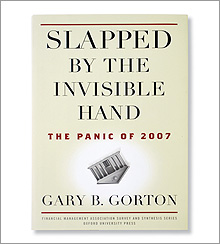
Slapped by the Invisible Hand: The Panic of 2007
(Oxford University Press, 2010)
Henry M. Paulson Jr.
On the Brink: Inside the Race to Stop the Collapse of the Global Financial System
(Business Plus, 2010)
Gregory Zuckerman
The Greatest Trade Ever: The Behind-the-Scenes Story of How John Paulson Defied Wall Street and Made Financial History
(Broadway Books, 2009)
Sebastian Mallaby
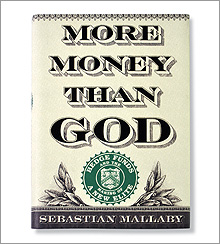
More Money than God: Hedge Funds and the Making of a New Elite
(Penguin Press, 2010)
Raghuram G. Rajan
Fault Lines: How Hidden Fractures Still Threaten the World Economy
(Princeton University Press, 2010)
Simon Johnson and James Kwak
13 Bankers: The Wall Street Takeover and the Next Financial Meltdown
(Pantheon Books, 2010)
The great uncertainty of all data in war is a peculiar difficulty, because all action must, to a certain extent, be planned in a mere twilight, which in addition not infrequently — like the effect of a fog or moonshine — gives to things exaggerated dimensions and unnatural appearance.
— Carl von Clausewitz
Something happened to us during these last three years, a momentous event, perhaps even a turning point in the history of global capitalism. But what, exactly? Everyone remembers the apex of the crisis, when Lehman Brothers perished, Bank of America bought Merrill Lynch, the Fed bailed out American International Group, and the U.S. Treasury Department took control of the U.S. government–sponsored loan companies Fannie Mae and Freddie Mac. In the time that has elapsed since a brief but heart-stopping paralysis behind the scenes in August 2007 set the stage for the later public event, a certain amount of sorting out has occurred.
An avalanche of good writing, much of it published this year, has been devoted to trying to decipher the chain reaction that took place between August 2007 and September 2008. These accounts may be divided into a few broad categories. There are narratives of the crisis itself, the analyses and prescriptions of economists, origin stories focused on various participants in the drama (the shorts, the quants, the hedge funds), and, of course, any number of corporate obituaries.
None of these books fully answer the question of what to expect as a long-term result of the crisis, but several of them, and one in particular, seem to go to the heart of the puzzle of what exactly happened to get it started.
The Narrative Framed
In the best business book of the year on the economy, Slapped by the Invisible Hand: The Panic of 2007, Gary B. Gorton of Yale University’s School of Management explains in some detail how in August 2007, the financial markets found themselves in the grip of a phenomenon thought to have been rendered impossible by various safeguards: a banking panic of the sort that rocked global capitalism a dozen times between 1837 and 1907. This time, however, the spectacle did not consist of individual depositors lined up outside the locked doors of retail banks, but rather firms creating runs on other firms. Instead of some familiar physical address, this occurred at the intersection of the securitization business and the shadow banking system, two enormous industries that had barely existed 25 years earlier.
The story of how a long “quiet period” in American banking — roughly 75 years without a single panic — gave way to a seismic near-collapse after years of tumultuous behind-the-scenes change makes for fascinating reading. The implications for how the authorities might have acted differently is even more interesting. After all, if the meltdown was mainly an old-fashioned banking panic at a higher level of abstraction, it should have been easier to fix.
The great virtue of Slapped by the Invisible Hand is that it was written in real time, as the crisis unfolded. The book consists primarily of two essays that Gorton wrote for a pair of Federal Reserve conferences. The first was at Jackson Hole, Wyo., in August 2008, on the eve of the public crisis; the second was a session nine months later, on Jekyll Island, Ga. (where plans for the Federal Reserve System had been drawn up a hundred years before). It also includes a third paper, written 15 years earlier when the shadow banking system was just emerging, which provides historical perspective, and a coda, titled “A Note to Those Reading This in 2107,” which makes it clear why the Dodd-Frank Wall Street Reform and Consumer Protection Act of 2010 probably will not on its own be enough to stop the next panic.
What happened, according to Gorton, was a classic panic, not all that different from the E. coli spinach recall in 2006 or the fear of mad cow disease that shut down British butcher shops a few years back — except that in this case, it was the pervasive fear of “toxic assets” that shut down the world economy for a time. Other observers are now reaching the same conclusion, in economics textbooks and journals, and, in all likelihood — since Gorton was among the first witnesses called to testify — in the December 2010 report of the Financial Crisis Inquiry Commission, chaired by former California state treasurer Phil Angelides. In other words, a consensus is emerging. But with Gorton’s book, you are there as the fog first begins to lift. You see how and when the narrative was framed. Moreover, Slapped by the Invisible Hand is tightly focused on prevention. You get a sense of how it could have turned out differently, if only the proper diagnosis had been widely shared among regulators at the time.
Why the star turn here? Gorton is not an ordinary economist. He has a master’s degree in Chinese literature, and earned an economics Ph.D. at the University of Rochester in 1983 with a dissertation on banking panics in the 19th century, which was highly unfashionable for the academic tastes of the times. After several years at the Federal Reserve Bank of Philadelphia, he moved to the Wharton School of the University of Pennsylvania and, eventually, to Yale. His most salient experience, however, was as a consultant to AIG Financial Products, where for more than a decade (beginning in 1996), he modeled markets for exotic financial products for the giant insurance conglomerate. Having knowledge of both policy history and current practice provided him with a privileged position from which to observe the events of 2007 and 2008.
At Jackson Hole, Gorton reminded his listeners of history that had been forgotten — that half a dozen panics had occurred in the era of national banking, which spanned the 50 years from 1863 (when Congress authorized national bank charters and established a uniform currency) to the creation of the Federal Reserve in 1913. They usually happened near business-cycle peaks, when people worried about losing their savings in a bank failure. Some unexpected piece of news would send depositors rushing to demand their money and, sure enough, since most of the money had been loaned out, the bank would fail, even if it was competently managed. (This is the situation everyone knows from Frank Capra’s film It’s a Wonderful Life.) Privately owned clearinghouses evolved to squelch rumors about member banks when they arose — sometimes squelching them successfully, sometimes not.
The Federal Reserve Board was created to deal with panics by imitating the Bank of England as “lender of last resort” to threatened banks. (J.P. Morgan had demonstrated the efficacy of this approach by single-handedly stanching the Panic of 1907.) But then the Fed itself panicked after the stock market crash in 1929 and permitted hundreds of banks to fail. So Congress created a number of safeguards of its own: insuring deposits, carefully defining banking, and restricting entry into the business. Depositors were reassured that they didn’t have to worry. And for the next seven decades, banking panics simply disappeared in the United States.
In the 1970s, however, two far-reaching changes in the system began to take hold, both of them described with considerable economy in Slapped by the Invisible Hand. Financial deregulation commenced when Wall Street ended fixed commissions on May Day 1975. The old partitions began crumbling. Money market mutual funds began accepting deposits. Junk bond underwriters entered the highly profitable lending business that had previously belonged mainly to the banks. Banks responded with innovations of their own, securitization chief among them. For centuries, banks held the mortgage loans they made to maturity. Now they learned to assemble mortgages into large pools, to slice and package the anticipated payment streams into “tranches” according to the seniority of the claim, and to sell the strange new securities that resulted to fast-growing institutional investors looking for a safe, steady return. This was the “originate to distribute” system.
Deregulation, securitization, and financial innovation became the foundation for the shadow banking system — though today it is probably better to call it the financial intermediation industry, since it is banking grown far out of its boots. Its lifeblood had become “repos” (sale and repurchase agreements), meaning the cash on hand of pension funds, investment houses, insurance companies, money market mutual funds, banks, corporations, governments, and every other kind of organization under the sun. Repos were the institutional equivalent of demand deposits.
But there could be no government insurance for sums like these. Collateral was required to make this short-term borrowing work. Along with a promise to return the principal on demand, repo lenders received a claim on bonds, often in the form of asset-backed securities, sometimes held by a third party. Thus did giant financial-services firms learn to finance themselves in the age of Fannie Mae, subprime borrowing, and Walmart. Gorton compares the money grid to the electricity grid. Everyone takes it for granted — writing checks, investing in AAA securitized products, etc. — until something goes wrong. Then, he says, the inner workings of the financial system turn out to be very complicated, just like the network that supplies electricity.
The shock that triggered the panic came in the summer of 2007, a few months after a new market for credit default swaps — the ABX index — was introduced, permitting arbitrageurs to take sides for the first time on the future of the subprime mortgage market. For seven days in August, quantitative funds, especially those in the high-flying subprime market, found themselves in a vertiginous twist. The Fed staved off the panic with a half-point cut in its discount rate.
By then, however, the smart money had been put on notice: Something had gone badly wrong with mortgage lending. For the next 13 months, the authorities in Washington tiptoed around the problem while banks sought to raise capital and confidence waned. What might have prevented the meltdown from occurring? A frank recognition of the problem and a guaranteed floor on the value of subprime mortgages in late 2007 or early 2008 might have done it, says Gorton.
Even at Jackson Hole, crucial aspects of the situation remained unclear to central bankers and their economic advisors. Only after an exchange between Gorton and another participant, Bengt Holmström of the Massachusetts Institute of Technology, did economists begin to zero in on the significance of all the tranches of asset-backed securities. Debt value is supposed to be immune to most information about it, just as US$100 bills are supposed to be difficult to counterfeit. In normal times, the complexity of collateral didn’t matter. When it became clear that greater scrutiny was required, transactions slowed down. In the case of repos, they stopped altogether for a time.
Slapped by the Invisible Hand is not an easy book, but that’s mainly because much of the material is unfamiliar, and some of it is abstruse. It contains enough tables and diagrams to help readers follow the argument where it leads (to some equations, naturally), along with a timeline to help readers reconstruct what they knew in the past three years and when they understood its significance. It’s possible to skip the hard parts and still master the frame. If you do, this is the book that, some years from now, you will be most glad to have read.
A Pair of Paulsons
Gary Gorton’s book has become the framework through which I view almost every other book I have read about the crisis, especially those that fill in parts of the crisis map that might otherwise be labeled “Here There Be Tygers.” The first of these, On the Brink: Inside the Race to Stop the Collapse of the Global Financial System, is from former U.S. secretary of the Treasury Henry M. Paulson Jr.
Paulson is a lovely person: an Eagle Scout, college football star, and devoted family man who made his way via mergers and acquisitions to the top job at Goldman Sachs. But he will probably become the crisis fall guy. Whereas Ben Bernanke had studied all his life for his task as central banker, a reluctant Paulson was thrust into the job and at first had little grasp of the situation he faced. He favored measures that might have been good for a firm — mark-to-market accounting in particular — but that were not suitable to a fire sale. And he focused on the wrong problem: Fannie Mae and Freddie Mac. When he ousted their managers, he thought he had saved the world. Lehman began to collapse the next day.
What, then, makes On the Brink so worth reading? In a word, candor. Paulson conveys the experience of the fog of war, one surprise after another, as his team pieces things together and the impending collapse is finally, expensively, halted. The Treasury’s “Break the Glass” bank recapitalization plan gradually evolves behind the scenes into the Troubled Asset Relief Program (TARP) as the situation deteriorates. “What we did not realize then, and later understood all too well, was how changes in the way mortgages were made and sold, combined with a reshaped financial system, had vastly amplified the potential damage to banks and nonbank financial companies,” writes Paulson. That about sums it up. The Bush administration may have been a little late to the party, but, thanks to Bernanke and Paulson, it finally arrived.
The Paulson from the economic events of 2007–09 who will be remembered longest, however, will probably be John rather than Henry. John Paulson is the hedge fund proprietor who learned how to use credit default swaps to short the subprime market with almost none of the downside risk associated with traditional short selling, and who then made exactly the right series of bets. In The Greatest Trade Ever: The Behind-the-Scenes Story of How John Paulson Defied Wall Street and Made Financial History, Wall Street Journal reporter Gregory Zuckerman, with exemplary clarity, explains how John Paulson groped until he understood the developing situation better than anyone else and, by trading the ABX index in the summer of 2007, made $16 billion for his investors and $4 billion for himself.
The Greatest Trade has been overshadowed in bookshops by The Big Short: Inside the Doomsday Machine (W.W. Norton, 2010), in which Michael Lewis, the best-selling author of Liar’s Poker: Rising through the Wreckage on Wall Street (W.W. Norton, 1989) and Moneyball: The Art of Winning an Unfair Game (W.W. Norton, 2003), covers much of the same subprime territory — but without Paulson, who was telling his story to reporter Zuckerman. Lewis is, I suppose, the more gifted storyteller, and he mobilizes a colorful cast of characters. But the subprime scandal without Paulson is Hamlet without the prince. The Greatest Trade Ever is the perfect companion to Slapped by the Invisible Hand, which, it should be noted, is so antiseptic in its determination to stick to banking and economic issues that it contains not so much as an anecdote. Zuckerman, on the other hand, turns the bubble and its highly profitable pricking into an adventure story.
Risky Business
You get a glimpse of what the secretive hedge fund business is about from John Paulson’s story, but if you want to know more about how the industry mushroomed in the 1990s, the book to read is More Money than God: Hedge Funds and the Making of a New Elite. Author Sebastian Mallaby was for many years a correspondent for the Economist. He had plenty of access to many of the ordinarily reclusive money managers who populate this relatively new niche in the asset management business.
George Soros was the hedge funds’ only well-known name in 1990, when they managed $39 billion in assets. But by the peak in early 2008, the figure was $1.93 trillion, thanks to such pioneers as Michael Steinhardt, Helmut Weymar, Julian Robertson, Paul Tudor Jones, Bruce Kovner, Stanley Druckenmiller, Thomas Steyer, James Simons, and David Shaw, all of whom populate the book. (In contrast, the four biggest banks in the U.S. had $7.7 trillion in loans and other assets earlier this year, more than twice as much as the next 46 banks put together.)
Hedge funds avoid regulation by accepting investments only from institutions and wealthy individuals, and by not advertising. Mallaby thinks that is as it should be, because fund managers have an outsized appetite for risk. They make money by betting against central bankers who defend unwise government policies, lending to institutions in need of liquidity, and scouting out mispricings. They are useful discoverers of bad news. They are small enough to fail — which they regularly do — without jeopardizing the financial system.
Mallaby thinks hedge funds may be the new merchant banks, and he likens them to the top investment banks — the Goldman Sachses and Morgan Stanleys of 50 years ago. If he is correct, it would have been nice to see him put in a word for the various proposals for quick-response investigations aimed at figuring out what happened whenever one of them blows up. After all, it is what we do when an airplane crashes.
The IMF Playwrights
Journalists write the playbills, but economists write the plays. Few positions offer a better view of the unfolding drama than that of chief economist of the International Monetary Fund. It is not surprising, therefore, that all three holders of the job in the last 10 years have written cogent, journalistic books on the dangers ahead.
Last year, Kenneth S. Rogoff of Harvard University, in collaboration with Carmen M. Reinhart of the University of Maryland, wrote the well-received This Time Is Different: Eight Centuries of Financial Folly (Princeton University Press). This year, Simon Johnson, who returned from Washington to MIT’s Sloan School of Management, published 13 Bankers: The Wall Street Takeover and the Next Financial Meltdown (with coauthor James Kwak), and Raghuram G. Rajan, back at the University of Chicago’s Booth School of Business, delivered Fault Lines: How Hidden Fractures Still Threaten the World Economy.
Rajan, who now serves as an economic advisor to the prime minister of India, writes with the revisionist authority of someone who has come to see the last 30 years with fresh eyes. Flying into Moscow, he reflects on how far we have come: The highways are clogged with cars (which, of course, bring new problems). Returning to Washington, he notes that since the mid-1970s, nearly 60 cents of every dollar of real income growth has gone to the top 1 percent of households. The rifts that worry him are not just the imbalances in financial flows among nations; the inequalities that exist within the industrial democracies are just as dangerous.
Johnson, who thunders away against the political influence of the financial industry on the influential website the Baseline Scenario, spent only 18 months at the IMF before leaving in August 2008 to denounce the political power of the banks — first in an article in the Atlantic (“The Quiet Coup”), then on his blog, and finally in 13 Bankers. The big financial firms have become an oligarchy, Johnson argues, comparable to those in, say, Argentina, Indonesia, or Russia — a self-perpetuating elite able to use its economic power to dictate government policy even in the midst of a meltdown. Only a bust-up of the biggest banks, based on antitrust principles, would curb their power. With the passage of the financial reform act, Johnson lost the battle, at least for now.
Does the debate sound familiar? It is reminiscent of the climate of opinion in the United States in 1912, in the aftermath of the Panic of 1907. Expert opinion then, too, was bitterly divided about what to do about the “money trust.” In a four-way presidential race — Republican William Howard Taft, “Bull Moose” trust-buster Theodore Roosevelt, Socialist Eugene Debs, and Democrat Woodrow Wilson — the centrist Wilson won. The Federal Reserve System was established, but otherwise banking continued its familiar patterns.
But we haven’t seen a panic like the one that began in 2007 before. That is why, in my view, Gary Gorton’s Slapped by the Invisible Hand stands out clearly as the best business book of the year on the economy. He tells us what happened, and we will be quicker to understand the next mania, panic, and crash because of it.
A hundred years ago, political scientist Theodore Marburg noted that every panic brought something new to light. “Accumulating experience should in time enable us to prolong the interval of recurrence,” he wrote, “if not eventually to prevent the recurrence entirely, just as epidemics of disease, formerly thought inevitable, are now prevented.” It took a while, but he was right. Once we got the hang of it, the quiet period lasted three-quarters of a century.
Author profile:
- David Warsh is the proprietor of EconomicPrincipals.com, an independent economics journalism site. He covered economics for the Boston Globe for 22 years and is a two-time winner of financial journalism’s Gerald Loeb Award.
