

Capturing the Value of Supply Chain Management
An exclusive survey shows CEO participation, smart use of technology, and bold change initiatives are key to successful Supply Chain Management.
For two major consumer products companies that recently merged, rationalizing and integrating their two supply chains — the set of operations and processes a company uses to obtain materials, transform them into finished products, and distribute these finished products to customers — was a prodigious undertaking that could make or break their union. Millions of dollars in savings were at stake, and many complex process changes lay ahead.
| “When Supply Chain Management is a CEO-level agenda item, annual savings improvements in the ‘cost to serve customers’ are nearly double.” |
This rare merger success story underscores the power of Supply Chain Management (SCM) when it is viewed not as an isolated function within a corporation, but as an embedded cross-functional capability designed to unify and rationalize otherwise incongruent parts of a dispersed organization. But this victory is the exception, not the rule. Although SCM officially reached “adulthood” this year — 21 years after Booz Allen Hamilton coined the term — it continues to fall short of its great promise.
A survey conducted by Booz Allen in the fourth quarter of 2002, which received nearly 200 responses from manufacturing and industrial companies in North America, Europe, Asia, and Latin America, many with annual sales of more than $1 billion, clearly identifies reasons the discipline has underdelivered. The core message from respondents, which included chief operating officers, chief financial officers, chief administrative officers, manufacturing/operations vice presidents, and logistical/shipping directors, is this: Top management needs to take a far broader view of Supply Chain Management, deepen its own involvement in the design and ongoing guidance of the function, and take a more realistic view of what technology can — and cannot — do.
Learning from Mistakes
Overwhelmingly, the survey showed that senior executives at large companies worldwide believe SCM hasn’t lived up to what it promised in the 1980s, when it took the corporate world by storm. Nevertheless, respondents’ answers suggest a number of ways executives can learn from SCM’s youthful mistakes, and improve this management practice. Among the survey’s conclusions:
-
In organizations where Supply Chain Management is part of the overall business strategy — and, therefore, a CEO-level agenda item — annual savings improvements in the “cost to serve customers,” a broad measure of manufacturing costs, were nearly double (8.0 percent versus 4.4 percent) those of firms where SCM responsibility resided lower in the organization.
-
Companies willing to consider steps as significant as reorganizing the supply chain itself when appropriate (also known as “breaking constraints”) achieve savings in two key cost measures that are 36 percent and 55 percent greater than companies willing only to make adjustments within the existing supply chain structure.
-
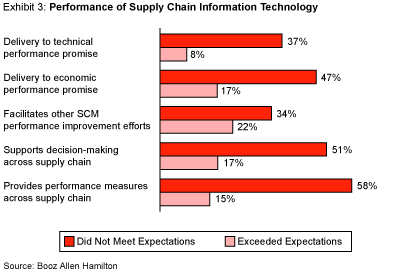
Nearly half (45 percent) of survey respondents said their supply chain information technology (IT) solutions have failed to live up to expectations, suggesting that for Supply Chain Management to reach its full potential, technology alone is not the answer.
Leadership Cuts “Cost to Serve”
Today Supply Chain Management, which is more complicated and challenging than ever before, requires precise and decisive strategic leadership from the top. Without such careful guidance and oversight from the CEO and the company’s full leadership team, our survey suggests companies can’t achieve the results they desire — and should get — from SCM.
| “Supply Chain Management is most powerful when it is viewed as an embedded cross-functional capability in an organization.” |
At most companies, responsibility for Supply Chain Management tends to be pushed down the leadership hierarchy. And typically each functional component of SCM (i.e., procurement, transportation, distribution, and inventory) is managed discreetly and with little coordination among the elements. For example, procurement and transportation may well be dealt with in separate functional departments, often without the involvement of sales and distribution in day-to-day decisions. Furthermore, SCM isn’t usually included in the strategic-planning process, which is an opportunity to fit the pieces of the SCM puzzle together.
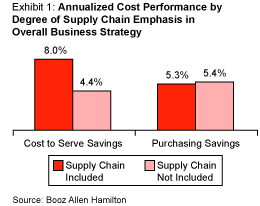 Although senior management involvement in SCM provides the big benefit of reducing the cost to serve customers, it doesn’t improve the savings in purchasing, according to our survey. (See Exhibit 1.) This is not altogether surprising because purchasing is a narrower part of a company’s cost base; it includes only the procurement costs for and price of raw materials. Because procurement departments are designed to cut purchasing costs (and are measured by their ability to do this), it is reasonable to assume purchasing costs can be effectively controlled regardless of how much SCM and corporate strategy are integrated.
However, responses did show a modest edge in purchasing savings improvement (5.9 percent versus 5.0 percent) for companies at which the CEO is personally engaged in setting the supply chain agenda.
Breaking Constraints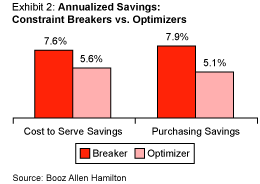 Greater cost savings are achieved, the survey shows, when management is willing to take a broad approach to SCM — tying together numerous functions across the entire organization — to the point where the overall structure of the supply chain is visible and can be reevaluated when necessary (what we call breaking constraints). This finding is in contrast with management teams that are only willing to make improvements to the existing supply chain structure, what we call optimizing within constraints. (See Exhibit 2.)
For example, a narrow “optimizing within constraints” SCM approach to falling demand for Product B might be to reduce purchases of the raw materials used for Product B and let the rest of the chain adjust to the reduction. A broader “breaking constraints” approach might be to reduce procurement and inventory of Product B, keep manufacturing running at 85 percent of capacity by increasing production of Product C — which happens to use a similar manufacturing process — and switch distributors to those with better knowledge of the Product C marketplace.
| “Nearly half of survey respondents said their supply chain IT solutions have failed to live up to expectations.” |
Technology Is No Panacea
According to the International Data Corporation, businesses worldwide invest more than $19 billion annually on information technology systems solutions to improve their supply chain performance, yet nearly half of the companies represented in the Booz Allen survey, who are among the biggest IT spenders, were disappointed with the results.
Every year, it seems, supposedly “breakthrough” IT is introduced for the supply chain. A few years ago it was enterprise resource planning (ERP) software, the management tool that gathers information across procurement, inventory, manufacturing, and distribution. Today, the hot technology is radio-frequency ID tags, which allow for automated, real-time tracking of inventory.
The truth — perhaps, a somewhat sad truth for information technology vendors and their customers — is that there is no way to optimize supply chain performance with technology alone. On all measures of IT systems performance, survey respondents indicated that the solutions they implemented did not meet expectations much more often than they exceed them. (See Exhibit 3.) Equally striking, among companies spending $25 million or more over three years on supply chain IT, only 21 percent said their systems exceeded expectations; 38 percent said they did not. These expectation gaps were generally true across geographic regions.
These results, however, only reinforce a truth about IT that is often ignored. Information technology, or any technology for that matter, is ultimately and intimately tied to human variables (e.g., Can people actually use the technology the way it is supposed to be used? Are the management limitations and opportunities to optimize use of IT tools understood? How does IT change the way processes are managed?). For example, the Internet provided great hope for IT supply chain solutions. There was a belief that the mountains of data that could be generated across the supply chain with the Internet’s help would automatically enable managers to make better SCM decisions. Not surprisingly, the Internet hasn’t been a panacea. The reason is that there is simply too much data overwhelming and confusing the decision-making process. Without better ways to manage and analyze the data, the Internet is a great generator of information but not a great tool to facilitate human insight.
This is not to say there isn’t enormous potential to improve SCM using Internet technology. But the potential is only as great as the company’s strategy and managerial prowess of the people who use it.
Herculean Rewards
Whether the issue is the quality of the technology, leadership, or execution, or all three, we believe when companies focus on SCM and put genuine effort (time and money) into the process, the promise becomes more tangible. Our research shows companies that make the biggest commitment to better Supply Chain Management outperform those companies where the effort is merely incremental.
| “Companies that classified their SCM effort as ‘Herculean’ reported annual purchasing savings 26 percent higher than those with less commitment.” |
Of course, companies’ spending close to $19 billion a year on supply chain technology and not achieving the results they want reinforces the fact that money alone can’t buy success. What matters just as much is creativity, dedication, and patience.
| Authors
Peter Heckmann, heckmann_peter@bah.com Peter Heckmann is a vice president with Booz Allen Hamilton in Düsseldorf. Mr. Heckmann specializes in sourcing/procurement, logistics, and e-business for companies in the telecommunications, electronics, and energy industries. Dermot Shorten, shorten_dermot@bah.com Dermot Shorten is a vice president with Booz Allen Hamilton in Boston. Mr. Shorten focuses on value stream restructuring with specific expertise in Supply Chain Management, supply base configuration, and manufacturing strategy. Harriet Engel, engel_harriet@bah.com Harriet Engel is a senior associate with Booz Allen Hamilton in New York. Ms. Engel has worked on Supply Chain Management in the nonprofit and public sectors for organizations in such industries as publishing, telecommunications equipment, diversified manufacturing, pharmaceuticals, paint manufacturing, and IT services. |
