
Major Media in the Shopping Aisle
Marketers are using digital and video technology to reach shoppers at the moment that matters most.
 |
|
Illustration by Opto |
It’s no surprise that marketers face enormous hurdles today in getting their message in front of the right consumers. At the height of the mass marketing era in the 1950s, advertisers could buy commercial time during I Love Lucy or The Ed Sullivan Show and be confident of reaching a huge percentage of their target audience. But no single TV show, newspaper, or Web site offers such widespread access to consumers today. The last bastion of prime-time mass marketing may well be the retail shopping environment, an advertising vehicle that many people would not even consider a communication medium.
“Everybody has to shop, so the store is the last place where mass marketing exists,” says George Wishart, global managing director of Nielsen In-Store, the retail media division of the Nielsen Company. “Even better, you are reaching people who are declared shoppers. They’re there for a purpose.”
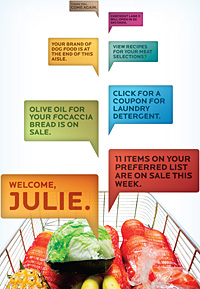
During the last few years, marketers, retailers, and media companies have intensified efforts to increase the impact of in-store advertising and make it a bigger part of the marketing mix. They are moving beyond traditional vehicles such as cardboard displays, printed ads, coupons at checkout, and video screens that run the same ad throughout the store. Video ads in stores are more targeted than they have ever been. They are powered by networks that offer programming aimed at particular shoppers, on the basis of where they are standing in the store, the promotions on nearby displays, and the time of day. Consumers in some stores can find shopping carts that help them navigate the aisles; if they pick up a bag of charcoal, the cart suggests barbecue recipes and guides them to the ingredients — mentioning, perhaps, which brands are on sale. If consumers swipe the charcoal with a handheld scanner, the scanner generates a coupon for it and for complementary barbecue items such as chips or soda.
The next generation of in-store advertising, in the not-too-distant future, will allow shoppers to request information via their mobile phones or kiosks that provide product advice, help consumers make choices, and make it easier for people to find what they’re looking for.
Most of these in-store marketing experiences exist only in prototypes and experiments, in a very few retail locations. For them to become ubiquitous, the media and marketing ecosystem — including marketers, agencies, media companies, and technology companies — must address several important challenges. First, the medium itself is still in development. Marketers and retailers need to experiment and collaborate to find the right mix of creative content (writing and video production) and technology to reach consumers in a meaningful way. Second, the metrics that measure in-store advertising effectiveness need to reach the same level of sophistication and standardization that exist with other, more established media. Finally, marketers have to learn how to integrate their in-store advertising programs with other in-store promotions and display activities, as well as with national media campaigns.
As the various players in the ecosystem address these issues, in-store advertising will transform the retail environment. It will also transform the advertising industry, reconfiguring marketers’ advertising budgets, their overall approach, and some of their strategic assumptions about reaching consumers.
The State of the Store
A few numbers make it easier to see the growth potential of in-store media. Advertising spending in traditional media such as TV, newspapers, magazines, and radio grew by less than 2 percent annually during 2006 and 2007. But spending for online advertising grew by more than 20 percent annually. Already, the Web takes in more advertising dollars than cable TV or radio. This shift reflects marketers’ desire for greater targeting, interaction with consumers, and measurability — all qualities offered by in-store media.
A similarly significant trend is the movement away from so-called measured media, such as advertising (which has been measured by conventional tracking methods such as TV viewer ratings), to “below-the-line” marketing categories such as promotions, loyalty programs, word-of-mouth, events, and any form of retail store display or shopper marketing. (This includes coupons, customized displays, and custom packaging, called shippers, that organizes the product on the shelf and delivers a promotional message.) At nearly three-quarters of a trillion U.S. dollars per year across all product categories, spending on below-the-line marketing programs already tops spending on traditional measured media advertising for most product categories, and it is growing more than three times as quickly, with 6 percent annual growth.
Within the realm of below-the-line marketing, in-store advertising promises to attract substantial marketing dollars, for a number of reasons. First, it transforms the way marketers interact with consumers. Since people make most purchase decisions at the shelf, in-store advertising allows marketers to reach them just before the “first moment of truth” (as Procter & Gamble Company CEO A.G. Lafley calls it), when they pick up the product. Second, in-store advertising can increase the effectiveness of the rest of a marketing campaign, “activating” promotions and sponsorships by making them click in consumers’ minds. For instance, if an individual has caught glimpses of Olympic gymnast Shawn Johnson in magazine ads and TV commercials for Procter & Gamble’s Secret deodorant, those impressions — and the brand attributes P&G is seeking to reinforce in its integrated campaign — will be triggered when they see her face in a video ad running on a screen near a product display in the store.
Today, marketers can run ads on in-store video networks spanning thousands of screens in retail stores. Given the number of times these ads are viewed over a week or month, they reach more consumers than the major broadcast networks. These ads can increasingly be targeted to a specific aisle in the store, rather than to the store as a whole, allowing marketers to run their ads closer to their promotional displays, and at the time of day when their shoppers are most likely to be present. Targeting by geographic market (for example, by the store’s zip code) will allow more granular delivery of marketing messages, reaching the specific sets of consumers with the greatest likelihood of buying the product, based on their income and demographic profile.
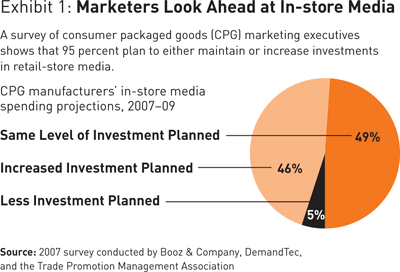
Currently, in-store media is only a US$500 million annual business. But it could equal (or even exceed) the growth rate of its online counterpart, especially since the rate of growth for newly introduced media appears to be accelerating. It took cable television 25 years (from 1981 to 2006) to reach ad sales of $20 billion. It took Web-based advertising about half as long, from 1995 through 2008, to reach the same milestone. Could in-store media reach it even faster? Nearly half of consumer packaged goods (CPG) manufacturers plan to increase their investments over the next two years. (See Exhibit 1.) Although these investments will focus on grocery, drug, convenience, and big-box stores, other sectors could drive advertising in other retail channels — technology companies in consumer electronics stores, for example, or building-products manufacturers in home improvement outlets.
Tracking the Transition
The money to fuel in-store advertising’s dramatic growth will come from several sources. Some marketers, seeking to develop integrated campaigns, will think in terms of overall “video spend,” including in-store video, rather than having separate TV, online, and out-of-home video sources. For other marketers, “alternative out-of-home spending” will continue to increase, especially as media in outlets such as health clubs, sports arenas, and transportation hubs become more prominent, and more digitally enhanced. Finally, shopper marketing budgets that tap into promotional spending to drive consumer behavior in the store will increasingly include video ad networks as a component.
The growth in in-store advertising does not represent a zero-sum game; it often signifies an expansion in the overall pie. The vast majority of dollars for in-store video advertising to date has come from below-the-line budgets, rather than from cannibalization of above-the-line paid media spending. True, some of this spending has come at the expense of traditional television budgets or out-of-home budgets for non-digital ads, such as static billboards, but a significant share is incremental.
Some media companies are already benefiting from the rise of in-store advertising by supplying content. In many cases, in-store media can become an important component of the editorial portfolio. National cable and magazine players in categories such as gardening, food, home improvement, sports, and health can extend their brands and deepen their position across multiple media platforms, while creating richer opportunities to develop integrated campaigns with leading advertisers. For example, a cable network that owns a show focused on a celebrity chef might film additional segments targeted specifically for retail outlets, with recipes tied to particular ingredients. Similarly, magazine companies will be able to reinforce their relationships with readers in key interest groups, developing video content that can be leveraged in the store, as well as other digital platforms such as online and mobile. Local television stations, newspapers, and radio stations can use in-store media to increase their presence in their markets. They can offer advertisers ways to reach consumers across a variety of digital touch points at once: in the home, in the store, and on the go.
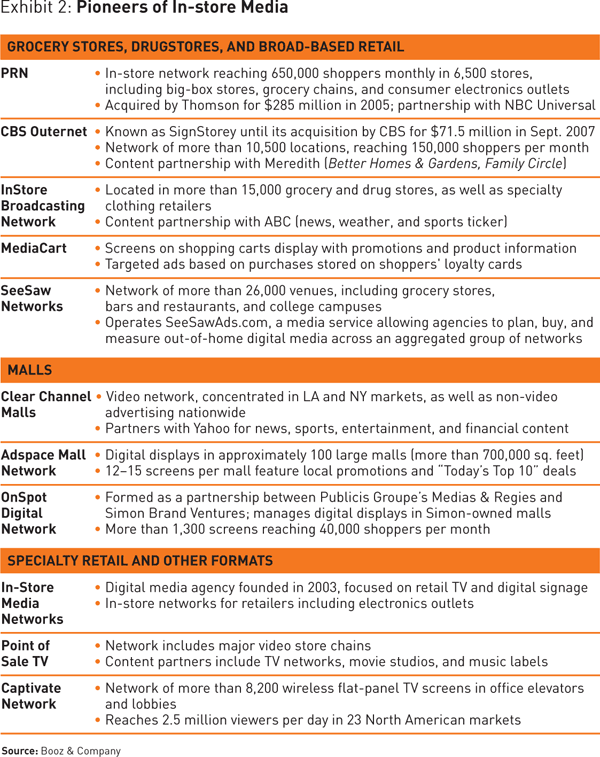
Today, a number of in-store video advertising networks are available to marketers. (See Exhibit 2.) They range from large-scale multichannel operations such as Premier Retail Networks (PRN) to smaller video networks focused on particular retail sectors (point-of-sale TV at Blockbuster and Hollywood Video) or technologies (MediaCart with interactive shopping cart displays).
Smart, Engaged, Accountable Networks
For the promise of in-store advertising to be realized, several challenges need to be addressed.
• Targeting. Today, the same ad is typically broadcast to every aisle across a chain. But some retailers are experimenting with in-store video advertising that achieves a level of personalization and focus unmatched by broadcast and cable TV, because messages can be customized by store aisle, time of day, and neighborhood to better target specific shopping occasions.
These new possibilities are made feasible by in-store ad networks’ switch from broadcast, satellite-based technologies to Internet protocol television (IPTV), in which the signal is downloaded through high-speed Internet connections. With IPTV, thousands of different videos are instantly available at any kiosk or screen within a store. Similar to video-on-demand servers, which deliver movies or TV shows to homes at residents’ request, IPTV systems tailor video ads to locations within a store, for example, running one ad in the dairy aisle and another ad in the beauty section. PRN is expanding its use of IPTV after tests in 2007 demonstrated that product sales in stores using this technology were at least 10 percent higher than sales in those that used a less targeted approach. Other in-store video advertising networks are also likely to make the necessary investments to migrate to a more targeted approach.
Wal-Mart Stores Inc. will be among the first to mine the potential of IPTV. The retailer announced in September 2008 that it is rolling out the “Wal-Mart Smart Network” in 2,700 of its stores, in partnership with PRN. The network will help advertisers gauge how effectively certain ads work in particular locations in the store, in different geographic locations, and at various times of day. “Let’s say Coke is an advertiser,” says Richard Fisher, president of PRN. “Because our data feed takes into account the temperature in different regions, the Coke ad could run as soon as the temperature goes above 75 degrees Fahrenheit in a particular store’s town. And think about how this technology could allow the ads to grow more sophisticated over time: Coke could produce the same ad in 10 different colors and test which is more appealing by measuring how those ads are performing against sales in different regions at different times of day.”
• Quality of engagement. Video remains the preferred way to deliver emotional impact and build brand equity. And thus far, only broadcast TV and cable advertising can consistently deliver high-impact campaigns to large audiences. The Internet is rapidly becoming a video medium, but it is still difficult for advertisers to achieve comparable reach online without aggregating one purchase across a number of sites — a daunting prospect for advertising media buyers. To counter the perception that the higher production values of home television make brands look better than retail store displays ever could, in-store video ad networks will need to develop research that demonstrates the ad recall and influence of their campaigns. They will need to show that the ads have an impact on consumers; that they are complementary to ads running on traditional broadcast and cable TV; and that they can represent an essential part of an integrated campaign.
 |
|
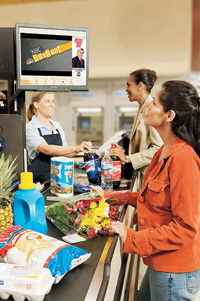
A Premier Retail Networks video screen
at a checkout station. Photograph © Premier Retail Networks |
And the potential for customer appreciation is also high. For example, in complex categories, such as digital cameras or lawn and garden pest control products, consumers often walk away from the shelves confused, without making a purchase. In-store video can help, providing in-depth information and education, reinforcing brand awareness and preference, and helping marketers learn what consumers are looking for.
To be sure, consumer products companies, their agencies, and their media partners have not yet fully adapted the techniques they need to produce ads for this new environment. When online advertising took off, a set of new ways to create, package, and buy ads rapidly emerged. In-store video advertising has yet to undergo such a transition. It relies heavily on the traditional practices of mass-market television. For example, the average consumer watches only about one minute of programming per store visit and catches less than 10 seconds of the average video segment before walking past. But the industry continues to produce the traditional 30-second spot. In-store video advertising networks and their content partners will need to invest in higher-quality creative work that is customized to this environment.
Other forms of in-store advertising could become as targeted and relevant as the ads that appear today next to Internet search results, calibrated to match the subject of the search. MediaCart, for example, has designed shopping carts, in conjunction with Microsoft and Wakefern, that take in consumer data when shoppers scan their loyalty cards into handheld scanners in Wakefern’s ShopRite stores. If customers have previously made a shopping list online and linked it to the loyalty card, the cart can help them find those items more easily. It can also inform them when items they have bought in the past are on sale. Advertisers can analyze ad performance data and make special offers that apply directly to particular consumers. The carts also feature automated shopping lists linked to maps of the store aisles, recipe and health information, and electronic coupons.
Other interactive systems will link promotional displays and kiosks to consumers’ mobile phones. People interested in learning more about a product could text for additional information, or opt to have offers “pushed” to their handheld devices. Information on a product might show up on the phone when a consumer moves past a “smart” display. Much of this information will be sent only with consumers’ permission, after they request information from a kiosk or sign up for a mobile service offered as part of a shopper loyalty program.
• Accountability. Some marketers and retailers are running experiments to measure the impact and effectiveness of in-store video advertising. Initial trials suggest that it can generate a significant sales lift, especially in combination with traditional in-store promotions and on-shelf displays. For instance, MASI International, a marketing research company, studied the impact of in-store digital advertising in supermarket chains across the country and found a noticeable sales lift in virtually all the brand campaigns it tested. Forrester Research has also cited in-store marketing pilots that led to a 15 to 60 percent boost in sales, depending on the location, season, and item.
 |
|
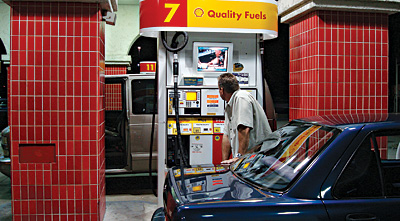
A driver watches NBC Universal programming on a Fuelcast screen, part of the Outcast network.
Photograph © Outcast |
Until recently, however, there were no standard metrics for audience delivery that could serve as the currency to negotiate ad sales contracts or to optimize the performance of campaigns. Furthermore, traffic data is available only at the store level — not at the level of the aisle or the shelf. Although existing research efforts are helpful in demonstrating the value of in-store media, they don’t provide the systematic, standard sets of metrics that are available for more established media.
Recognizing this gap, a consortium of dozens of CPG manufacturers and retailers banded together in 2007 through the In-Store Marketing Institute to create a new joint initiative called Pioneering Research for an In-Store Metric (PRISM). They selected Nielsen as the preferred research partner. After extensive testing and mining of insights over the past year, PRISM is now ready for commercial rollout as a syndicated data service from Nielsen’s fledgling in-store media unit.
PRISM represents a significant leap forward for in-store media. It provides a consistent set of reach and frequency metrics for brand messages across a broad set of retail media touch points. These are not limited to in-store video advertising screens, but include endcaps (the displays at the end of each aisle), pallet displays, display packaging, and other in-store media. Brand advertising messages on TV can be tracked by time of day (“daypart”), media type, and geographic market; similarly, PRISM provides the ability to track in-store media at the brand level by “store part,” media type, daypart, and region. In addition to enabling the comparison of in-store media with other media, PRISM links in-store media back to point-of-sale results.
The data, while valuable, still needs to be better matched to existing standards — for example, regional trading areas, the geographic areas used by PRISM, don’t currently map to the designated market areas (DMAs) used to track other forms of advertising. But Nielsen and its participating retailers are working on these issues.
• Brand integration. Finally, there is significant potential for CPG manufacturers to integrate their brands more effectively into the store. Video ads, for example, may refer consumers to other products, in the same way that Amazon.com currently suggests complementary titles to its book buyers. Marketers can also weave product placements into programming to provide indirect celebrity endorsement.
Perhaps the greatest potential, however, lies in using in-store video ads to activate sponsorships and promotions, and thus get more leverage from them. For many consumer packaged goods and apparel manufacturers, ad campaigns linked to sponsorships can represent one-third to one-half of paid media spending. These manufacturers already use the imagery from these sponsorships — including the Olympics, NASCAR, the NFL, the NCAA, blockbuster movies, and concert tours — in TV spots and online ads, and they are also beginning to use them in retail store displays. Imagine, then, ads for Frito-Lay snack foods featuring a sponsored concert guitarist being shown on screens in the retail store, while the same musician’s image appears nearby on the shelf display or packaging. To date, experimentation with this potential strategy remains limited; there is an opportunity for creative marketers to take the lead.
Covering New Ground
Some factors inhibiting the potential of in-store advertising are already being addressed, for example, through the PRISM initiative. But this is not enough to engender an in-store revolution. The entire marketing and media ecosystem needs to tackle three key priorities.
First, marketers and their partners must create a programming model tailored to the retail environment. They cannot just reduce video spots to 10 seconds or improve the technology with which in-store advertising is delivered. Marketers need to improve the way they frame their message. To date, they have mostly relied on programming that has already proven popular on television. For example, Nickelodeon adapted its Kids’ Choice product awards for Wal-Mart’s in-store network.
But a better solution lies in creating programming that is developed specifically for retail stores. It should combine the entertainment value of television with the benefits of in-store sampling and counseling — offering education as well as entertainment. This represents a particularly attractive opportunity for cable networks and magazine media brands to “own” those specific in-store interest areas such as food, gardening, home improvement, sports, or health and beauty. Media companies that develop attractive solutions will be able to capture a greater share of campaign spending than they otherwise could.
Second, marketers and their partners need to better use in-store marketing efforts to upgrade promotions and analytics. Promotional spending in the U.S. by companies in consumer packaged goods, entertainment, sporting goods, consumer electronics, and home improvement totals roughly $300 billion annually. But the in-store media of choice are still circulars, coupon dispensers, customized displays, and product packaging. There is enormous opportunity to further enhance the effectiveness of these vehicles through in-store advertising formats. Given the magnitude of this investment, getting a return on it will be a top priority for chief marketing officers for years to come.
Third, integrating in-store media with the broader marketing mix will require some organizational change. Marketing organizations need to break down the traditional walls between divisions and work more directly with a diverse set of agency and media partners. Just as marketers spent decades building stronger capabilities to achieve a better return on their investment in consumer and trade promotions, they now need to build new capabilities in both advertising and shopper marketing. This will include developing better metrics to make it easier to gauge the impact of in-store ads as part of any campaign.
It also needs to be easier for marketers to buy ad inventory by region, rather than by store or by chain. The example to follow is the cable TV industry; cable companies, which once sold ads independently, learned to team up so that an advertiser could buy ads across every cable system in a given market, such as the New York metropolitan area. In-store video networks will need to undergo a similar evolution.
Players across the ecosystem will also need to find a common way to track and demonstrate results. At present, the back-office processes for in-store advertising — trafficking, campaign reporting, and invoicing — are complicated by the use of different systems in different stores. More standardized platforms will make for easier analysis and execution. So will the emergence of ad networks that integrate inventory across many players of various sizes.
As companies address these challenges, in-store advertising will become a more valued and widespread component of marketing campaigns. Indeed, the global market for in-store video advertising is poised to take off. Leaders who take the initiative and invest in the right combination of assets and capabilities stand to reap significant rewards.
There are ample opportunities for all parts of the media and marketing ecosystem: media companies, brand marketers, advertising agencies, retailers, mobile phone carriers, and technology development firms. And there will also be a growing emphasis on large-scale providers. CBS’s recent acquisition of SignStorey and NBC Universal’s partnership with PRN and a host of other video ad networks have signaled a major shift in the market. There is a greater emphasis on “place-based media,” which reach out to consumers in different locations with relevant ad messages, such as spots for healthy food on advertising networks in fitness centers. CBS Outernet, for example, is more than an extension of an existing outdoor advertising business into a broad set of place-based media; it represents an effort to extend the core video content business into new venues, reaching consumers on the go in less-cluttered media environments. NBC Universal’s push into a broad set of alternative media channels, dubbed NBC Everywhere, is following a similar direction, though with a strategy that is focused on partnerships rather than ownership of alternative out-of-home media assets.
Ultimately, it will require collaboration among various players to develop this new media frontier. With the right push, in-store video advertising can achieve its own form of hyper-growth. Given the unique potential of in-store marketing to reach customers in a way that no other form of media can achieve, that push would be an effort worth making for everyone in the marketing and media ecosystem. 
|
Marketing by the Numbers |
|
Historically, successful retailers were efficient at two things: logistics and procurement. Then Wal-Mart Stores Inc. came along and taught everybody that they didn’t really know anything about logistics after all, and they couldn’t dream of matching Wal-Mart’s muscle in buying. So what did retailers fall back on? Marketing, branding their stores, differentiating themselves, and investing in their consumers in ways that they never had before. Retailers and marketers alike need to understand the return they’re getting on these activities. Spending on in-store programs, if consumer and trade promotions are taken into account, is now greater than spending on paid media advertising. There has always been some evidence that the spending was worthwhile: Retailers and manufacturers could see some short-term increase in sales volume as a result, and there was anecdotal evidence of such spending’s benefits for long-term brand building, as it reinforced a brand’s image and generated trial and repeat purchases. But ultimately, the people who decide where to spend marketing budgets need metrics to justify their choices. They also need to overcome a certain psychological block: Many people in the marketing world do not believe that in-store activities truly contribute to brand equity. So we at the Nielsen Company jumped into the deep end and said that we would create a set of metrics that would quantify the value of in-store marketing. Pioneering Research for an In-Store Metric (PRISM) is an initiative that Nielsen launched with the In-Store Marketing Institute and a consortium of retailers, manufacturers, and media agencies. The goal of this project is to determine reach and frequency for marketing messages in stores, in the same way we can deliver that data for ads on TV or in a magazine. To do so, we audit a store in two ways. First, we install sensors at the entrances and place auditors in the stores to understand store traffic. Second, we divide the whole store into four-foot (1.2-meter) sections and record every marketing message in each section — every display, every digital sign, every flyer. And then we track that data against the store’s daily sales. With this information, we can now answer three key questions: How many people were in the store? What marketing messages did they see? How did those messages affect sales? We have a much better understanding of how various marketing vehicles work in the store, and how marketers can use a mix of methods to achieve certain results. For example, consider “Brand X” Hair Care. Like all products, Brand X ultimately strives to get the highest possible number of gross impressions (the most distinct encounters in which a consumer views the brand’s marketing message) and the greatest possible rate of audience conversion (the percentage of consumers who walked through the store area containing a particular category and bought a product within that category). Thanks to the data gathered by PRISM, Brand X knows that in-store marketing garners more gross impressions than any other form of media — more so even than TV ads on American Idol, currently the highest-rated U.S. broadcast television program in prime time. Within the store, though, Brand X could generate more impressions than it does; the hair-care section gets only about 10 percent of the store’s traffic. However, the hair-care category does have a high rate of audience conversion — 65 percent of people who visit its section make a purchase. Logically, then, if Brand X can just get more people into the section, its sales will increase. PRISM data shows that some in-store marketing vehicles are better than others at attracting traffic — specifically, for Brand X, flyers placed over displays, which are most powerful in grocery stores; signage, which works best in mass outlets; and floor graphics. Given this knowledge, Brand X can better plan its in-store marketing mix across channels. And as in-store media becomes more technologically advanced and more sophisticated at attracting customers, PRISM and other such systems will continue their role as arbiters of information, helping marketers judge which new media will work best, in which parts of the store, with which customers. George Wishart is global managing director of Nielsen In-Store, a division of the Nielsen Company. |
|
Catching the Eye |
|
The number one challenge for many digital networks in retail environments is getting people to look at the screens so that they will engage with the advertisement. At NBC Universal, we think that’s our piece of the puzzle: Can we produce relevant content and then put the appropriate advertiser in that context? The key is that the content can’t be repurposed from television. It must be tailored to its purpose and specific to its setting, which may be any of the locations where we have what we call place-based media — fitness centers, sports arenas, subways, and, of course, retail stores. For obvious reasons, the content can’t be a 30-minute sitcom, and the ads can’t be 30-second spots. In many areas of the store, you won’t hold a consumer’s attention for more than 10 seconds, so the message in those areas needs to be customized to the length of time the consumer will watch. For advertisers, the advantage is that they can begin to think of ways all their marketing messages can reinforce one another and can benefit from being associated with NBC’s popular content. Think, for example, of the natural relationship between NBC’s The Biggest Loser and a brand of low-fat salad dressing. Ten years ago, the dressing’s manufacturer might have just bought a spot during the broadcast. Now, however, the company can also target a customer via the media network at his gym, and create a spot with a Biggest Loser contestant telling the consumer that when he is finished on the treadmill, he can do something else good for his health and purchase the low-fat dressing. At the store, the same consumer might see a different piece of content featuring The Biggest Loser — one that includes a recipe incorporating the salad dressing. Because it taps into the consumer’s activities and makes the brand part of his interaction with his environment, it is a branding experience that’s unique to place-based media. Retailers, too, benefit from an in-store media network that mixes content with advertising. When TV screens are placed at the checkout counter, retailers find that customers think they spend less time waiting in line than they actually do. Carefully placed advertising can also lead to increases in sales; for instance, through the Outcast Network, Fuelcast screens are embedded into gas pumps, showing NBC content mixed with advertising messages when the consumer starts pumping fuel. Convenience stores with Outcast have seen sizable increases in sales when items sold in the store — such as lottery tickets — are advertised at the pumps. Finally, NBC’s approach can help get consumers into certain stores in the first place. “NBC in Transit,” a new initiative still in development, incorporates screens on the New York/New Jersey PATH transit system. Retailers like Dunkin’ Donuts and Starbucks, which have locations next to the train stations, can use that channel to target commuters who will soon be walking past their stores. Eventually, consumers can expect a whole world of messages that are tailored precisely to the places in which they find themselves. These messages will be anchored by popular programming to catch their attention in a crowded media landscape. Mark French is senior vice president and general manager of NBC Everywhere, a division of NBC Universal. |
Reprint No. 08406
Author profiles:
Matthew Egol is a partner in Booz & Company’s global consumer and media practice and is based in New York. He focuses on growth strategy and sales and marketing effectiveness for clients in the consumer products and media industries, including developing new in-store and relationship marketing capabilities.
Christopher Vollmer is a partner with Booz & Company in New York. He leads the firm’s North American media and entertainment practice, and focuses on strategy development and implementation for clients in those industries as well as in consumer goods. He is the author of Always On: Advertising, Marketing, and Media in an Era of Consumer Control (McGraw-Hill, 2008).