
The Capabilities Premium in M&A
A new study of inorganic growth shows that deals made to enhance or leverage the things that companies do well consistently outperform others.

Illustration by Brian Cairns
Note: This article was originally published by Booz & Company.
It is a perennial question in every major industry: What distinguishes the companies with a track record of M&A success? We think we’ve found the answer — and a few companies have figured it out, too. It’s a business strategy that uses capabilities as the basis for inorganic growth.
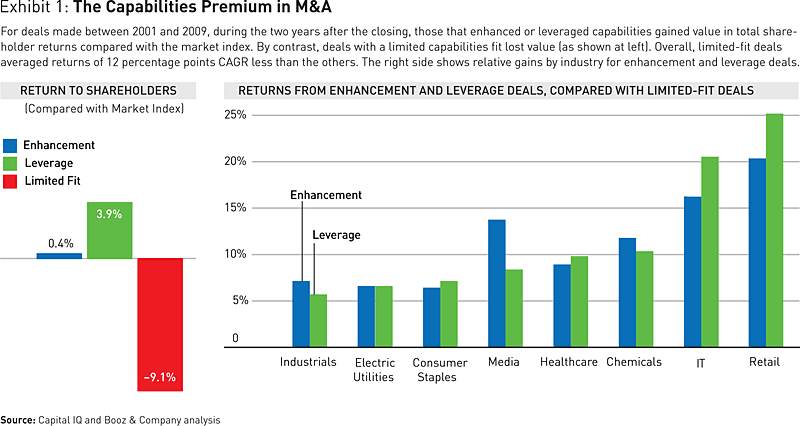
Successful acquirers make M&A deals that either enhance their distinctive capabilities systems, leverage those capabilities systems, or do both. These companies have been rewarded with deals for which the compound annual growth rate (CAGR) averages 12 percentage points more in shareholder return than M&A deals by other buyers in the same industry and region. Even during the difficult years since the 2008 economic crisis, deals linked to a capabilities-driven strategy have tended to increase shareholder value for the acquirer — while most other inorganic growth moves have led to a loss of value.
That is the key finding of a study we conducted in 2011, analyzing more than 300 transactions between 2001 and 2009 in eight industry sectors: industrials, electric utilities, consumer staples, media, healthcare, chemicals, information technology, and retail. (See Methodology.) Deals do better when the incoming company matches the acquiring company’s capabilities system. Some industries, such as information technology and retail, show a larger effect; all industries we studied, however, show a consistent, observable capabilities premium in M&A. (See Exhibit 1.) The same conclusions hold true in our research on successful serial acquirers (“Pac-Man” companies): Deals made with a capabilities perspective are far more likely to generate value over time.
A capabilities system, in this context, is something specific: three to six mutually reinforcing, distinctive capabilities that are organized to support and drive the company’s strategy, integrating people, processes, and technologies to produce something of value for customers. These are not the “keep the lights on” capabilities that every major company needs just to stay in business, such as bare-bones legal, tax, operations, and facilities management capabilities. Nor are they the competitive necessities, or “table stakes,” that apply to particular industries, although there may be some overlap. Rather, they are differentiated and complementary, working together to reliably and consistently deliver a specified outcome, in support of a company’s long-term strategy and market position. (See “Winning Moves for 12 Industries,” s+b, Spring 2012.) These capabilities systems are typically complex and multifunctional, and tied closely to the company’s identity; they take a lot of attention and investment to build and maintain. Once in place, they guide a company’s way of creating value in the market and provide distinction and prowess to its products and services.
A good example of a capabilities system is that of the Walt Disney Company. Practically since its start, this company has excelled at content development for young people, channel management, experience design, and copyright protection. Disney applies these capabilities to businesses as diverse as animated films, theme parks, television and radio channels and programs, apparel, and retail, making them all distinctively its own. Amazon.com Inc. is another example: Its capabilities in online retail interface design, back-end supply chain management, merchandising, customer relationship management, and technological innovation all fit together, enabling Amazon to be a trusted, attractive, reliable e-commerce hub for products and services around the world. Another example is Procter & Gamble Company, with its highly distinctive capabilities in consumer product innovation, international marketing and brand management, and leading-edge manufacturing.
It’s no coincidence that P&G (since 2000), Disney, and Amazon are all known for their successful use of M&A. Their understanding of who they are and what they do well gives them, and companies like them, an advantage when it comes to investing their capital. They avoid trying to win in areas where they have no inherent capabilities advantage; if this sometimes means they miss a chance for a quick profit, it also limits the magnitude of their mistakes. P&G has exited categories, such as food, that didn’t match its capabilities system; Amazon has scrupulously held back from investing in bricks-and-mortar retail; and Disney avoids making films that stray from its target audience.
The capabilities orientation is particularly valuable in M&A transactions, when time is often short and the stakes high. Executives who understand their companies’ capabilities system end up with a reliable and rapid guide to sound judgment. When a seemingly attractive prospect comes along that doesn’t fit, they recognize it in time to avoid a mistake. When a deal fits, they have a more solid basis for evaluating the right price. And during the execution of the merger, they are in a better position to gain value.
Matching Intent and Fit
This study grew out of decades of experience helping companies develop business cases on prospective acquisitions and postmerger integration efforts. We noticed a pattern: When deals exceeded expectations, the acquiring companies had used their own capabilities as a starting point. In their due diligence, instead of just looking for financially attractive opportunities, they asked: “What do we do uniquely well? How does this prospective deal fit?” And they made their decisions accordingly.
Everybody talks about fit when it comes to M&A, but these successful companies seemed to have an unusually clear idea of what fit meant. It did not mean adjacency: bringing in a seemingly related product or service, filling a hole in a grocery shelf category, or entering a new geography. Those types of acquisitions often fail. Rather, fit was related to coherence, the advantage that accrues to a company when its capabilities fit together into a system, aligned to its market position, and applied to its full lineup of products and services.
We decided to test our observation as a hypothesis: In a broad universe of transactions, would we find a correlation between capabilities fit and deal success? We started by identifying the 40 biggest deals by value, in which the buyers were public companies, in each of eight sectors — 320 deals in all — over an eight-year period. To isolate potential M&A success factors, we divided the deals by their stated intent (as defined in corporate announcements and regulatory filings), thus capturing the prevailing view of the purpose of each deal. We used five classifications of intent:
1. Capability access deals. The explicitly stated goal of these deals was to appropriate some capability that the target company had and that the acquirer wanted or needed. Comcast’s 2002 acquisition of AT&T Broadband (so it could offer more comprehensive telecommunications services) and Walt Disney’s 2006 acquisition of Pixar (to extend its animation capabilities and add new films it could market to its established audience) fit into this classification.
2. Product and category adjacency deals. In these deals, a company bought a business with a product, service, or brand related to, but not identical to, its existing business categories. Procter & Gamble’s purchase of Gillette in 2005 and Johnson & Johnson’s acquisition of Pfizer’s over-the-counter drug division (Pfizer Consumer Healthcare) the following year were two well-known deals of this sort.
3. Geographic adjacency deals. The idea behind these deals was to use M&A to expand, but into a new location rather than a new sector or category. Examples include the acquisition of Lucent (U.S.) by Alcatel (France) in 2006, and South African Breweries’ purchases of Miller (U.S.) in 2002 and Bavaria Brewery (Colombia) in 2005.
4. Consolidation deals. These deals were intended to take advantage of synergies and economies of scale, usually between two companies with similar businesses. Oracle’s acquisition of PeopleSoft in 2005 and the Delta–Northwest merger in 2008 were both consolidation deals.
5. Diversification deals. These deals allowed companies to enter a new or unrelated sector, typically with the rationale of insulating results against the business cycle. In recent years, there have been relatively few diversification deals, and they have typically been initiated by holding companies such as Berkshire Hathaway. The private equity sector is now trying to develop the ability to generate value from these types of deals. (See “The Next Winning Move in Private Equity,” by Ken Favaro and J. Neely, s+b, Summer 2011.)
We then cross-categorized the deals by their capabilities system fit. Our capabilities classifications were:
• Enhancement deals: in which the acquirer adds new capabilities to fill a gap in its existing capabilities system or respond to a change in its market.
• Leverage deals: in which the acquirer takes advantage of its current capabilities system by applying it to incoming products and services (and in many cases improving the acquired business’s performance).
• Limited-fit deals: in which the acquirer largely ignores capabilities. The transaction doesn’t improve upon or apply the acquiring company’s capabilities system in any major way. In fact, these deals often bring the buyer a product or service that requires capabilities it doesn’t have.
Almost two-thirds of the transactions in our study made good use of capabilities, through either enhancement or leverage. (See Exhibit 2.) But that left a substantial group of deals (37 percent) that were, in effect, conducted with capabilities as an afterthought. This provided us with a clear basis for comparison.
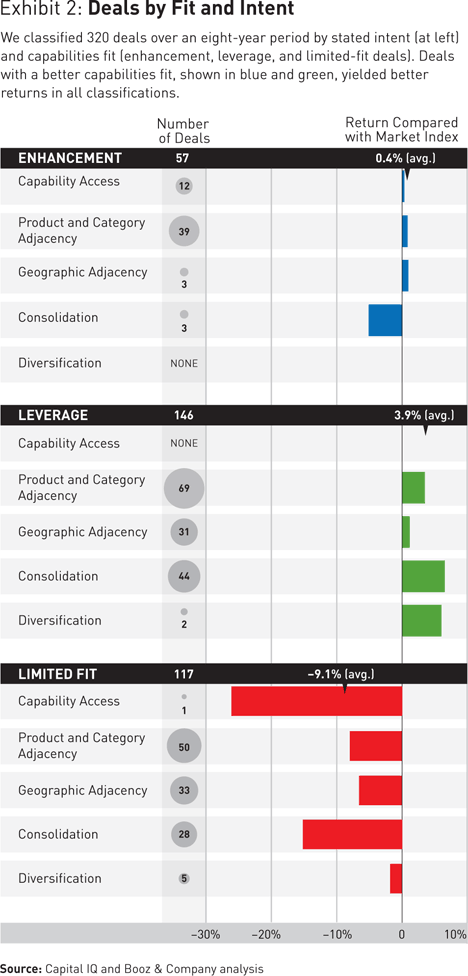
We analyzed deal performance by looking at the acquisition’s impact on shareholders — relative share price change plus dividends received, if any — two years to the day after a transaction closed. The eight-year period covered by our study was unusually volatile for the stock market; overall share prices fell in the early 2000s, then surged to record highs, then collapsed after the 2008 financial crisis. Many deals announced between June 2006 and June 2008, in particular, had lower share prices 24 months later, given the battering that shares took overall. We corrected for these market swings across industries by using relative shareholder returns (compared with the sector and region). Throughout this turbulence, shareholder returns held up considerably better among the acquirers that paid attention to capabilities than among those that did not.
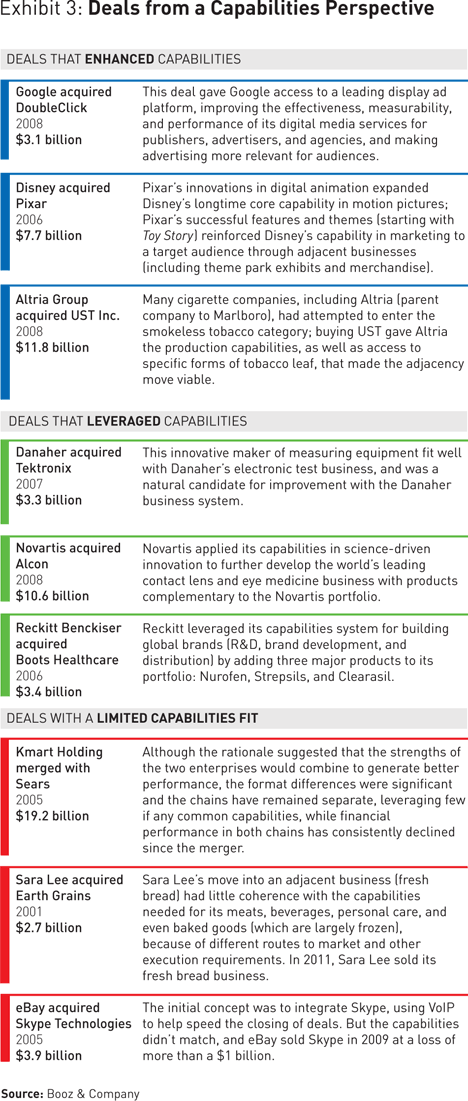
On average, the biggest premiums went to our “leverage” classification — deals that made use of the acquiring company’s capabilities system. Their success is not surprising; in these deals, buyers are applying their already advantaged capabilities systems to incoming businesses, products, and services, generating performance improvements and giving them an environment in which to thrive. Examples include Novartis’s acquisition of Alcon; just about any Danaher acquisition; and Oracle’s acquisitions of Siebel Systems, Hyperion Solutions, and BEA Systems (which took advantage of Oracle’s capabilities in database management and the sale and integration of enterprise software). In a leverage deal, the acquirer may not need to change anything about its own capabilities system to make it work; these are often low-risk deals.
Enhancement deals had the next-biggest premiums among transactions in our study. Analysis of the data suggests that they add less value than leverage deals, at least in the short run, because they lead to changes in the core capabilities system. These deals may require investment, involve some market risk, or (most likely) simply take more time to reach fruition. Enhancement deals can provide a way to deepen a capability a company already has; for example, Disney’s acquisition of Pixar catalyzed its revitalization not just as a producer of animated films, but also as a provider of entertainment to children and teenagers. They can also enable success in an adjacent category through capabilities expansion, as Altria found when it acquired UST and expanded successfully from cigarettes into smokeless tobacco.
Limited-fit deals fared the worst. Every deal faces execution risks, including integration challenges, cultural differences, and the departure of key executives. But deals that ignore capabilities are flawed in a more fundamental way; the best postmerger integration practices in the world can’t save them. (See “Motherhood and Snapple Pie,” by Rob Hertzberg, below.) At first glance, limited-fit deals may seem like another name for diversification deals, but they are actually quite different; there are many adjacency and consolidation deals whose incoming capabilities do not fit well with the acquiring company’s capabilities system. Examples include William Morrison Supermarkets’ 2004 purchase of Safeway, a U.K. convenience store chain; the 2003 merger of Biogen (biotech) with IDEC (pharmaceuticals); and Home Depot’s 2006 purchase of the construction materials wholesaler Hughes Supply — which it divested less than a year later to focus on fixing its core big-box retail business. Some limited-fit deals generate significant returns, especially consolidation plays, but as a group, their performance is far below that of deals that take capabilities into greater account.
Motherhood and Snapple Pie
by Rob Hertzberg
If capabilities-aware M&A often succeeds, deals that ignore capabilities usually flop — sometimes spectacularly. Here are four infamous M&A failures of the last two decades. See if you can match the disasters to the rationales for the deals, which are taken from either the original press release or a senior executive’s comments to the media. (The text has been edited slightly to remove spoilers.)
|
DEAL 1. Quaker Oats bought Snapple (1994) 2. Bank of America bought Merrill Lynch (2009) 3. America Online bought Time Warner (2000) 4. Cisco bought Pure Digital Technologies, makers of the Flip video camera (2009) |
RATIONALE PROVIDED A. “This is a once-in-a-lifetime opportunity to turn promise into reality. We’re creating a unique new company that has unparalleled assets and the ability to have a profoundly positive impact on society.” B. “The acquisition exemplifies our ‘build, buy, and partner’ innovation strategy to move quickly into new markets and capture key market transitions.” C. “This is a great opportunity for our shareholders. Together, our companies are more valuable because of the synergies in our businesses.” D. “This deal brings together the marketing muscle and growth potential of two of the great brands in America.” |
|
|
Answers: 1-D; 2-C; 3-A; 4-B |
If consideration of capabilities fit should drive companies’ decisions on what to add through M&A, it should also drive decisions on what to sell. Indeed, capabilities fit helps explains the spin-off and divestiture discussions that preoccupied many big companies in 2011 — including Fortune Brands’ sale of its home and security business (so it could focus on whiskey and other spirits), Kraft’s announced division into separate snack food and grocery businesses, Sara Lee’s divestiture of its fresh bakery and food service businesses, and ConocoPhillips’s decision to turn its upstream and downstream oil businesses into two separate companies.
Indeed, it seems likely that mature industries evolve through this type of capabilities migration. Businesses are naturally drawn to the capabilities systems in which their products and services can best thrive, with M&A opening the pathways. Over time, this leads to consolidation: not around assets, as the conventional wisdom would suggest, but around distinctive capabilities systems.
Bringing Capabilities Home
The results of this study suggest that a CEO — generally used to relying on financial considerations in evaluating M&A — should look every deal prospect up and down from a capabilities perspective. (See Exhibit 3.) This lens isn’t used often enough, perhaps because capabilities are not on the strategic radar for many companies, either in the boardroom or on Wall Street. They are seen as functional matters, not as fundamental levers of value creation that can make the difference between success and failure for a corporate direction.
Board members and investment bankers are used to focusing on financial questions when evaluating a deal: How much of a premium is justified? Does it make sense to use debt? Will the deal be accretive or dilutive? What short-term cost synergies can it drive? Questions like these, although often urgent, tend to draw attention away from strategic issues toward transactional concerns (which are, after all, often the primary concerns of a traditional due diligence process). These types of questions may also stem from narrow visions of a company’s future direction — visions that don’t take into account the capabilities system and strategy that underpin the company’s success.
By contrast, a capabilities-oriented assessment will involve everyone, including the board and major shareholders, in thinking more fruitfully about the long-term value of deals. This type of assessment is best conducted throughout the M&A process. In the strategy and screening phases when a business case is being made, during valuation, and again during due diligence, the following questions are relevant:
• What is unique about the target company’s capabilities system? How does this company create value for customers?
• How does the acquired company’s capabilities system differ from our own?
• If we are buying the company for its product and service portfolio (a leverage deal), are we sure that those products and services will thrive within our current capabilities system?
• If we are acquiring the target company for its capabilities (an enhancement deal), will we be able to preserve and integrate them?
• How will this newly merged entity deploy and execute its evolving capabilities system? What are the risks of incoherence?
• Which facilities, processes, suppliers, and employees are critical to bring on board, for the sake of the combined capabilities system? Are any of them (or any key customers) vulnerable to poaching by competitors?
These types of questions call for qualitative assessments, going beyond financial and legal considerations to focus attention on technological, organizational, and cultural issues. This may seem like unfamiliar practice in M&A, but it pays off in better decisions being made about deals, and in far more effective integration.
After the transaction is complete, it’s important to avoid complacency. All too often, the buyer’s unstated presumption is, “I bought you; therefore, everything happens my way.” But integrating capabilities with different histories and practices can be extremely complex and messy — especially when the acquiring company has not clearly articulated its own capabilities system, as most companies have not. (For survey results on this subject, see “Data Points: Corporate Incoherence,” s+b, Summer 2011.)
It helps to acknowledge up front that you don’t have all the answers, and adjust your integration strategy as the value of capabilities becomes clearer. In 2009, Pulte Homes Inc. bought the struggling Centex Corporation for US$3.1 billion, creating the largest homebuilding company in the United States. Centex was a bargain; its shares had fallen 60 percent during the housing crisis, because of its high level of short-term debt and extensive inventory of unsold land. Pulte’s original plan for extracting value was straightforward: Eliminate redundancies. After the acquisition, however, the Pulte executives discovered they had absorbed some significant capabilities with Centex, including a sophisticated, highly efficient methodology for managing the entire homebuilding process from scheduling to supply chain to construction. Instead of cutting across the board, Pulte spared these pieces of Centex and incorporated them into its own capabilities system. Although the housing downturn continues to challenge Pulte Homes, the integration of Centex’s capabilities is ultimately worth thousands of dollars per home — a much-needed advantage in this challenged industry.
A Tale of Three Pac-Men
Some companies have learned over time how to expand through acquisition. They are not just aggressive about doing deals, but consistently better than their peers at getting good results. When we took a closer look at three of these serial acquirers (also known as Pac-Man companies), we found a strong capabilities angle to their M&A activities.
• The Danaher Corporation. This manufacturer of scientific and technological equipment has been highly acquisitive during the last 15 years. It has spent more than $22 billion on dozens of mostly small deals that have helped it carve out positions in sectors as diverse as industrial components, mechanics’ hand tools, measuring instruments, and dental equipment. Danaher’s success with M&A is directly linked to its insistence that all acquired businesses adopt the Danaher business system (DBS) — a group of lean manufacturing methods and quality improvement processes that make up the company’s most important capabilities. Even more important, Danaher uses potential fit with DBS as a criterion for the acquisitions it targets.
Before completing a deal, Danaher will often visit the target company’s plants to determine how much process improvement — and margin improvement — it can expect. No activity is too small for Danaher’s attention; the company uses process mapping and kaizen techniques to improve every aspect of production: the way products move between stages, the management of parts, and even the way individual workers handle tools. Within months of buying Sybron Dental Specialties in 2006, Danaher’s process specialists figured out a way to reduce the time needed to make a clear ceramic orthodontic bracket from 24 days to six, and to reduce Sybron’s manufacturing floor space by 30 percent.
The 31 transactions (worth 72 percent of its market capitalization) that Danaher has conducted between 1995 and 2011 are almost all leverage deals, in which the company applies its capabilities system to a new or adjacent product or service area. Danaher’s M&A program has helped raise the company’s share price by a factor of 15 over that time period, a performance far superior to that of the S&P 500 and many of Danaher’s competitors.
• Li & Fung Ltd. Based in Hong Kong, this sourcing company designs and transports products for manufacturers, including many apparel and durable goods makers in the United States. Li & Fung’s capabilities system — which includes the management of a network of suppliers, seasoned skills for negotiating both price and quality of delivered goods, and a highly refined distribution network in North America and Europe — has made it the world’s largest supplier of toys and clothes to retailers. The company showed a 25-fold rise in total shareholder return between 1995 and 2010. (This was offset somewhat by a 45 percent drop in 2011, which led to a management shake-up; however, most observers agree that the cause was the global recession and flagging consumer sentiment, and prospects for the company remain strong.)
Although sourcing might not seem like a fertile sector for acquisition, Li & Fung has spent about $5 billion, more than one-fifth of its current market capitalization, to buy 24 smaller competitors. All of its deals broaden and deepen its sourcing network, already one of the most extensive in the world. These acquisitions bring Li & Fung additional revenue and new manufacturing customers, and sometimes allow it to add expertise in a new product area. In 2010 and 2011, for instance, Li & Fung bought leading suppliers of leather goods, health and beauty products, denim products, and toys, along with onshore sourcing companies in the U.S. and western Europe. In an interview in June 2011 with Bloomberg News, company chairman William Fung said rising wages in China may also prompt the company to look for deals in other developing markets, such as Vietnam, Bangladesh, and India. In all these acquisitions, the capabilities-oriented logic remains constant.
• Walgreen Company. The largest drug retail chain in the U.S. has more than 7,700 stores in the United States, many of which it opened organically. But it also has a track record of acquiring companies that contribute to share performance, and the company is noteworthy for making both leverage and enhancement deals. In its leverage deals, Walgreens typically buys regional drugstore chains, such as Happy Harry’s (founded in Delaware) and ApothecaryRx (which has 18 pharmacies in five Midwestern states). It rapidly converts all incoming retail properties to the Walgreens format (its counterpart to the Danaher business system), minimizing store downtime during integration. In addition, by bringing rigorous pharmacy management capabilities to its acquired stores, Walgreens drives up its productivity (as measured by prescriptions sold and same-store sales) and reduces operating costs.
The enhancement benefit that Walgreens can gain from acquisition was evident in its 2010 purchase of Duane Reade Inc., a signature New York City chain with some unique capabilities, including local marketing and the merchandising of fresh food and beauty products. Similarly, the recent acquisition of the online-only retailer Drugstore.com will enable Walgreens to learn from a more experienced e-commerce player and to forge a multichannel strategy in a competitive sector where consumers increasingly want to shop online.
It takes a great deal of skill to be a successful serial acquirer; most companies fail at M&A more often than they succeed. When they look back at their unsuccessful deals, executives tend to blame timing or some financing blunder: “We paid too much; we took on too much debt.” To be sure, those factors make a difference. But behind every truly bad deal there is typically some fundamental mistake in capabilities assessment, or poor execution in integrating capabilities. Danaher, Li & Fung, and Walgreens avoid those errors because they understand their capabilities systems and design their deals accordingly, time and time again.
Beyond Arbitrage
Every few years, an approach to M&A emerges that confers competitive advantage to those who spot it early and become proficient at it. For a while, this type of M&A represents an arbitrage opportunity: Companies that practice it can buy properties, turn them around, and either run or sell them at a premium. In the 1980s, financial engineering (basically, using debt to finance acquisitions) was one such arbitrage opportunity. Then the private equity approach — slashing expenses and selling the company — became a second.
These two forms of M&A are well suited to financial players looking for short-term accretion. They have less value to strategic buyers looking for long-term uplift. M&A with a capabilities orientation is far more enduring because it puts assets, products, and services into the hands of companies that can make the most of them. It can therefore produce a more sustainable long-term return than arbitrage-oriented transactions can.
Although companies like Danaher, Li & Fung, and Walgreens have quietly practiced capabilities-oriented deal making for years, it is only now emerging as a visible alternative on Wall Street — not coincidentally, at a time when most “easy money” deal-making approaches have stopped working. We may be moving toward a time when companies gain advantage by articulating their own capabilities systems, showing a clear understanding of the handful of things they do that provide customers genuine value. Once companies have tangible answers — once they can settle on the capabilities system that differentiates them from rivals — they will have a reliable guide to enable them to make the right decisions about the deals that come to their attention.
If you are a strategy or corporate development executive, it might be an interesting exercise to go through the history of failed deals at your company — studying the video, as it were, and trying to spot the previously unseen capabilities gremlins. Of course, it would also be a bit of an academic exercise; what’s done is done. The important thing is to make sure that in the next deals you make, the capabilities logic is airtight and you follow our recommended first rule of M&A: Pay attention to your capabilities system. It will make a huge difference to your shareholders, and to you. 
Methodology
Our study looked at the 40 biggest deals during an eight-year period (2001–09) in each of eight industries: industrials, electric utilities, consumer staples, media, healthcare, chemicals, information technology, and retail. To measure the performance of these 320 deals, we took the acquiring company’s total shareholder return (TSR) CAGR — stock price plus dividends — two years after the acquisition was completed, and compared that with the TSR CAGR of the large-cap index in the acquiring company’s country. (For benchmark indexes, we used the S&P 500 in the U.S., the FTSE 100 in the U.K., the CAC 40 in France, and the DAX in Germany.) If the company didn’t pay dividends, the TSR was equivalent to the change in the company’s share price.
One part of the research required some judgment: the classification of deals’ intentions, and especially the deals’ fit from a capabilities perspective. To help with this, we examined corporate announcements, external press coverage, and SEC filings. For the fit classification, we ultimately relied on our judgment, analysis, and experience with clients to determine whether these were enhancement, leverage, or limited-fit deals.
Some deals appeared to have multiple goals — for example, they were intended as both a product and geographic adjacency, or they were expected to both leverage and enhance capabilities. We slotted those deals into the single main category that we believed they fit best.
Reprint No. 12105
Author profiles:
- Gerald Adolph is a senior partner with Booz & Company in New York. He leads the firm's mergers and restructuring practice and is coauthor of Merge Ahead: Mastering the Five Enduring Trends of Artful M&A (with Justin Pettit and Michael Sisk; McGraw-Hill, 2009).
- J. Neely is a Booz & Company partner based in Cleveland. He specializes in mergers and restructurings.
- Cesare Mainardi is the chief operating officer of Booz & Company and managing director of its North American business. He is coauthor, with Paul Leinwand, of The Essential Advantage: How to Win with a Capabilities-Driven Strategy (Harvard Business Review Press, 2011).
- Also contributing to this article were Booz & Company partner Paul Leinwand, senior associate Ignacio Diaz, associate Maneesha Mukhi, and contributing writer Robert Hertzberg.