

The Realist’s Guide to Moral Purpose
Four ideals of leadership that appeal to our deepest instincts — and can inspire a company to long-term success.
(originally published by Booz & Company)
 |
|
Illustrations by John Craig |
Here the answers are not so obvious, but upon close observation, they become clearer. The most successful organizations, over time, are those in which people act consistently and decisively, innovating and building high-quality relationships. The task of leadership is to stimulate these kinds of actions, reliably and continually. The executives who can do this are not magicians. Consciously or not, they have learned how to deploy a conceptual tool that allows them to inspire and lead an organization toward enduring competitive advantage.
That conceptual tool is called moral purpose. A moral purpose is a value that, when articulated, appeals to the innate sense held by some individuals of what is right and what is worthwhile. For example, by all accounts, Sam Walton was a tough businessman, but at the company he founded, Wal-Mart, making money was secondary to another moral purpose: giving customers a good deal. He made his “associates” (as he called employees) feel that their work was worthwhile, by tapping into their natural good feelings toward fellow human beings. This in turn led them to treat customers in a friendly and helpful way, which (combined with his fierce pursuit of low prices) established the kind of customer loyalty that has been the central competitive advantage of his company. Mr. Walton could do this because he shared these feelings himself and communicated them at every turn. Indeed, his altruistic appreciation of his fellow human beings shines through his account of his own motivations (in his 1992 autobiography, Sam Walton: Made in America, written with John Huey, published by Doubleday):
[Our associates] learn to stand up tall and look people in the eye and speak to them, and they feel better about themselves…. Wal-Mart has helped their pocketbooks and their self-esteem. There are certainly some union folks and some middlemen out there who wouldn’t agree with me, but I believe that millions of people are better off today than they would have been if Wal-Mart had never existed.
Of course, outsiders may not always credit Sam Walton with altruism; they may attribute more ruthless self-interest to Wal-Mart than to other organizations. They may even have good reason for doing so. But that does not affect the degree to which an ideal of service drove Sam Walton and his employees during his lifetime, and made possible Wal-Mart’s success.
Moral purpose of a very different sort allowed Siegmund Warburg to build the financial firm S.G. Warburg into one of the top two merchant banks in London after World War II. This was a highly disciplined, innovative, and idiosyncratic firm. It was, for example, responsible for the first Eurobond issue (which was sold, characteristically, to a company no one else would have thought needed external financing), and for a series of hostile takeovers that offended more conventional European bankers. Mr. Warburg’s own name for his approach was “haute banque.” He strove for heroism, directly inspired by the writings of Friedrich Nietzsche, with the moral purpose of creating an aristocracy of elite financiers who would bring, as he put it, “the diverse potentialities of the human being to their highest possible level.” The drive to win and to achieve gave him and his firm capabilities that their competitors could not even begin to emulate.
Investor Warren Buffett, who similarly disdains the popular following of fashion in the stock market, has his own form of moral purpose. He seeks neither altruism nor heroism, but excellence. In his writing, he describes his purpose as being an artist, with investment as his canvas. He has never bothered to create an organization; his firm, Berkshire Hathaway, retains a tiny head office, for that is all that an artist needs.
A fourth moral purpose, the value of discovery for its own sake, has driven many entrepreneurs into new innovative domains. In the 1930s, it drove Thomas J. Watson Sr., the founder of IBM, to explore the thus-far-unseen potential of the data-processing industry, the scope of which he thought he alone recognized. Accordingly, he took huge risks and invested heavily in research, helping to make IBM impregnable. In doing so, he created a tradition of innovation that helped keep the firm close to the cutting edge of technological development for many years.
Behind every successful company one can find leaders with a similarly well-formed moral purpose. (See Exhibit 1.) You may not like, or agree with, their particular moral sensibilities, but you cannot argue with the impact: Each moral purpose, in its own way, compels the people who work in that organization to rewrite the rules of their industry’s game and generate unprecedented results.
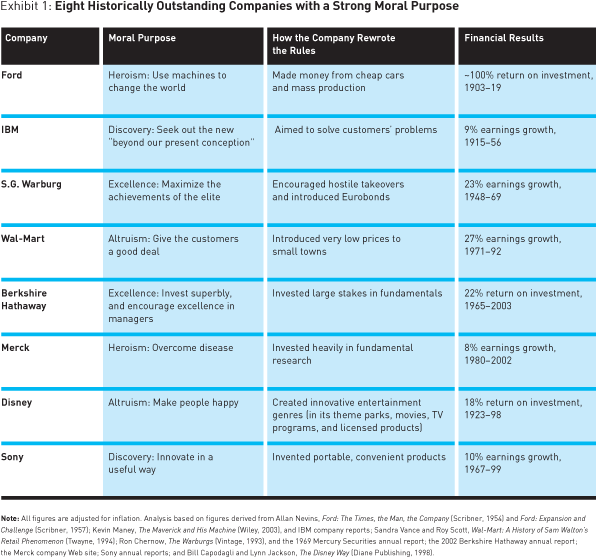
A well-chosen moral purpose, one that resonates with the sensibility of customers, employees, and other constituents, can serve a number of functions. It contributes to morale by establishing a sense of community and common meaning, grounded in mutual respect: Employees know that they have more than their paychecks in common. It fosters innovation by sensitizing people to market conditions and opportunities. For example, their drives for power and discovery, respectively, made Henry Ford and Tom Watson identify the potential of cheap automobiles and data processing. In providing a degree of emotional certainty, a well-grounded moral purpose also counters the natural risk aversion of a large company, which might otherwise hold back innovation. It inspires people to search out solutions to problems, to not give up, to keep on trying. In short, an organization’s moral purpose provides a unifying theme that allows its people to understand and facilitate the complex fit among its actions, assets, and strategic position.
The Test of Time
Why, some will ask, is moral purpose so important? Is something so seemingly esoteric really essential to the proper functioning of the firm? After all, there are plenty of hugely profitable businesses at which the overwhelming purpose of the management team is merely to make as much money as possible, or perhaps to be recognized as star achievers. There are even more businesses for which moral purpose is no more than a confection, providing a little boost to morale when needed but peripheral to the firm’s central profit-maximizing dynamic. Given these undeniable facts, why shouldn’t we attribute all of a company’s success to, say, the characteristics of the CEO, or the workings of the top team?
There are three reasons. First, moral purpose is where the big money is. Most stories about wealth creation and success are far easier to understand when we recognize the part that moral purpose has played.
Second, moral purpose reveals the underlying human dynamics of the firm, the most fundamental issues involving motivation and behavior.
Third, moral purpose is all that successful CEOs want to talk about — although they do not put it in those terms.
When no clear moral purpose is articulated, a company acquires a de facto amoral purpose: expediency. It becomes the kind of company that professes, “We are here only to make money.” This can be very successful in the short run, but companies without a clear moral purpose cannot endure; they do not survive the changes they will face in their markets or business environments. Even so, this type of company is preferable to the company that pretends to follow a moral purpose, such as excellence or altruism, but actually practices expediency. This gap between real and professed moral purpose breeds cynicism among employees. Companies that profess moral purpose but do not display it become crisis-ridden and paralyzed, precisely because employees have inconsistent, even contradictory, guidance for their decisions and cannot set priorities.
Moral purpose is especially powerful when it prompts leaders to take radical steps that others would not take, and thus change the basis of competition in their industries. That is why moral purpose is a critical, if often unseen, element of strategic breakthroughs. A moral purpose can give a company the collective courage and persistence to strike out from the pack. To be sure, the transformation of a company or industry can be triggered by factors other than moral purpose. But the moment there is a genuine change in moral purpose, the organization transforms.
An effective moral purpose is intrinsic to a company’s identity and not a means to some other end. It is not a public relations or human resource tool. If the top team treats it simply as a means to profit, then it will not work effectively as a means to profit. It must be pursued for its own sake. By the same token, moral purpose is not corporate social responsibility, which is a company’s sense of moral obligation to a wider society or community. The BP Group, as the most explicitly environmentally oriented large oil company, holds a collective moral commitment to environmental standards. This forms part of its moral purpose. It also professes a social responsibility toward indigenous communities near its facilities around the world. But this latter responsibility is not so clearly aligned with its strategy, and is therefore less productive, for both BP and the world. It may be a good thing, but it is not part of BP’s moral purpose.
A moral purpose’s effectiveness also depends on its connection to the shared culture of humanity — to the extent that it draws on philosophical ideas that have stood the test of time. I disagree with the view put forward by Jim Collins and Jerry Porras in their influential book, Built to Last: Successful Habits of Visionary Companies (HarperCollins, 1994), that the content of the ideas animating a corporation matters little compared to how hard they are pushed by management. Not all ideas are born equal. It is true that a relatively isolated institution can effectively brainwash its members into believing anything. But when the average length of employment with one company is 4.5 years, this is not going to become standard business practice.
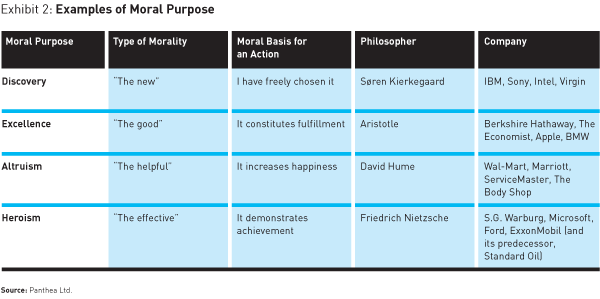
At the same time, the fit between moral purpose and strategy does not take place automatically. Company leaders must manage moral purpose and strategy so that they are aligned, so that the nature of the moral purpose helps the firm advance in its environment. Discovery, excellence, altruism, and heroism represent four sets of ideas, each with its own philosophical roots and long-standing cultural integrity. (See Exhibit 2.) They are not the only moral purposes that are influential in our culture. (See “Moral Purpose Outside Business,” below.) But these four, as the successes of Thomas Watson, Warren Buffett, Sam Walton, Siegfried Warburg, and many other business leaders have shown, are most relevant to competitive businesses today. An effective corporate strategy, I believe, starts by identifying which of these moral purposes is closest to the company’s strategic intent — and worthy of the investment of the senior team’s attention and engagement.
|
Moral Purpose Outside Business |
|
There are, of course, a number of moral ideas besides the four described in this article that are influential today. They include belief in equality and universal justice, religious morality, obedience to authority and precedent, and patriotism. These have value outside business and have sometimes been associated with successful businesses. But for a variety of reasons, they do not in themselves inspire employees in ways that would make these concepts useful as moral purposes for most competitive firms. For example, fostering equality used to be the moral purpose of many firms. But that is no longer compatible with the competitiveness of the contemporary world. Telephone and power utilities, in exchange for their government-sanctioned monopolies, treated all customers equally. But the moment a utility is privatized, that utility must necessarily segment its customers and offer them different products and services and different prices, or it cannot stay competitive. Similarly, patriotism is no longer appropriate as a moral purpose for business in a nonmercantilist world. Many British companies have successfully transformed themselves by changing their moral purpose. They were built to serve the Empire; they enjoyed local privileges in India, South Africa, and Australia. But patriotism cannot sustain those firms any longer, so they have become global, European, or regional competitors. |
 Discovery: Adventure’s Challenge
Discovery put America on the map, men on the moon, and the dot-coms in business. It involves a love of the new and the innovative, and it animates many technological enterprises. This type of moral purpose is rooted in the intuition that life is a kind of adventure. At Sony, the “joy of technological innovation” was explicitly stated by its founder as a reason for the company’s existence.
This is the intuition of the existentialist, articulated by Søren Kierkegaard in Denmark in the early 19th century. When we live authentically, we are free to continually seek out the new and the worthwhile, without being bound by convention. But — and this is why discovery is a moral purpose and not just a continuation of adolescence — this does not mean constantly changing course. Precisely because we have chosen our course freely, we are committed to what we are doing and pursue it consistently. In the last analysis, each individual has to make his or her own choices, if only to decide which rules to accept.
This emphasis on our complete freedom of choice and our resulting commitment to the consequences occurs again and again in existentialist philosophers. It implies a constant attempt to perceive each situation freshly, and invent our own response, without being burdened by the conventions of the past. Tom Watson of IBM would have agreed with this: “THINK” was his slogan, which he plastered up all around the company. He recognized that he would have to live with the consequences of his decisions, which took the company to the edge of bankruptcy on more than one occasion.
Discovery is a difficult principle to live by because humans tend to identify with the groups or corporate bodies to which they belong, and to accept external rules governing behavior and thought. When we operate under the moral purpose of discovery, we accept the unbearable, painful state of free choice, challenging though the consequences may be.
 Excellence: Virtue’s Fulfillment
Excellence built the great cathedrals of Europe and today’s most successful professional and creative businesses. The standards of excellence, like those of an artist, are defined by the craft itself rather than by the customers. Medieval craftsmen spent as much time carving angels that would be invisible to visitors as they did on the cathedral’s more prominent ornaments because God would see all of the carvings. Businesses pursuing excellence would rather turn away customers than compromise their quality. Not that the pursuit of excellence and profit maximization need to conflict: Warren Buffett is one of the best examples in modern business of a successful practitioner of both.
This type of purpose is rooted in the idea that the supreme good is excellent performance of one’s role in life, both as an individual and as a community member. Aristotle articulated this ideal in Athens in the fourth century b.c. He called it eudaimonia, sometimes translated from the Greek as “happiness,” but closer in meaning to “fulfillment,” “flourishing,” and “success.” Aristotle’s audience was composed of young men who were to become citizens, and the question of reaching individual fulfillment within a closely knit democratic society was tangibly important to them. We cannot achieve fulfillment simply by aiming for it, Aristotle taught; instead, we must cultivate traits of character (which he called virtues) that will lead us to behave automatically in a way that contributes to our success.
Aristotle identified the following as relevant for the Athens of his day: courage, temperance, liberality, magnificence, pride, good temper, friendliness, truthfulness, wittiness, shame, justice, honor. In our time, we might choose others; the particular virtues matter less, under the moral purpose of excellence, than the eternal commitment to try to reach them.
Aristotle also writes about vices. For every virtue there are usually two vices — one representing too much and one too little of the virtue in question. The vices of fearfulness and foolhardiness, for example, represent an imbalance of courage. Those who pursue excellence will cultivate a reasonable and measured way of life, the famous doctrine of the “golden mean.”
 Altruism: Empathy’s Justification
Altruism is the moral purpose underlying all major political movements, most charities, and a whole range of businesses, including many small businesses, that exist primarily to serve their customers. In these organizations, altruism may take the form of personal service beyond formal obligation (as at Nordstrom or Marriott, with its “Spirit to Serve” slogan), the provision of products at prices so low that they transform customers’ lives (Sam Walton’s Wal-Mart), or the use of technology and ideas to improve human experience (Hewlett-Packard and even Hallmark Cards).
Altruism in business is not always directed at the customer. At the Body Shop, Anita Roddick’s altruism is directed at animals and at her employees. As she put it: “How do you ennoble the spirit when you are selling something as inconsequential as a cosmetic cream?” Her answer: By following a set of altruistic principles, the most famous of which is to refuse to sell any cosmetic known to be tested on animals. This principle is unconnected with any standards of product quality or customer service excellence. Another, more traditional, variation on altruism is paternalism toward staff. A good example is the leading British retailer Marks & Spencer (at least in its heyday), whose founders established a tradition that staff were to be treated as “part of the family.” Altruistically driven businesses often “care” about the staff, who will in turn care for customers — an approach summed up by FedEx as “People–Service–Profit.”
Under the moral purpose of altruism, the ultimate justification for any action is to increase happiness. David Hume, the 18th-century Scottish philosopher, argued that the desire for happiness is rooted in innate human empathy, triggered by the pleasure or pain we feel when we contemplate good or harm to others. We as individuals maximize our own happiness by taking into account the happiness of others, trading off our selfish pleasures against the pleasure generated by fulfilling our moral instinct to care about others.
Other philosophers, notably Adam Smith (professor of moral philosophy at Glasgow University), Jeremy Bentham, and John Stuart Mill built on these ideas, eventually developing the philosophy of utilitarianism. This is the view that the right action in any situation is what brings the greatest possible happiness (or absence of unhappiness) to the largest number of people. Utilitarianism is often used to justify capitalism, free markets, and profit maximization: These are all said to be good because they maximize wealth, which in turn is said to maximize happiness. The ethical justification of commerce and business, in short, is traceable directly to altruism; the market is worthwhile, from this view, because it creates the most happiness for the most people in the long run.
In this sense, altruism doesn’t mean debasing oneself in the service of others; it means adopting an ethic of service as a path to happiness for all, including oneself. ServiceMaster, the ancillary services company, depends for its economic success on being able to recruit and motivate low-wage employees. Its professed Christian values are expressed as an explicitly altruistic moral purpose: to treat its employees with respect. This in turn reinforces employees’ commitment, so that moral purpose and strategy are perfectly aligned. The hotel chain Marriott has a similarly altruistic moral purpose, encapsulated in its slogan “The Spirit to Serve.” Since 1979, Marriott has targeted welfare recipients in its recruitment and training programs in the U.S., which it expanded after the welfare reforms of 1996. This altruistic practice, offering people the chance to improve themselves, also meets the requirements of Marriott’s business by providing a large pool of low-cost labor with a relatively low turnover rate that, over time, helps to guarantee the service quality of these companies. It is important to note that ServiceMaster and Marriott cannot simply exploit their employees; they may not pay much, but they must honor the promises implicit in their moral purpose, including providing enough flexibility to allow their employees to care for their families.
 Heroism: Power’s Effectiveness
Heroism resulted in the Roman Empire, Wimbledon champions Serena and Venus Williams, and many of the most spectacular growth companies, from Standard Oil to Microsoft. When Gary Hamel and C.K. Prahalad (in the Harvard Business Review in 1989) described “strategic intent” as an “obsession with winning” linked to “heroic goals,” they were championing this moral purpose as a means to business success. Bill Gates’s plan to put his operating system into every desktop computer represented just such a will to win. It is not the specific goals themselves that inspire people, but the ambition, daring, or heroism evident in those goals.
Henry Ford was by far the most famous industrial hero of his day. At first glance, his ambition to “democratize the automobile” by reducing its cost and his introduction of the $5 daily wage for his workers might indicate a strongly Humean moral purpose, a desire to bring happiness to customers and workers alike. But he pursued widely varying social and economic goals throughout his life; the welfare of customers and workers was less important to him than his ambition to exercise his will on the world through the Ford Motor Company, which he referred to as his “machine.”
Heroic moral purposes such as Ford’s gain their force from the Nietzschean intuition that only some people are truly free. If you are one of these people, then you will inevitably be drawn to exercise your willpower and lead. Otherwise, you should follow those who are true leaders, admiring them for their superhuman intensity. For the Nietzschean, the ultimate reason for an action is that it increases overall human achievement and effectiveness.
Writing in Germany in the late 19th century, Friedrich Nietzsche was repelled by what he perceived to be the mediocrity of the democratic age. In the emerging bureaucracies of the industrial era, he wrote, “the herding animal alone attains to honours” in contrast to “the higher man, the higher soul” with his “creative plenipotence and lordliness.” He longed for rule by an aristocracy of greatness, and argued that the French Revolution was justified because it paved the way for Napoleon.
“We want to become…human beings who are new, unique, incomparable,” he wrote, “who give themselves laws, who create themselves.” To achieve this, a certain kind of character is required. The necessary levels of courage, pride, and firmness are found in relatively few human beings. It is easy to see why this moral theory has been used to justify the extremes of fascism. Many modern writers on management, with their adulation of leadership, achievement, and strength, have Nietzsche’s will to win as their underlying moral assumption.
Purpose in Practice
As Ken Andrews, the father of the field of business strategy, has written, the success of a strategy depends primarily on the level of emotional support that the strategy attracts from the chief executive, other executives, and employees in general. Thus, successful strategies are always shaped by the company’s moral purpose, at least in large companies with some history.
Evidence suggests that, over the medium to long term, the morale of a large company is more influenced by the strength of its moral purpose than the magnetism or strength of its leader. Charismatic leaders like Sam Walton are effective precisely because they are communicating moral purpose; leaders who try to inspire by sheer force of character have at best a short-term impact. Some well-known companies, such as 3M, maintain high morale without relying upon charisma. It is moral purpose that attracts, retains, and motivates the staff.
On the most fundamental level, competition between large companies is always a battle between moral ideas. Apple and Microsoft, for example, have two very different sets of ideas about what matters in the world: good design and innovation (excellence) versus broad-based effectiveness (heroism). These ideas attract their staff, maximize their morale, guide their strategies, and provide their moral foundation in the public eye.
The winner of corporate competition, at any given moment, is the company whose moral purpose best fits the prevailing environment and assets. Thus, before World War I, Henry Ford’s Nietzschean efforts to mass-produce automobiles and dominate the industry created competitive advantage. But after World War I, this same moral purpose no longer matched the growing diversity in the customer base for automobiles, and the Ford Motor Company was overtaken by Alfred Sloan’s General Motors, aiming altruistically at recognizing customer needs and providing different cars to match. GM’s more customer-focused, Humean ethic held sway from 1929 to 1985, when the advantage passed to Toyota’s Aristotelian ideal of excellence.
Moral purpose helps employees foster communities of expertise that transcend corporate boundaries. Discovery shaped Silicon Valley; the fashion and advertising industries embody excellence; and the pharmaceutical industry succeeds through its altruism or fails when it is not perceived as altruistic enough.
In 2001, GlaxoSmithKline launched a visible strategy for improving health care in the developing world. It involves a commitment to making drugs available at low cost, an ongoing program to research treatments for diseases common in the developing world, and a range of community partnerships. According to Profits with Principles, by Ira Jackson and Jane Nelson (Doubleday/Currency, 2003), the company was stung into this action by public outrage over the high prices of AIDS drugs in the developing world. The South African government had introduced a law overriding drug patents in some circumstances, GlaxoSmithKline (along with some other pharmaceutical companies) had sued the government, and the backlash was so strong that even the company’s institutional investors were concerned about reputational damage.
As the initiative unfolds, the GlaxoSmithKline leaders have a choice. They can pursue it as a public relations exercise, aimed at placating the opinions of customers, investors, and employees. Or they can pursue its strategic potential. Conscious of the size of the developing-world market and of the benefits that drug companies have gained from generosity in the past (for example, Merck after World War II in Japan), they could seek to reposition their company as a leading provider of drugs to the whole world. Strategy and the fundamental purpose of the company would then be entirely consistent with each other.
Business leaders cannot pretend that what they do is value-free, even if they want to. The individual who aspires to be a leader must throw off traditional typecast roles: the wealthy entrepreneur or investor, the famous deal maker, the tough chief executive, even the charismatic leader. These roles have become commodities — they can be adopted at will by individuals, and even bought and sold in the marketplace (a specialty of executive recruiting firms). The true business leader’s more significant role is to be in touch with, and act on, the moral currents that influence his or her colleagues. People do not want commoditized leadership; they want principles. To fulfill this role requires understanding of the moral issues that sway individuals, whether they know it or not.
Obviously, leaders need to develop a competitive strategy around their companies’ strengths, but the difficult part, the differentiating part, is less likely to be the framing of the strategy than the inspiration that turns it into action. It is moral purpose that drives action consistently and in the long term. Hence moral purpose is central to the kind of modern business leadership that is hard to imitate and thus provides the basis for the kind of enduring competitive advantage that can sustain a company for decades.
|
From Moral Purpose to Strategy |
|
If your moral purpose is discovery: Take note of Intel. “Only the paranoid survive,” said its CEO Andy Grove, not because he feared the world, but because he knew he could never rest. Richard Branson operates with a similar ethic in his Virgin companies: He continually seeks new challenges that will test his informal, customer-centric business model. The most successful Internet companies — eBay, Amazon, Google, and Yahoo — have all been perennially capable of discovery. (Other ballyhooed Internet companies, like WebVan and Priceline, could not succeed because they adopted the moral purpose of heroism.) The challenge for your strategy will occur as your company matures: Can you, like Intel, continue to reinvent yourself, or will you need to create a change in moral purpose, as many innovative upstart companies (such as Microsoft and Nokia) have ultimately managed to do? If your moral purpose is excellence: Forget about cost leadership; you can never attain it because you are not selling commodities. Your profits depend on top-line performance. Apple prices its computers at a significant premium over Dell’s, precisely because people know they are paying for a different standard of machine. Many companies, including Motorola and Deutsche Bank, have tried to combine cost leadership with a purpose of excellence, and failed. At the same time, you don’t need a large organization; you can succeed with a small, innovative hierarchy. Warren Buffett’s Berkshire Hathaway firm has only six employees; BMW has a very small, highly profitable organization by automotive standards. Your vulnerability is mediocrity; Apple, when Steve Jobs was not chief executive, suffered because the quality of its designs declined. J Sainsbury suffered when it was no longer perceived as the provider of the United Kingdom’s freshest foods (Tesco overtook it by training its employees to remove any food they suspected of staleness from the shelves). If your moral purpose is altruism: You are vulnerable to the extent you are perceived as hypocritical. When Wal-Mart or Marks & Spencer is seen as abusing employees, the business loses appeal. Telephone companies have a history of altruism, which is one of the reasons they suffered so badly in the scandals of the recent bubble. William Clay Ford’s efforts to change Ford Motor Company’s purpose from effectiveness to altruism have not succeeded because he has not, to this date, walked the talk. He has not yet led the company to risk everything on the altruism of its professed environmentalism. (Toyota succeeds with its hybrid gasoline–electric Prius because it does make a full commitment, and because its environmentalism, an expression of its moral purpose of excellence, is more evident in its products.) Because competitive battles are so difficult for altruistic companies, you can expect, and should prepare for, fierce competition. Thus, like Wal-Mart and other successful altruistic companies, and like any effective foundation, you must maintain rigorous financial discipline to maintain the wherewithal to be altruistic. If your moral purpose is heroism: Others accord you respect because of your strength and effectiveness, and you will never increase that through good works or craftsmanship. Microsoft’s chairman, known for dominating his industry, started the Bill & Melinda Gates Foundation with his wife; the Ford Motor Company, founder of the auto assembly line, bought Jaguar, a car line distinguished by its elegant artisanship. But these attempts to broaden horizons have had no impact on the success of either company. Combativeness suits your purpose; the newer “upstart” airlines such as Southwest are succeeding through a moral purpose of heroism, precisely by undermining a complacent group of airlines that had been altruistic so long they had come to take their customer loyalty for granted. Top leaders of heroic companies are effective when they seek control; Jack Welch’s line, “Control your destiny or someone else will,” represents a heroic strategy. Thus, heroism requires scale, at least enough to dominate a niche. If you cannot ever be No. 1 or No. 2 in your market domain, as Mr. Welch once mandated for GE, then you will probably not be able to realize the benefits of this moral purpose. You don’t have to be there now, but you have to have a credible path for getting there. |
Reprint No. 05405
Nikos Mourkogiannis (nikos@panthealeadership.com) is a partner in Panthea Ltd., a consulting firm based in London. Formerly a senior executive with the Monitor Group and General Dynamics, he taught international negotiation at Harvard University. This article is adapted from a forthcoming book.
