

The Best Years of the Auto Industry Are Still to Come
Even as they struggle through the economic meltdown, vehicle makers can look ahead to a high-growth, flexible, global future.
 |
|
Illustration by Marc Burckhardt
|
Automobiles designed for emerging economies are getting some attention these days. In March 2009, Business Week covered the launch of the celebrated US$3,000 microcar by Tata Motors Ltd. with the headline “What Can Tata’s Nano Teach Detroit?” A number of other vehicle makers, such as Mahindra & Mahindra and Maruti in India, Chery in China, and global auto companies such as Renault, Volkswagen, and GM, have been noted for the inexpensive cars they are designing for new markets.
But the inexpensive microcar is only one small part of a much larger and more diverse trend. The motor vehicle manufacturing industry, which is 100 years old, is only now emerging from its infancy. Its time of greatest growth is yet to come. Automakers that are willing to think freshly about their markets and their business models will be in a position to benefit from the greatest wave of expansion that the industry has ever seen.
It takes fortitude to make this assertion in 2009. Few people see the auto industry as poised for growth at all. Even before the devastation of the credit crisis, motor vehicle manufacturing was considered a mature sector, with static (or even eroding) markets and too much competition. Since the crisis began, the industry has been portrayed as beleaguered and hapless, with jaded consumers and deeply discounted products, and needing billions of taxpayer dollars just to stay afloat.
But the reports of the industry’s death, and even the perception of decline, are greatly exaggerated. Look beyond its current challenges, and you can see increasing levels of productivity and capability, significant innovations in both the power train and the look and feel of motor vehicles, and — most important of all — a wave of accelerating economic development in many countries that will, sooner or later, produce immense new demand for personal mobility.
To grasp these dynamics, we must first understand the automobile market, not as it is often perceived, but as it really is. Millions of people around the world are making their way into cities and seeking automobiles as a means to a better life. That momentum may have slowed in 2008 and 2009, but it hasn’t vanished. Research conducted recently by Booz & Company shows that the global customer base for automobiles over the next 10 years falls into three broad categories, based primarily on which countries customers live in.
- The rapidly emerging economies (REEs) consist of the so-called BRIC nations (Brazil, Russia, India, and China) and a group of other relatively wealthy developing nations, such as Malaysia, Argentina, Mexico, Turkey, Thailand, Iran, and Indonesia. Millions of families in these countries are making or contemplating the purchase of their first automobile.
- The lower-growth economies (compared to the REEs) consist of about 100 nations with relatively impoverished populations and poor economic prospects. However, their political leaders are interested in building up the middle class and see personal mobility as a major stepping stone. These countries may become markets for motorized transportation after 2020.
- The mature economies include the established industrialized nations in North America and Europe, and Japan. Population growth and vehicle replacement, rather than economic growth, will determine the market for automobiles there.
These three groups add up to an enormous amount of market potential: Booz & Company estimates suggest that more than 370 million additional vehicles could be sold by 2013 and more than 715 million by 2018. But business models in the auto industry are not currently equipped to capture these increases. During their first 100 years, vehicle manufacturers (VMs) grew used to applying a single dominant approach to assembling and selling automobiles around the world. They sold similar vehicles with the same power trains through remarkably similar franchised dealer networks, with 80 percent of automotive sales and production based in the United States, Europe, and Japan.
Now, however, the auto markets are becoming far more diverse and complex than those of previous decades. Henceforth, VMs cannot expect to succeed by stripping down models they sell in western Europe and shipping them to Asia or Latin America. REEs are different from industrialized countries, and different from one another as well. They have widely varied population densities, geographies, and natural resources. Their governments have diverse priorities that have led to different configurations of urban land use, public transportation, roadways, and energy infrastructure. Each country that an automaker enters has distinctive consumer demand patterns; distributor networks; and regulations on imports, foreign direct investment, safety, and transportation in general.
Competition is also becoming much more intense. The global automotive industry began in Europe and North America and, in the 1970s, expanded to Japan with the advent of Toyota, Honda, and Nissan (then Datsun) as car exporters. Korea’s Hyundai followed in the 1980s. Now, manufacturers from China, India, and perhaps other emerging nations will be significant sources of supply, and customers around the world will demand new vehicles at ever-decreasing prices. Subcompacts like the Tata Nano are designed to be affordable and practical in Asian and African cities that previously had almost no vehicle traffic.
In addition, the imperative of the climate change problem and the volatile price of oil have made automakers around the world realize that alternatives to petroleum-fueled power trains are inevitable. For the first time since the demise of electric- and steam-powered cars in the early 20th century, motor vehicles based on diverse technologies will coexist on the same roads. The most progressive manufacturers also recognize that automobiles, in the future, must fit into a broader transportation system. Many governments, for instance, are investing in intermodal systems that make it easier for travelers to switch from privately owned and operated vehicles to other forms of transportation.
Succeeding in this business environment will not be easy. But established vehicle makers have not yet come to terms with the wholesale transformation that they will face. They will have to design and market vehicles to a wider range of consumers than ever before, often at prices that now seem breathtakingly low. They will need to incorporate suppliers, assemblers, and distributors from around the world into their value chains, and design products and processes with unprecedented flexibility and responsiveness.
Global vehicle makers will also need to develop speedier innovation, with locally inspired solutions to local problems. For instance, marketers in some nations may need to reach consumers who cannot read. The auto brand names of today may adorn a variety of products in the future — engines, car bodies, or mass transit vehicles. Popular car models may well be produced with several power-train options available: electric in major Chinese cities struggling to reduce air pollution, ethanol in sugarcane-rich Brazil, diesel in oil-rich Russia.
Not all of today’s automakers will survive this transition, but those that innovate appropriately will enjoy the prospect of hundreds of millions of new customers.
Getting to Know the REEs
Our confidence in this immense market potential is based on a worldwide phenomenon: the well-documented nonlinear relationship between economic growth and personal mobility. In any industrializing nation, as per capita income rises, so does per capita car ownership — not in a straight line, but in a classic “S-curve.” (See Exhibit 1.) Rates of vehicle ownership stay low during the first phases of economic growth, but as the GDP or purchasing power of a country reaches a level of sustained broad prosperity and as urbanization reshapes the work patterns of a country, vehicle sales take off. (At this point, you see fewer families packed onto a single motorcycle and more families in inexpensive subcompact sedans.) Eventually the growth rate levels off as the country becomes saturated with automobiles, but at a much higher level per capita than before.
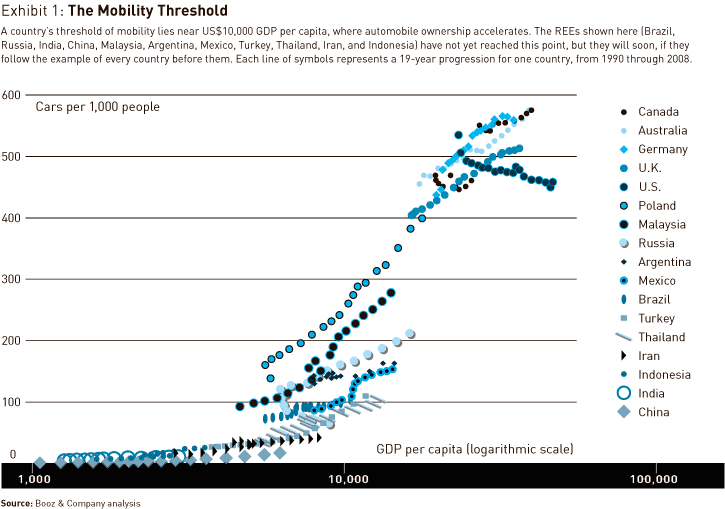
How will the global recession affect this pattern? Indicators so far suggest that it will underscore the importance of the REE market. Growth in these countries, although now slower than it was before 2008, is still outpacing growth anywhere else in the world, especially among the demographic of first-time vehicle owners.
Thomas Friedman’s concept that “the world is flat” allowed many businesspeople to assume that they could adopt one business model for every region around the world. But as IESE Business School professor of global strategy Pankaj Ghemawat has pointed out, the world is actually “semiglobal.” Emerging markets require a variety of strategic approaches that fit into an overall strategy, including making difficult decisions about which markets to avoid. Vehicle manufacturing is a high-profile industry that generates enormous revenue, employs millions of people, and is often a proxy for a nation’s manufacturing prowess and economic influence. Governments are extensively involved in regulating or influencing virtually every aspect of the product and the way the industry operates — including setting emissions and safety standards, licensing distributors, and setting tariffs and rules about how much manufacturing must take place locally. This reality makes the job of understanding each market and appreciating the differences more vital. For example, a summary overview of the BRIC nations reveals the differences among these markets and the operating complexities in all of them.
- Brazil is the Western Hemisphere’s leading member of the REE club (the next most prominent members are Mexico and Argentina). It is relatively small in population, with 188 million people (by comparison, China and India each have more than 1 billion). Yet car usage is already relatively high: 104 cars in use per 1,000 people, nearly 10 times the rate of usage in India, according to the Economist Intelligence Unit. Because of this, growth projections for Brazil are relatively low, more in line with developed nations than with the other REEs. According to the industry research firm Global Insight, sales will grow just 2.0 percent from 2008 to 2013, underperforming even the U.S. market’s 3.2 percent growth rate.
Nonetheless, there is much to recommend Brazil as an auto market. It is socioeconomically stable, with increasing wealth and a maturing finance system that is helping to propel growth among rural, first-time buyers who prefer compact (or B-segment”) cars. Few domestic brands exist; the market is dominated by GM, Ford, Fiat, and Volkswagen. Prompted by generous government incentives, high import taxes, and exchange rate risks, foreign VMs have invested significantly in Brazil, which has thus become an unrivaled production hub for the rest of South America. Brazilian consumers live in a country with large rural areas and very rough terrain; they demand fairly large, SUV-like cars, made with economical small engines and flex-fuel power trains friendly to the country’s biofuel industry. When a Latin American family buys its first automobile, chances are it was made in Brazil.
- Russia, with 142 million people, is the smallest of the BRIC countries in population. It has the highest auto adoption of the four: 213 cars in use per 1,000 people. (Western Europe, by comparison, has 518, according to the Economist Intelligence Unit.) Yet Global Insight expects future sales growth to average 6.5 percent from 2008 to 2013 — far outpacing Brazil (2.0 percent), western Europe (1.2 percent), and Japan and Korea (0.2 percent).
Given Russia’s proximity to Europe, consumer preferences there are more akin to those of the developed markets than to those of China or India, and expensive, status-enhancing European models remain popular — although European safety features, interior components, and electronics are often stripped out to reduce costs. For VMs, the attractions of the Russian market include an absence of both local partnership requirements and significant local competitors. But there is high political risk. So far, the Russian government has permitted foreign VMs, but the Kremlin’s history of meddling in private enterprise and undercutting private ownership worries some executives. These concerns were heightened in November 2008, when Russia implemented tariffs against car imports in hopes of avoiding layoffs that might spark labor unrest among the country’s 1.5 million car industry workers.
-
India has 1.1 billion people within its borders, but its level of car adoption is relatively low, with only 11 cars in use per 1,000 people. The upside to that low penetration is higher potential growth. Of all the REEs, India is expected to have the fastest-growing auto sales, 14.7 percent from 2008 to 2013, according to Global Insight. Sales of subcompact cars are strong, even during the global recession. The popularity of these small cars combines with India’s energy shortages and the country’s chronic pollution to give foreign VMs an ideal opportunity to apply electric power-train technologies there.
Until the early 1990s, foreign VMs were mostly shut out of India. (The period from 1947 to 1990 was known as the License Raj for its elaborate corporate licensing requirements, its protectionist regulations, and its restrictions on business.) That has changed radically; today, foreign VMs are welcomed. The government promotes foreign ownership and local manufacturing with tax breaks and strong intellectual property protection. And since the License Raj era gave local VMs time to develop, India has capable manufacturers and suppliers, which provide talented partners for foreign VMs. Local competition is strong, but it is thus far concentrated among three players: Maruti Suzuki India Ltd. (the most successful to date), Tata, and the Hyundai Corporation, which is well established in India.
- China stands out among the REEs. It is almost as large as the other three combined in total auto sales and production. Its overall auto usage is just 18 cars per 1,000 households, but its expected auto sales growth, from 2008 through 2013, is 8.3 percent. Its size and growth potential make this country a game-changer; if a significant number of its 1.3 billion people want a certain type of vehicle, some VMs will produce it and it will thus become available elsewhere. China’s auto sales are expected to accelerate in the next few years, as the new urbanites of rapidly growing cities in the vast “under-motorized” interior begin buying compact and subcompact cars. (China has more than 140 cities with populations of more than 1 million.)
The Chinese government plays a central role in shaping the auto industry. Ownership policies mandate that foreign VMs enter into 50/50 joint ventures with local automakers, and poor intellectual property rights enforcement puts the design and engineering innovations of foreign VMs at constant risk. At the same time, to cope with energy shortages and rampant pollution, the Chinese government is strongly encouraging R&D on alternative power trains, including electric cars and gasoline–electric hybrids. As a result, VMs from China may develop significant power-train capabilities ahead of their competitors.
Like their Indian counterparts, VM aspirants in China have outpaced global automakers in developing cars specifically for emerging markets. A few global VMs are competitive, like Volkswagen AG, which has sold its Santana models in China through a joint venture (Shanghai Volkswagen Automotive Company) since 1985. Some Chinese VMs, like BYD Company, aspire to become global leaders in the industry. But many suffer from a talent shortage and inexperience in managing across borders. This may prompt them to acquire all or part of distressed Western automobile companies in the near future or to hire skilled auto executives from established VMs and suppliers.
In short, each of the four BRIC nations has a completely different set of market and industry dynamics. And the same is true for the remaining REEs. Meanwhile, the number of autos in use in the REEs is projected to expand almost sixfold by 2018. (See Exhibit 2.)
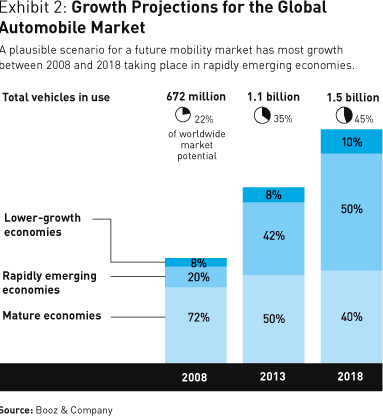
And what of the other two parts of the global auto market? In the mature economies of industrialized nations, the credit crunch is preventing many consumers from buying new cars and is denying short-term financing to many companies. The market also suffers from a glut of motor vehicles. Auto sales fell a precipitous 36 percent in 2008 in the United States, which had long been the world’s largest motor vehicle market. (In late 2008, for the first time, China surpassed the U.S. in the number of automobiles sold per month.) U.S. sales are not expected to rebound much in 2009 or soon thereafter, and auto sales will also remain flat in Europe and Japan for several years.
 |
|
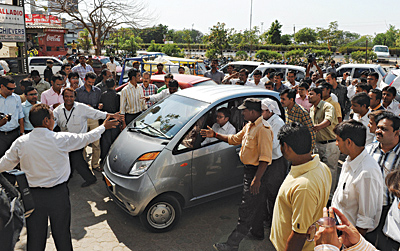
The world's cheapest car (so far), the Tata Nano, arriving at the Cargo Motors showroom for public display in Ahmedabad, India, in April 2009. |
But many of these changes will turn out to be cyclical; they will not add up to permanent market saturation. Moreover, like emerging nations, industrialized countries treat their auto industries as strategic assets, in part because VMs have a multiplier effect on overall economic growth and employment. Hence, the auto industry will likely receive a disproportionate share of stimulus funds from governments around the world. Sooner or later, credit will return, and so will the need for vehicle replacement. Market growth will probably return at levels of 1 to 2 percent per year, especially in the United States, where the population is more likely to keep expanding than it is in Europe.
As for the large number of lower-growth economies: Those markets will probably not cross the threshold of mobility until after 2020. Current conventional wisdom posits that car companies from the REEs may be better positioned there, because they know the markets better. But any VM that has prospered in an REE, no matter where the VM comes from, could be positioned to sell to the millions of potential auto purchasers in these countries.
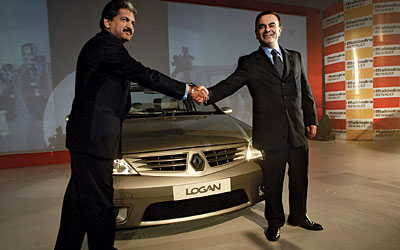
Mahindra & Mahindra executive Anand Mahindra, left, and president and CEO of Renault Carlos Ghosn at the launch of the Logan in India in 2007.
Photograph © AP Photo/Gautam Singh
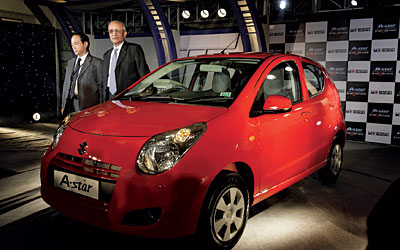
Maruti Suzuki India executives with the A-star car in India, in November 2008.
Photograph © AP Photo/Manish Swarup
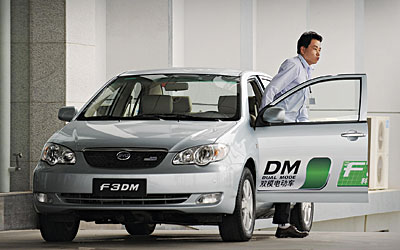
The BYD Auto F3DM hybrid car, built for the Chinese market.
Photograph © Peter Parks/AFP/Getty Images
The Struggle with Established Ideas
Even as they try to keep afloat in the bleak business environment of 2009, vehicle manufacturing executives would do well to look ahead to the immense global market that will emerge over the next 10 years, and prepare for it now. A recovery plan focused exclusively on the short term may help VMs survive the current downturn but could make that survival bittersweet and brief.
Some VMs are already building the requisite culture of innovation. They see that “moving people” doesn’t necessarily mean selling petroleum-powered, four-door sedans around the world. Daimler AG and Volkswagen have defined three car categories that require the support of distinct products and services. The first is a car for intracity travel, moving people short distances, not at high speeds, and possibly in combination with other forms of public transportation. For example, a commuter might take a train to an urban rail station, get in a small electric car to go downtown, and park in a communal lot where someone else could then pick up the car for use. Putting this kind of comprehensive system into place means developing new linkages and “smart” features, such as automated parking tolls, plug-in outlets for recharging electric vehicles, and car service networks integrated into the daily commute.
The second category is a car that fills the need for regional travel, such as going to and from work in relatively suburban or semi-rural areas. The distances are longer, the speeds are higher, and the desire for a permanent family car is greater. Therefore, a different type of car with a non-electric drive train, perhaps a hybrid, is optimal.
Vehicles intended for use in long-distance travel at higher speeds and carrying more people or cargo make up the third car category. Advanced diesel-fueled vehicles are well suited to this kind of driving because of their low operating cost per mile and their efficiency in an emissions-constrained environment.
Daimler-Benz is already differentiating its vehicle designs accordingly. The company plans to launch an all-electric Mercedes for urban consumers. For suburban drivers, its new S-Class lithium-ion battery hybrid claims 30 miles per gallon (mpg) (compared with 12 mpg for a gasoline-powered S-Class); reportedly, a forthcoming hybrid will get 45 mpg. And it has developed an efficient, clean diesel engine for long-haul travel.
Some car companies will undoubtedly go further. They might sell refueling stations for batteries and hybrids or hookup rights for those vehicles. They could reconceive dealerships as services that coordinate the intracity use of shared vehicles. For many U.S. auto dealers, particularly those at the low end of the market, the vehicle is already a loss leader intended to establish a relationship that leads to the sale of more profitable products and services, including long-term repair contracts. Such strategies will grow in popularity in the REE nations, where automobile dealer franchises must invent themselves from scratch.
Among the incumbent VMs from Europe, Renault SA appears to have made the most progress in developing vehicles specifically for emerging markets. The Logan is a no-frills car produced jointly by the French manufacturer and its subsidiary the Dacia Group of Romania. Launched in 2004, the Logan has seen sales rapidly increase; for example, its sales rose almost 20 percent (about €1.5 billion, or US$1.9 billion) between 2005 and 2006. The car has been manufactured at Dacia’s plant in Mioveni, Romania; in Colombia; in Brazil; and at other sites around the world. An Indian launch took place in June 2007 in collaboration with Mahindra & Mahindra Ltd., which helped Renault cut costs by 15 percent.
Designed from the outset as an affordable car, the Logan keeps costs low with simple features, 50 percent fewer parts than a high-end Renault, and a limited number of electronic devices. This simplicity serves the dual purpose of lowering costs and making the car easier and cheaper for owners to repair themselves. Most importantly, the Logan is not just a stripped-down version of Western design. The car’s engineers took into account differences between road and climate conditions in emerging and mature economies. The Logan’s suspension is soft and strong, and the chassis sits higher than on most other superminis to help negotiate dirt roads and potholes. The engine is designed to handle lower-quality fuel, and the air conditioning system is powerful — no small benefit in sweltering climates and slow-moving traffic.
A Developmental Path for Vehicle Makers
Success stories like those of the Renault Logan involve a long time horizon. It can take years to recruit and develop local executives, make a long-term commitment, and establish an in-depth presence in the countries being entered. The first step is to change the company’s own mission from selling cars — a relatively narrow, engineering-driven focus — to solving mobility problems. For companies that can embrace this broader, more market-oriented purpose, a wide vista of opportunity opens.
The second step along this path is getting to know the REEs where much of this initial future growth will occur. China’s dense urban centers, with their breakneck construction and strong central planning, present opportunities quite different from those offered by Russia’s vast geography, aging infrastructure, and rural poverty. Car companies may also have to adapt to cultural differences among the REEs that affect the management of factories and distribution centers. Hyundai, for example, has a command-and-control culture that works well in some countries (India, for example) but doesn’t necessarily mesh well elsewhere.
The third step is thinking freshly about the value chain. To find the best local approaches, a VM must draw on technology, practices, and experience from across the globe. This means developing a sophisticated international value chain. A manufacturing process developed in China today might help solve a problem in the U.S. tomorrow or in Indonesia the next day. Even a cursory survey of the BRIC nations reveals many ways automakers can adapt.
- Innovation. In China, the government’s direct management of urban planning and technology development may yield advancements in alternative power-train technologies applicable there and elsewhere. In India, low engineering salaries ($3 per hour, compared with $48 in western Europe and $36 in Japan and Korea) make the country attractive as an offshoring destination for R&D. Russia benefits from a legacy of expertise in science and research and a history of respecting intellectual property. Brazil is a leader in agriculture-based fuel, particularly ethanol made from sugarcane.
- Supply base development. China and, to a lesser degree, India will likely become significant bases for component exports. The sheer size of China and its large market segments provide distinct advantages to companies choosing that country as a global supply base. India’s smaller segment focus uniquely positions it for niche plays in components. Brazil, with its well-established base of foreign VMs, is well positioned for marketing to the Americas.
- Assembly. The labor cost arbitrage for China and India will likely be significant for decades to come. Companies in these markets pay as little as $1 or $2 per hour in wages, versus $37 in western Europe, $26 in North America, and $19 in Japan and Korea. Russia, at $18 per hour, cannot compete on wages, though its proximity to western Europe is valuable. Brazil, meanwhile, offers scale advantages in South America.
- Distribution. Given the massive population in China across urban, suburban, and rural areas, improvements in distribution are likely; in India, distribution is already advancing. To reduce shipping costs, Tata does not fully assemble the Nano in factories; instead, the cars are shipped in parts and assembled in regional centers. Russia’s urban population demands high variety in low volumes; its vast rural expanse, in contrast, requires high volume but low variety to be economical. Brazil is expected to lead the way in creating distribution networks for alternative fuels.
- Sales and marketing. China must craft marketing techniques to sell low-cost car models to its vast rural and urban population. Automobile marketing in India may well follow the example of mobile phones, which have been widely adopted there. In Russia, multiple automobile models will demand niche marketing, everything from “ultra VIP” in urban areas to “no frills” in the rural reaches.
In the face of a challenging business environment, VMs can take heart in this fact: They operate in a dynamic global industry full of promise. Indeed, for all its frustrations, the automobile industry is the kind of industry in which one should aspire to be. At the end of the horse-and-carriage and steam train eras, executives must have been similarly frustrated. Most automakers already understand the need for change, but not all of them have translated this into the organization and approaches they will need in the future. Today’s economic climate is woeful and auto sales are declining worldwide, but VMs that persevere could be rewarded by another 100 years of prosperity.
|
The BYD Aspiration |
|
Could an unknown company from an emerging economy take advantage of a major technology disruption to become a leader in the automotive industry? That’s precisely what BYD Company has announced it intends to do by 2025. BYD (“Build Your Dream”) was founded in 1995 in Guangdong, China, as a manufacturer of rechargeable batteries for portable electronic devices. It is now the world’s leading producer of lithium-ion batteries for mobile handsets, with a 33 percent market share worldwide. In 2003, BYD became China’s first privately owned company to independently acquire an automobile factory. The company quickly developed its own line of vehicles, including a minicar and a convertible. By 2007, it was China’s sixth-largest producer of cars, with a 1.9 percent market share. BYD President Wang Chuanfu recently announced the company’s two major targets: to become the largest automaker in China by 2015 and largest in the world by 2025. In pursuing these goals, BYD is placing an enormous bet on the viability of electric power trains and its own core expertise in lithium-ion battery technology. BYD’s strategy is based on at least three premises: that the demand for electric vehicles will grow, that integrated battery technology will be a critical component (perhaps in a branded fashion, as with Intel or Windows in personal computers), and that this core technology is not easily replicated by or tradable to others. If these premises turn out to be correct (and it isn’t certain that they will), BYD would still face major challenges. It would have to take advantage of its lead in lithium-ion batteries to rapidly introduce prototype electric vehicles and hybrids, thus establishing itself as one of the first leading brands. And it would have to design and introduce new ways of manufacturing, selling, and servicing electric vehicles, probably starting with China’s enormous market. If the company leapfrogged past conventional auto industry practices and developed derivative designs (instead of spending money on original designs), it might become easier for other automakers to cooperate with BYD than to compete against it. — R.H. and J.J. |
Reprint No. 09204
Author profiles:
- Ronald Haddock is a Booz & Company partner based in Zurich. He has been with the firm since 1994 and has spent 10 years in Asia in the firm’s China, India, and Korea offices. During his recent assignment in Shanghai, he led the auto and industrials practice in Greater China.
- John Jullens is a principal with Booz & Company in Cleveland. He specializes in demand-side transformation issues, including revenue growth strategies, brand management, customer retention, and retail channel effectiveness for clients in North America, Europe, and Asia.
- Also contributing to this article was consulting editor Michael Sisk.
